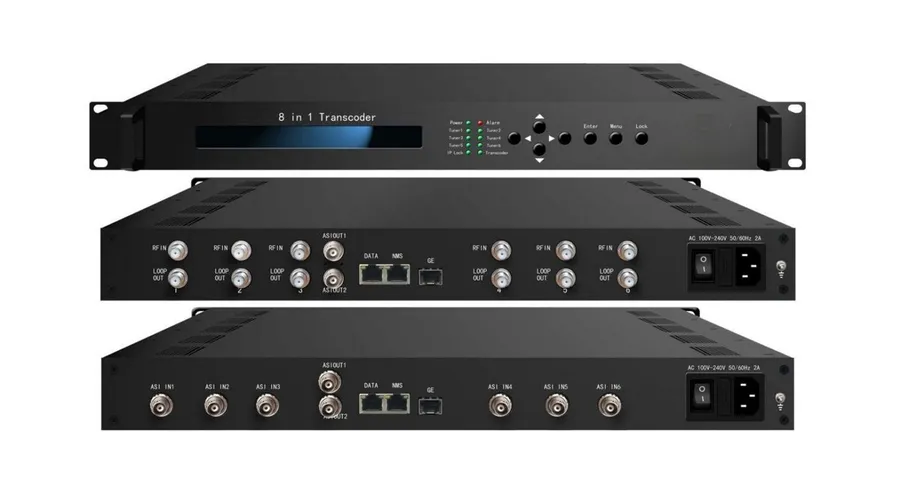
FUQ4359 Transcoder 6 Tuner-ASI Inputs 8 IP Inputs
The Hanxing FUQ4359 is an IRD / decoder / transcoder in the FUQ4 line, built in our Guangzhou headend factory. Published specifications: Audio: Bit Rate 64Kbps-384Kbps; Trans-coding 4*MPEG2 HD → 4*MPEG2/H.264 HD; 4*MPEG2 HD →; Rate Control CBR/VBR. 8 parameters are published on this page from the model's own datasheet; quotations are factory-direct.
Our FUQ-4359 transcoder converts between H.264 and MPEG-2 in both directions, carrying HD and SD video for broadcast and media distribution operators. It takes 6 tuner or ASI inputs and 8 IP inputs, and delivers output over IP or ASI. Operators configure and monitor it through web-based NMS.
- Audio Bit Rate
- 64Kbps-384Kbps
Send the channel count, input format and output standard — we reply with a model confirmation and factory-direct pricing.
Technical specifications
Taken from the datasheet we publish for the FUQ4359. Every value below comes from our own specification document — ask us if you need a parameter that is not listed.
| Trans-coding | 4*MPEG2 HD → 4*MPEG2/H.264 HD; 4*MPEG2 HD → 4*MPEG2/H.264 SD; 8 *MPEG2 SD → 8 *MPEG2/H.264 SD |
|---|---|
| Rate Control | CBR/VBR |
| Sampling rate | 48kHz |
| Audio: Bit Rate | 64Kbps-384Kbps |
| General: Approx weight | 4.8 Kg |
| General: Temperature range | 0~45℃ (operation), -20~80℃ (storage) |
| General: Power requirements | AC 110V±10%, 50/60Hz or AC 220V±10%,50/60Hz |
| General: Power consumption | 20W |
FUQ4359 datasheet
Our full FUQ4359 datasheet (Word .docx, editable) — interfaces, formats, dimensions and power.
FUQ4359 — quick answers
Direct answers about the Hanxing FUQ4359: what it is, what it is typically used for, and the parameters we publish for it. Nothing here is estimated — where a value is not published, the answer says so rather than guessing.
What is the Hanxing FUQ4359?
Our FUQ-4359 transcoder converts between H.264 and MPEG-2 in both directions, carrying HD and SD video for broadcast and media distribution operators.
What is the FUQ4359 used for in satellite turn-around and monitoring?
Receiving, descrambling, decoding and transcoding satellite or IP feeds — turn-around, monitoring and contribution links.
What is the price of the FUQ4359, and how do I get a quote?
Hanxing builds this headend equipment in our own factory in Guangzhou, and it is offered for sale factory-direct. Send the channel count, the input format and the output standard you need, and we reply with the price, lead time and shipping options.
What power supply does the FUQ4359 need?
General: Power consumption: 20W
Is the FUQ4359 datasheet available?
Yes — the datasheet we publish for the FUQ4359 is on this page and can be opened or downloaded directly.
Typical use
Receiving, descrambling, decoding and transcoding satellite or IP feeds — turn-around, monitoring and contribution links.
- Broadcast headends
- Monitoring & test
More from this range
All IRD / Decoder / Transcoder models
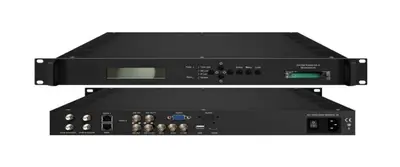
Next stage in the chain
An IRD receives, descrambles and converts a feed; the output usually has to be combined with other sources before it is distributed. That combination, including PSI/SI handling and scrambling, is the multiplexing stage, and it is what the receiver output is normally handed to.
Get a quote for the FUQ4359
Tell us the quantity, the input sources and the output standard you distribute. We confirm the configuration against the unit we build and come back with pricing, lead time and shipping options.