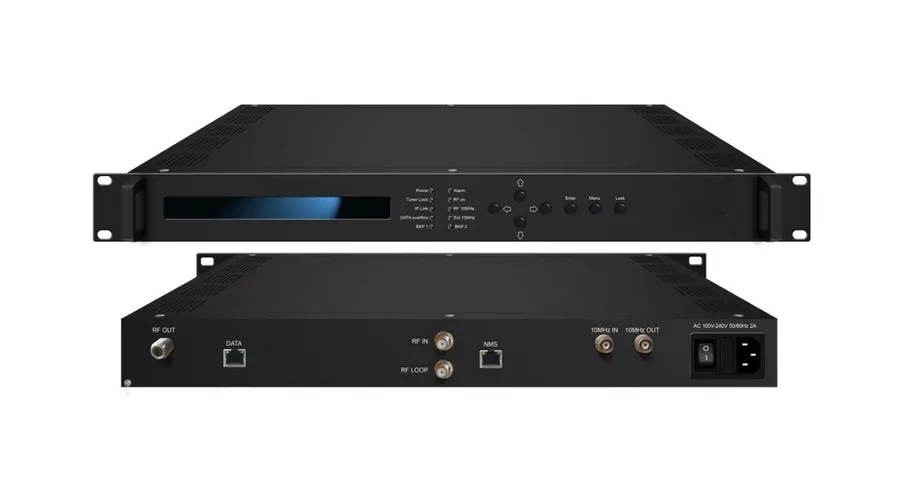
FUQ4515 Satellite Modem 1x Ethernet Port IP
The Hanxing FUQ4515 is a headend device in the FUQ4 line, built in our Guangzhou headend factory. Published specifications: Constellation QPSK,8PSK,16APSK, 32APSK; Power AC 100V-220V±10%, 50/60Hz; Standard DVB-S2. 9 parameters are published on this page from the model's own datasheet; quotations are factory-direct.
We make the Hanxing FUQ-4515 two-way DVB-S2 satellite modem for IP data transmission over satellite. It modulates and demodulates IP signals using TCP acceleration to optimize performance. Web-based NMS with LCD and keyboard support keeps setup and supervision on the box itself, and 1x Ethernet port carries the IP traffic. Typical deployments: satellite networks in broadcast, enterprise and remote data services.
- Constellation
- QPSK
- Power
- AC 100V-220V±10%
- Standard
- DVB-S2
Send the channel count, input format and output standard — we reply with a model confirmation and factory-direct pricing.
Technical specifications
Taken from the datasheet we publish for the FUQ4515. Every value below comes from our own specification document — ask us if you need a parameter that is not listed.
| Standard | DVB-S2 |
|---|---|
| Outer coding | BCH Coding |
| Inner coding | LDPC Coding |
| Constellation | QPSK,8PSK,16APSK, 32APSK |
| Roll-off Factor | 0.2, 0.25, 0.35 |
| Symbol Rate | 0.05~40Msps (32APSK); 0.05~45Msps (QPSK/ 8PSK/16APSK) |
| Dimension | 482mm×328mm×44mm (W× L× H) |
| Temperature | 0~45℃ (work), -20~80℃ (storage) |
| Power | AC 100V-220V±10%, 50/60Hz |
FUQ4515 datasheet
Our full FUQ4515 datasheet (Word .docx, editable) — interfaces, formats, dimensions and power.
FUQ4515 — quick answers
Direct answers about the Hanxing FUQ4515: what it is, what it is typically used for, and the parameters we publish for it. Nothing here is estimated — where a value is not published, the answer says so rather than guessing.
What is the Hanxing FUQ4515?
We make the Hanxing FUQ-4515 two-way DVB-S2 satellite modem for IP data transmission over satellite.
What is the FUQ4515 used for alongside an encoder or modulator line?
Supporting headend hardware — capture, processing, analysis and interfacing devices used alongside the encoder and modulator line.
What is the price of the FUQ4515, and how do I get a quote?
Hanxing builds this headend equipment in our own factory in Guangzhou, and it is offered for sale factory-direct. Send the channel count, the input format and the output standard you need, and we reply with the price, lead time and shipping options.
Which modulation does the FUQ4515 use?
Constellation: QPSK,8PSK,16APSK, 32APSK
Which standards does the FUQ4515 support?
Standard: DVB-S2
What bit rate does the FUQ4515 support?
Symbol Rate: 0.05~40Msps (32APSK); 0.05~45Msps (QPSK/ 8PSK/16APSK)
What power supply does the FUQ4515 need?
Power: AC 100V-220V±10%, 50/60Hz
What are the physical dimensions of the FUQ4515?
Dimension: 482mm×328mm×44mm (W× L× H)
Typical use
Supporting headend hardware — capture, processing, analysis and interfacing devices used alongside the encoder and modulator line.
- Satellite turn-around
- Broadcast headends
More from this range
All Other Devices models
Next stage in the chain
Processing units in this range clean up, re-clock or re-package a signal before it is distributed. The output still needs a carrier to reach coax networks, so the modulator stage is the usual next step once the processing chain is defined.
Get a quote for the FUQ4515
Tell us the quantity, the input sources and the output standard you distribute. We confirm the configuration against the unit we build and come back with pricing, lead time and shipping options.