FM Transmitters Explained: 50W vs 5KW, What to Buy
A practical guide to FM transmitter power levels: coverage, cost and licensing for low-power (0.5–100W), mid-power (100W–1KW) and high-power stations. Each model named in this article is one of 190 in the Hanxing catalogue, published with its own specifications and datasheet.
Hanxing Team
Broadcast & IPTV Experts
The path this guide walks
- Studio audiothe analogue or digital feed from the studio or playout
- ExciterFPGA signal processing sets the carrier and the modulation
- Amplifierthe LDMOS stage sets the output power the licence allows
- Combine and switchredundant transmitters are combined and switched before the feeder
- Feederevery decibel of cable loss is subtracted from the ERP
- Antennagain adds to the ERP, at the height the licence permits
Power is set in the rack, but coverage is decided at the top of the mast: the licence fixes ERP and height, then the antenna system turns the chassis rating into that ERP.
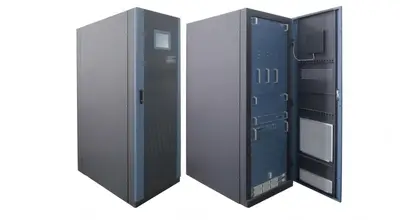
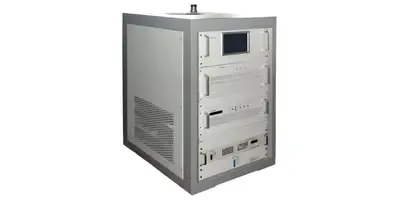
An FM broadcast transmitter is chosen by the licence class and the coverage target, not by one watt figure. Our published FUQ-72XX Series is adjustable from 10 W to 10 kW in a 4U rack chassis; 50 W into a 3 dBd antenna behind 1.5 dB of feeder delivers 70.6 W ERP; and 100 times more power, 20 dB, multiplies free-space reach only ten times. This guide covers the three decisions that actually pick the model: power class, antenna system and licence.
What Does the Watt Rating on an FM Transmitter Actually Buy?
The watt figure is transmitter output power at the RF connector, not what leaves the antenna. A listener receives ERP: output power plus antenna gain minus feeder loss. In most countries the licence names both the ERP you may radiate and the antenna height you may use, so the watt figure is an input rather than the answer.
Two worked examples from the same correction. A 50 W transmitter (17.0 dBW) into a 3 dBd antenna fed by 1.5 dB of cable gives 18.5 dBW, or 70.6 W ERP. A 5,000 W transmitter (37.0 dBW) into 6 dBd with 3 dB of feeder gives 40.0 dBW, or 9,976 W ERP. Our published FM chassis hold output to ±0.1 dB AGC stability, which is what makes those figures survive a day of temperature and mains drift.
The same arithmetic runs the whole transmitter range, where the FM chassis sit beside the television ones, and the TV version of the decision is walked through in the DVB-T transmitter guide.
How Far Does 50 W Reach Compared With 5 kW?
In free space, distance grows as the square root of power, so 100 times the power — 20 dB, 5 kW against 50 W — multiplies reach by about 10, turning a 2 km fringe into 20 km. On a real site antenna height, terrain and co-channel interference take most of that back.
The hard ceiling is the radio horizon, which follows 4.12 × (√h_transmit + √h_receive) with heights in metres. A 30 m mast working into a 1.5 m car receiver sees 27.6 km; the same mast into a 10 m rooftop antenna sees 35.6 km. Beyond the horizon the field falls away far faster than any amplifier can recover, which is why a 50 W station on a 150 m hill out-reaches a 5 kW station on a 30 m mast.
| Transmitting antenna height (m) | Horizon to a 1.5 m car receiver (km) | Horizon to a 10 m rooftop antenna (km) |
|---|---|---|
| 10 | 18.1 | 26.1 |
| 30 | 27.6 | 35.6 |
| 50 | 34.2 | 42.2 |
| 100 | 46.2 | 54.2 |
| 150 | 55.5 | 63.5 |
These are geometric horizons, not guaranteed coverage. Buildings, hills and the noise floor set the usable contour, which is why we size a model from the site data rather than from a range table.
What Are the Power Classes, and Who Buys Each?
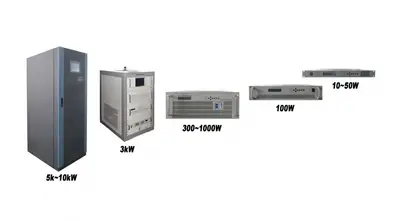
Suppliers split the market differently, but the buying decision is stable: under about 100 W you are normally in a low-power or community licence, between 100 W and 1 kW a community or regional licence, and above 1 kW a full broadcast licence with frequency coordination.
| Class | Transmitter output (W) | Typical site | Licence shape to expect |
|---|---|---|---|
| Low power | 10 to 100 | church, campus, drive-in, resort | low-power or exempt service |
| Medium | 100 to 1,000 | town, community station | community or regional licence |
| High | 1,000 to 10,000 | city, regional network | full licence with coordination |
The published FUQ-72XX output is adjustable across 10 W to 10 kW, so the model is set by amplifier stage, cooling and redundancy rather than by a separate product line. Station costs are broken down in the small FM station budget guide, and the aerial side in the broadcast antenna guide.
What Do the Published FM Transmitter Specifications Say?
Our model pages publish the RF chain and the standards, not a marketing watt claim. The table repeats the rows published on the two FM series pages; where a row is absent from those pages it is in the datasheet, and we confirm it against the unit we build rather than estimate it.
| Published row | Value on the FUQ-72XX pages |
|---|---|
| RF output | 10 W to 10 kW adjustable |
| Amplification | LDMOS |
| Signal processing | FPGA |
| Gain stability | ±0.1 dB AGC |
| Distortion (1× RF output variant) | ≤0.2% |
| Chassis | 4U rack-mount |
| Redundancy | dual transmitter with coaxial switching |
| Cooling (1× RF output variant) | air cooling |
| Control | NMS |
| Standards | GB/T4311-2000, GY/T169-2001 |
| Frequency stability | not published on these pages — ask for the datasheet |
Both series pages are linked here: the 10 W to 10 kW adjustable output model and the 1× RF output FPGA digital model. Broadcast centres run the NMS and the dual-transmitter coaxial switching from day one; community stations usually take the single chassis and add redundancy later.
Why Does the Antenna System Decide More Than the Amplifier?
Gain is added after every loss in the chain and costs far less per decibel than amplifier output. One 6 dBd antenna in place of a 0 dBd whip is a 4× ERP step for the price of an antenna, while those same 6 dB from the amplifier mean a four-times larger power stage, more cooling and more mains capacity.
Gain is quoted in dBd over a half-wave dipole or dBi over an isotropic radiator, and the same antenna reads 2.15 dB higher in dBi — a unit trap that flatters comparisons. Feeder loss is subtracted, not added, and it grows with frequency and length; every 3 dB lost in the cable is half the ERP. Polarisation, downtilt and the number of bays then shape the radiation pattern, which decides whether the licensed contour is filled toward the town or wasted over open ground.
How Does an FM Transmitter Compare With a DVB-T One?
Both sit in the same transmission stage, but the rows that matter differ: FM is a 200 kHz analogue carrier chosen by power class, while DVB-T is a 6, 7 or 8 MHz multiplex where MER and shoulder level decide whether receivers lock. Our television chassis publish those rows directly.
| Model | Published output (W) | MER |
|---|---|---|
| FUQ8351 | 10 / 20 / 30 / 50 / 100 optional | ≥35 dB |
| FUQ8322 | 200 / 300 / 400 / 500 / 600 optional | ≥36 dB |
| FUQ8313 | 800 / 1,000 / 1,200 selectable | ≥33 dB |
All three publish the 470 to 806 MHz band, with FUQ8351 covering any 100 MHz window inside it, and MER is the row that decides whether receivers lock. Beyond MER, FUQ8351-2 publishes frequency accuracy of ±100 Hz (MFN) and ±1 Hz (SFN), output reflection loss of ≥26 dB and a working temperature of -20 to +50 degrees Celsius; FUQ8313 publishes out-of-band suppression of ≥65 dBc, an in-band stray limit of ≤-60 dBc and a 2U rack chassis. Where a television transmitter is chosen on coverage rather than analogue audio quality, the DVB-T transmitter guide covers the multiplex side.
What Does the Licence Fix Before You Order?
The licence fixes two numbers — permitted ERP and antenna height — and both land directly on the transmitter specification. In the United States, 47 CFR §73.811 caps a low-power FM station at 100 W ERP at 30 m HAAT with a 50 W minimum, while 47 CFR §73.211 sets Class A at 6 kW ERP and 100 m reference height.
Above the low-power classes the same regulation publishes contour distances: Class A 28 km, Class B 52 km at 50 kW and 150 m, Class C 92 km at 100 kW and 600 m. Order of work matters. Frequency coordination and the permitted ERP come first, then the transmitter is sized to hit that ERP with the antenna you can actually mount. A bigger amplifier than the licence allows buys nothing but heat.
Solid-State or Tube in 2026?
Solid-state LDMOS is what we build and what nearly every new station buys. Our published FM chain pairs FPGA signal processing with LDMOS amplification, holds gain to ±0.1 dB AGC, publishes distortion at ≤0.2% on the 1× RF output variant, and fits a 4U rack chassis with air cooling.
Tube transmitters survive in high-power refurbishments, where the argument is the spare-parts shelf rather than efficiency. For a new build the trade is maintenance: a solid-state chassis has no tube to replace, runs cooler and can be left unattended behind NMS alarms, which is what a station running 24/7 needs.
What Should You Send Us for a Model Confirmation?
Send seven items and the model is confirmed in one reply: the licence class or permitted ERP, the transmitting frequency, the antenna gain and feeder length, the antenna height, whether redundancy and NMS are required, the mains available on site, and the required delivery date.
There is no list price, because power class, redundancy, band, monitoring and the antenna system move the number. We quote per project, factory-direct, with the datasheet attached; standard units are quoted per single unit and custom builds are confirmed with the quotation. The commercial rules are on the FAQ page, and the seven items can be sent through the contact form. The model list sits on the transmitter range page.
Bottom line: pick the licence and the antenna first, then the power class that fills the contour — a 50 W transmitter on a 150 m mast with 6 dBd of gain reaches further than a 5 kW unit on a 30 m pole.
Frequently Asked Questions
Is a 5 kW FM transmitter really 100 times better than a 50 W unit?
It is 100 times the power, which is 20 dB. In free space that multiplies distance by about 10, so a 2 km fringe becomes 20 km, but only along a clear path. Height, terrain and co-channel signals usually set the contour first, and the licence caps the ERP you may radiate, so the extra power is often unusable without a taller site.
How far will a 50 W FM transmitter reach?
Between about 2 km and 20 km, depending on the site. A 30 m mast into a 1.5 m car receiver has a 27.6 km radio horizon, a 10 m mast has 18.1 km, and buildings and hills cut the usable contour well inside those figures. We size the model from the radius, the terrain and the permitted ERP rather than from a range table.
What is ERP and why does it matter more than transmitter power?
ERP is output power plus antenna gain minus feeder loss. 50 W (17.0 dBW) into a 3 dBd antenna behind 1.5 dB of feeder gives 70.6 W ERP, so the antenna system changed the result by 41 percent. Licences are written in ERP and antenna height, which is why the antenna is specified before the amplifier.
What power do I need to cover a town of 20,000 people?
There is no single watt answer. A town that size usually needs a 5 km to 10 km contour, which a 100 W to 500 W transmitter reaches from a 30 m mast on open terrain, but the site decides and more power will not fix a mast behind a ridge. Send the coordinates, the antenna height and the target radius and we confirm the class.
Do I need a licence for an FM transmitter?
In most countries yes, and above 100 W almost always. In the United States 47 CFR §73.811 allows a low-power station up to 100 W ERP at 30 m HAAT with 50 W as the minimum, while a full Class A facility may radiate 6 kW ERP at 100 m reference height above average terrain. Confirm the class with the regulator before choosing a model.
Does the FUQ-72XX Series cover the whole 10 W to 10 kW span?
The series is published with 10 W to 10 kW adjustable RF output in a 4U rack-mount chassis, ±0.1 dB AGC stability and dual-transmitter redundancy with coaxial switching. The amplifier stage and cooling are set by the output you need, and we confirm the configuration against the unit we build before quoting.
Is frequency stability published for the FM series?
No. The FUQ-72XX pages publish the RF output range, LDMOS amplification, FPGA processing, ±0.1 dB AGC stability, distortion, chassis, redundancy, cooling, NMS and the GB/T4311-2000 and GY/T169-2001 standards, but no frequency-stability row. Ask for the datasheet and we confirm it against the unit we build rather than quote a number here.
How much does an FM transmitter cost?
There is no list price, because the configuration is the price: power class, redundancy, band, monitoring and the antenna system all move the number. We quote per project, factory-direct, standard units per single unit, and custom builds are confirmed with the quotation. Send the licence class and the coverage target and we size the chassis.
Previous
Hotel IPTV System: The Complete Headend Guide
Next
How to Choose a Broadcast Antenna: FM, VHF & UHF
Talk to the headend engineers before you specify
Send the model number you are looking at — or the channel count and the input and output formats you work with — and we answer with the datasheet, the configuration and a written price. The reply comes from the headend team in Guangzhou, not a sales line.