SMATV System Design: Components and Headend Choices
What an SMATV system needs: satellite and terrestrial feeds, the headend core that puts them on coax, and the published rows that decide the chassis. Each model named in this article is one of 190 in the Hanxing catalogue, published with its own specifications and datasheet.
Hanxing Team
Broadcast & IPTV Experts
The path this guide walks
- Dish and LNBthe satellite band arrives at the headend as a 950-2150 MHz IF signal
- Tuner bankone tuner locks one transponder, so the published count sets how many feeds are taken at once
- Descramble and re-multiplexCAM/CI or BISS clears encrypted services, then PIDs and PSI/SI are rebuilt
- Modulatethe finished multiplex goes onto DVB-C QAM or DVB-T COFDM carriers
- Combinethose carriers join the terrestrial channels on one trunk
- Roomthe television scans the carriers with no set-top box and no network
An SMATV headend ends in RF carriers on the building coax; the same tuner bank can feed a gateway instead when the new wing wants multicast.
An SMATV system takes one dish farm, adds whatever terrestrial feeds the site already has, and delivers a fixed channel line-up to every television socket in the building. The dish and the cable are installation work; the headend is where the model decisions happen, and where the published rows decide what the site can carry.
What Is an SMATV System?
SMATV stands for satellite master antenna television: a private dish and antenna installation that distributes television over one building's own coaxial network. The building owns the line-up, every socket receives it, and there is no subscription control at the wall — which is what separates an SMATV system from a CATV plant or an IPTV service.
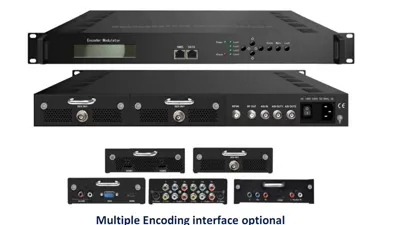
The European standard for these systems, ETSI 300 473, names the element every practical installation has: a head-end transmodulation unit that takes the satellite feeds and re-codes them onto the building's own carriers — a rack of tuners and modulators, or one chassis doing both.
SMATV is the usual answer for hotels, apartment blocks, hospitals and student residences — anywhere an operator must deliver a fixed channel list to every television without one receiver and subscription per room. MATV, SMATV, CATV and IPTV overlap in the equipment they use; the CATV headend guide sets out where the four systems part company.
What Does an SMATV System Consist Of?
Four parts, and only one of them is a buying decision that needs specification sheets. There is the dish and antenna farm, the headend that locks and rebuilds the signals, the distribution network of splitters, taps and cable, and the televisions themselves — which do the receiving with their own DVB-C or DVB-T tuners.
| Stage | What it does | What we publish for it |
|---|---|---|
| Dish and antenna farm | LNB and terrestrial antennas put the feeds on IF and VHF/UHF cable | Not published in our catalogue — site's own or installer's Bill of Materials |
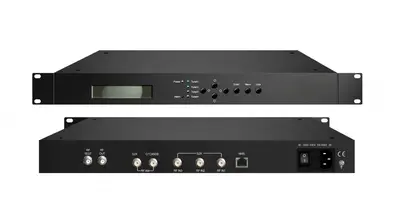
| Headend core | Locks the transponders and re-codes the services onto the building's carriers | FUQ4415EF, FUQ41013K, FUQ4653E |
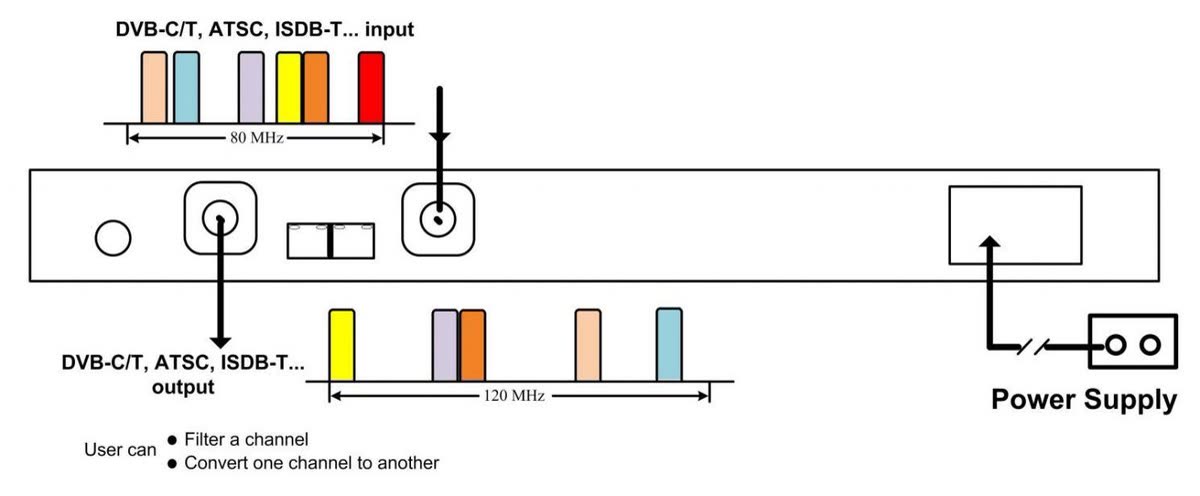
| Channel processing | Filters, converts and shapes the terrestrial, cable and local channels joining the line-up | FUQ46610K |
| Multiplexing | Selects services, remaps PIDs, rebuilds PSI/SI, descrambles where needed | FUQ4218K, FUQ4823C |
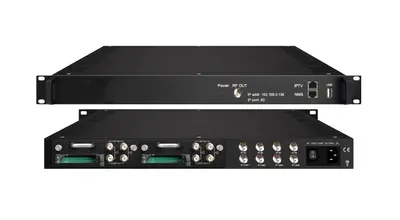
| Modulation to coax | Places the finished line-up on DVB-C (QAM) or DVB-T (COFDM) carriers | FUQ4459B, FUQ4459R, FUQ44105B-3, FUQ44105R-2 |
| Room side | Any television with a DVB-C or DVB-T tuner, no set-top box | Not a product line — the sets' own tuners, or an IPTV leg |
The passive side — splitters, taps, multiswitches, amplifiers, cable and wall sockets — is deliberately absent from that table. We quote the active headend and the receiving chassis; the distribution hardware is normally sourced by the installing contractor against the level plan.
How Does the Signal Travel From the Dish to the Room?
The chain is short and every project walks the same six stages: the LNB downconverts the satellite band to IF, the headend locks and rebuilds the services, a modulator puts them on new carriers, a combiner merges those carriers with the terrestrial channels, and the television tunes what it finds on the cable.
- Dish and LNB: the satellite band arrives at the headend as a 950–2150 MHz IF signal on coax.
- Tuner bank: one tuner locks one transponder, so the published tuner count sets how many feeds can be taken at once.
- Descramble and re-multiplex: CAM/CI or BISS clears encrypted services, then the multiplexer selects programs and rebuilds PSI/SI.
- Modulate: the finished multiplex goes onto DVB-C QAM or DVB-T COFDM carriers.
- Combine: those carriers join the terrestrial channels and the local channels on one trunk.
- Room: the television scans carriers, with no box and no network.
The second stage is the one that catches people out: twelve satellite channels need twelve transponders locked, not one dish, and the published tuner count is the number that answers it.
What Does an SMATV System Diagram Show?
A drawing for an SMATV system is a single line from the dish to the wall socket, and every block on it should carry a published row rather than an estimate. Six blocks appear on any usable diagram: the dish and LNB, the tuner bank, the multiplex and descrambling stage, the modulator output, the combiner and the socket layer.
| Block on the drawing | What it has to show | Published row that fixes it |
|---|---|---|
| Dish/LNB | Satellite position, and the IF run into the headend room | Site's own antenna work; the headend receives satellite IF at 950~2150MHz |
| Tuner bank | How many transponders are locked at once | 4 tuner inputs on FUQ4415EF, 8 on FUQ4459B and FUQ4459R, up to 24 DVB-S2 on FUQ44105B-3 |
| Multiplex | Which services survive, and which PIDs carry them | Multiplexing 128 per input channel on the FUQ4415EF; maximum PID remapping 256 per input channel on the FUQ41013K |
| CAM | Whether a CAM/CI slot or a BISS key path is drawn in | CAM/CI 2 sets on the FUQ41013K; BISS as Mode 1, Mode E on the FUQ4619C-3 |
| RF output | Carrier count and standard for every output port | 4 DVB-C RF or 2 DVB-T RF on the FUQ4415EF; 4 non-adjacent carrier outputs on the FUQ4459B; MER ≥42 dB on the FUQ44105R-2 |
| Combiner | Where the terrestrial channels join, and which risers leave the room | The carrier rows above; the passive side is the contractor's Bill of Materials |
Three things a drawing cannot fix — the frequency plan, the carrier-to-service map and the level budget at each tap — are worked out with you rather than copied between projects. The carrier chassis themselves are listed on the modulator and modem page, and the device-level difference between a transmodulator and a tuner-input modulator is set out in the satellite transmodulator guide.
Which Headend Route Fits the Building?
Three routes cover almost every SMATV project, and they differ in where the baseband work stops. A transmodulator takes satellite carriers in and gives DVB-C or DVB-T carriers out. A tuner-input modulator does the tuning inside the modulator chassis itself. A gateway turns the same feeds into IP and never produces an RF carrier.
| Route | What arrives | What leaves the chassis | Published models and rows |
|---|---|---|---|
| Transmodulator | Satellite IF carriers, cable or terrestrial RF | DVB-C or DVB-T carriers | FUQ4415EF: 4 tuner inputs, 128 per input channel. FUQ41013K: 2 DVB-S/S2/S2X tuners, CAM/CI 2 sets, DVB-T EN300744 |
| Tuner-input modulator | Satellite IF locked by the modulator's own tuners, plus IP or ASI feeds | DVB-C (QAM) or DVB-T carriers | FUQ4459B: 8 tuner inputs, 128 IP inputs via UDP/RTP, 4 non-adjacent carrier outputs. FUQ4459R: 8 tuner inputs, multi-mode tuners switchable 60~890 MHz |
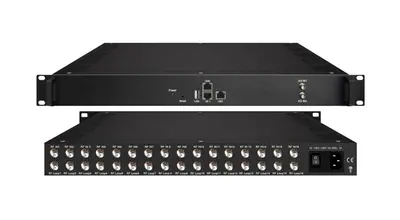
| Gateway | Satellite, cable and terrestrial tuners, plus ASI | MPTS and SPTS over IP | FUQ4619C-3: 24 tuner inputs + 2 ASI + 1 USB. FUQ46610F: 16 tuner inputs or 2 ASI feeds. FUQ3908: 8-input DVB-S/S2/S2X tuner receiver |
Choose the first two routes when the rooms already have televisions on the coax and nobody wants to touch the guest experience. Choose the gateway when the building is new, the screens are modern, or the operator wants apps and catch-up. They are not exclusive: a hybrid headend sends DVB-C to the old wing and multicast to the new one from the same tuner bank. The satellite transmodulator guide covers the device-level differences.
Which Feeds Can Share One SMATV Headend?
One headend can carry more than satellite. The same chassis will accept cable and terrestrial tuners, and a channel processor can bring analogue or locally generated channels into the same line-up, so the building ends up with one channel list instead of three.
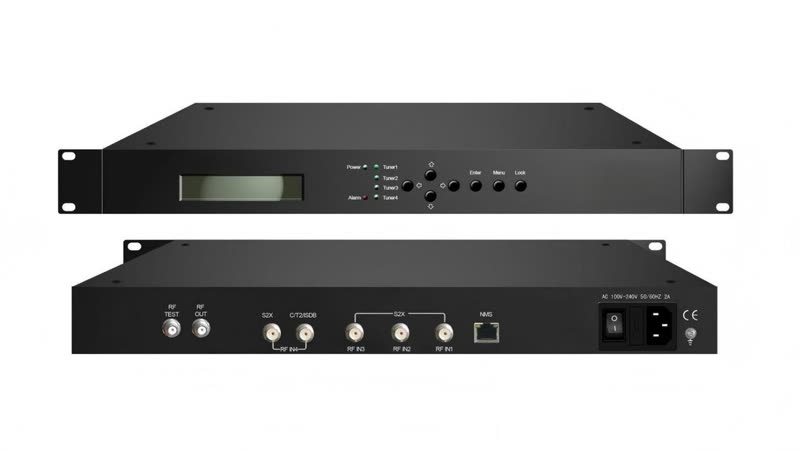
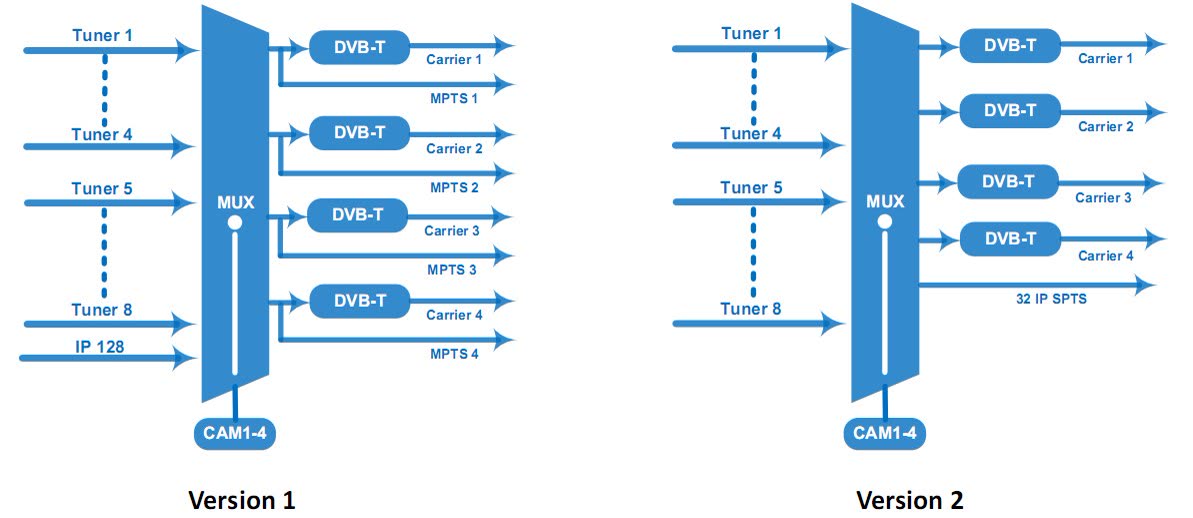
The published input rows make this concrete. The FUQ4415EF takes 4 tuner inputs in DVB-S/S2/S2X or DVB-C/T/T2/ISDB-T, and outputs 4 DVB-C RF or 2 DVB-T RF signals. The FUQ4653E publishes 4 tuner inputs for satellite, cable or terrestrial sources and 2 ASI inputs, and the FUQ4459R and FUQ4459B use multi-mode tuners switchable across 60~890 MHz.
For channels that do not come from a tuner at all — a local information channel, a camera feed, a media player — the headend needs an encoder first, then ASI or IP into the multiplex. Our FUQ4218K multiplexer takes 16 tuner inputs configurable for DVB-S/S2/S2X, DVB-C/T, ISDB-T or ATSC plus 2 ASI inputs, and multiplexes them into 4 IP outputs. IPTV encoder guide covers the encode side.
How Many Carriers and Services Will the Building Get?
Two published counts set the answer, and neither is a guess: the tuner count fixes how many feeds can be locked, and the multiplexing and carrier rows fix how much of each feed can be carried through the chassis to the cable.
| Model | Published input side | Published capacity row |
|---|---|---|
| FUQ4415EF | 4 tuner inputs in DVB-S/S2/S2X or DVB-C/T/T2/ISDB-T | Multiplexing 128 per input channel; 4 DVB-C RF or 2 DVB-T RF outputs |
| FUQ41013K | 2 DVB-S/S2/S2X tuners, 950~2150 MHz | Maximum PID remapping 256 per input channel |
| FUQ44105R-2 | 24/16 FTA DVB-S/S2/S2X tuner inputs, 256 IP inputs, 1 ASI | Maximum PID remapping 256 output per channel; MER ≥42 dB; EN300 744 |
| FUQ44105B-3 | Up to 24 DVB-S2 tuners, 128 IP sources over GE1, ASI | PID remapping automatically or manually; MER ≥40db; RF frequency 50~960MHz, 1kHz step |
| FUQ4459B | 8 tuner inputs, 128 IP inputs via UDP/RTP | 4 non-adjacent carrier outputs |
A practical plan starts from the room list, not from the chassis. Count the channels the site must carry, decide which of them are in the same transport stream on the satellite side, then size the tuners to lock those transponders and the carriers to hold the finished services. Anything the page does not publish — a specific frequency plan, a carrier-to-service mapping, a level budget — is worked out with you rather than estimated.
Do You Need CAM, CI or BISS Descrambling?
Only where the line-up contains encrypted services. If every channel on the dish is free-to-air, no descrambling hardware is needed at all. If a pay service is part of the package, the mechanism is published per model, and the three mechanisms are not interchangeable.
- FUQ41013K: CAM/CI 2 sets, published alongside its 2 DVB-S/S2/S2X tuners.
- FUQ4459R: CAM/CI descrambling and web-based NMS across 8 tuner inputs.
- FUQ4696: a CI receiver, 8 tuner inputs, where encrypted content is cleared through CAM/CI slots or BISS before re-muxing into transport streams; its outputs cover 1 MPTS and 16 SPTS.
- FUQ4415EF: embedded BISS descrambling, with demodulation, re-multiplexing and modulation run in one pass.
- FUQ4619C-3 and FUQ46610F: BISS descrambling Mode 1, Mode E.
Being able to descramble a pay service is not the right to redistribute it; that question sits with the content owner, not the headend.
The head-end side of the same decision is compared across standards in the DVB-C, DVB-T and ATSC modulator guide, and the leg that replaces the building coax when it is re-cabled is covered in the IP to QAM modulator guide.
When the Building Wants IPTV Instead
Where the screens are new and the operator wants apps, catch-up or video on demand, the same feeds can leave the headend as multicast instead of carriers. That changes the receiving chassis, not the dish: the tuners, the descrambling and the multiplex are the same work either way.
The gateway route is published in FUQ4619C-3 — 24 tuner inputs plus 2 ASI and 1 USB input onto IP — and in FUQ46610F with 16 tuner inputs or 2 ASI feeds. On the professional side, the 16-tuner FUQ4619C maps DVB-S/S2/S2X, DVB-C/T/T2, ISDB-T and ATSC tuner inputs onto IP with BISS descrambling up to 850Mbps.
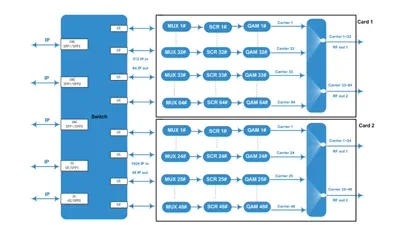
The reverse direction is common too: an IP line-up that has to go back onto building coax is an IP QAM job. The FUQ4455B takes 192 IP inputs across 4×FE and 1×GE ports and outputs 4 DVB-C RF carriers at 64/256 QAM. DVB to IP gateway guide covers the conversion the other way.
What Does the Installer Need From the Headend Side?
Three deliverables shape what you order: a rack plan with power and heat figures, a channel plan naming every carrier, and a system schematic for handover. Several licensing authorities ask for that schematic with the SMATV application, so it pays to fix the headend before the paperwork goes in.
Rack and power rows are published per model. The FUQ4823C multiplexer scrambler is a 482mm×328mm×44mm chassis, 3.5kg, ≤40W, with AC 110V±10% or AC 220V±10% at 50/60Hz. The FUQ4455B is 430mm×180mm×44mm with AC 100V±10% or AC 220V±10% at 50/60Hz. Temperature is published for both as 0~45℃ in operation and -20~80℃ in storage. The headend installation checklist covers cable, rack and commissioning.
What is not published here is the distribution hardware after the headend: splitters, taps, multiswitches, amplifiers, trunk cable and wall plates — normally the contractor's own Bill of Materials. Ask us for anything a page does not show; we confirm it against the unit we build rather than fill the gap with an estimate.
What Has to Be in Place Before the Headend Is Installed?
An SMATV installation is two work packages, and only one is ours. The rack arrives as active equipment; the dish, the trunk, the risers, the sockets and the cabinet work are the installing contractor's scope. What the building must have ready is a locked room, rack space, an AC feed and the IF run from the dish.
| Site item | What the site provides | What the headend publishes to size it |
|---|---|---|
| Rack space | A 19-inch rack with free units and enough depth for the chassis | 482mm×328mm ×44mm and 3.5kg on the FUQ4823C; 430mm×180mm ×44mm on the FUQ4455B |
| Power | A protected AC feed at the rack, on its own circuit | AC 110V±10% or AC 220V±10% at 50/60Hz on the FUQ4823C; AC 100V±10% or AC 220V±10% on the FUQ4455B |
| Room climate | A ventilated, lockable space, not a cupboard under a riser | 0~45℃ in operation and -20~80℃ in storage, published for both chassis |
| IF run | Cable from the dish to the headend room, terminated | Satellite tuner inputs at 950~2150MHz on the FUQ41013K |
| Socket layer | The standard the televisions in the building can tune | DVB-C QAM or DVB-T COFDM carriers from the modulator stage |
The order that keeps commissioning short runs against the drawing: rack in and powered first, then the IF and terrestrial feeds, then one socket per riser scanned before the rest of the building is connected. When a socket shows nothing, compare the signal against the MER row of the modulator in use — ≥40db on the FUQ44105B-3, ≥42 dB on the FUQ44105R-2 — before any passive component is suspected. The step-by-step sequence from rack to handover is in the headend installation checklist.
What Does an SMATV Headend Cost?
There is no list price, because the configuration is the price: an SMATV system price follows tuner count, carrier count, descrambling hardware, output standard, redundancy and any site-specific interface, so two projects with the same room count can differ by several chassis.
We build in our own factory in Guangzhou and quote factory-direct, per project; standard headend chassis are quoted per unit. Where a site wants its own branding, packaging or software build, the minimum quantity and the schedule are confirmed with the quotation, because they depend on the model. Send the site details and we reply with a model confirmation and a written quotation.
What to Send Us for an SMATV Quotation
Send these and we can confirm a configuration without a site visit. The list is the minimum we need to price an SMATV headend: the size of the site, the feeds available, whether anything is encrypted, the standard the rooms expect, and how much rack space the plant room has.
- The size of the site: buildings, floors and the number of television sockets.
- Which feeds exist or are planned: satellites and transponders, terrestrial antennas, cable, or a local source.
- Whether any part of the line-up is encrypted, and which service holds the rights.
- The output standard the rooms expect, and whether the televisions already have DVB-C or DVB-T tuners.
- The room side: coax to every socket, or IP to the newer screens — or both.
- Rack space available, power on site, and the delivery country.
Frequently Asked Questions
What is the difference between SMATV and MATV?
MATV distributes terrestrial and satellite channels from the building's antenna system to one building; SMATV does the same from a private dish farm. Both hand the receiving back to the television's own tuner and neither applies subscription control. A CATV plant or an IPTV service adds that control layer.
Does an SMATV system need a set-top box in every room?
No — that is usually the point of choosing it. The headend puts the line-up on DVB-C or DVB-T carriers and any television with a matching tuner receives it directly. A set-top box appears only if the site adds conditional access or IPTV middleware.
How many satellites can one SMATV headend take?
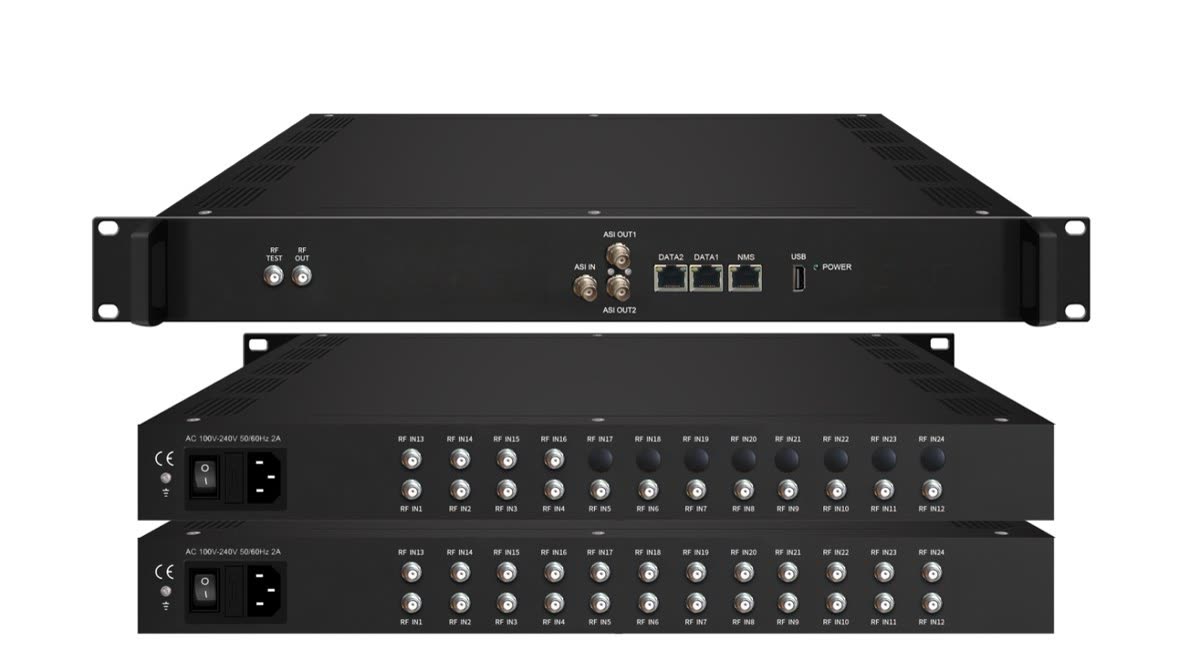
It follows the published tuner count, because one tuner locks one transponder: 2 on the FUQ41013K, 4 on the FUQ4415EF and FUQ4653E, 8 on the FUQ4459B and FUQ4459R, and 16 to 24 on the FUQ46610F, FUQ4619C and FUQ44105R. Several transponders can share one output carrier.
Can satellite and terrestrial channels go on the same coax?
Yes. The satellite services are rebuilt as DVB-C or DVB-T carriers, the terrestrial channels stay on their own carriers, and a combiner puts both on the trunk. The FUQ4415EF accepts 4 tuner inputs in DVB-S/S2/S2X or DVB-C/T/T2/ISDB-T, and the FUQ4653E publishes 4 tuner inputs for satellite, cable or terrestrial sources.
Do I need CAM modules or BISS descrambling?
Only for encrypted services. The published options are CAM/CI 2 sets on the FUQ41013K, CAM/CI descrambling on the FUQ4459R, CAM/CI slots or BISS on the FUQ4696, embedded BISS on the FUQ4415EF, and BISS Mode 1 and Mode E on the FUQ4619C and FUQ46610F. Clearance capability is not a redistribution right.
How many channels will the coax carry?
The chassis pages publish the counts that set it. The FUQ4415EF outputs 4 DVB-C RF or 2 DVB-T RF signals with multiplexing of 128 per input channel; the FUQ4459B and FUQ4459R each publish 4 non-adjacent carrier outputs; the FUQ44105R publishes a maximum of 256 output per channel. The final number depends on how many services each carrier holds.
Can an SMATV headend be upgraded to IPTV later?
Yes, and the tuner bank usually survives the upgrade. The descrambling, multiplexing and service selection happen before the output stage, so a site can keep the existing RF headend for the old coax and add a gateway leg for new screens on the data network — a hybrid headend serving both room types from one set of tuners.
What is not published for an SMATV system on this site?
The dish and LNB, and the passive distribution chain: splitters, taps, multiswitches, amplifiers, trunk cable and wall sockets. Those are normally the installing contractor's Bill of Materials. The active headend, the receiving chassis and their published rows are all in the catalogue, and we confirm anything a page does not list against the unit we build.
What should an SMATV single-line diagram show?
Six blocks: the dish and LNB, the tuner bank with its transponder count, the multiplex and descrambling stage, the modulator output with its carrier count and standard, the combiner, and the socket layer. Each block should carry the published row it is sized from, so the drawing can be checked against the datasheets instead of against a supplier summary.
Previous
Headend Core: IRD, Multiplexer and CAS/SMS Chain
Next
SDI to RF Modulator: SDI, HDMI and CVBS to QAM
Talk to the headend engineers before you specify
Send the model number you are looking at — or the channel count and the input and output formats you work with — and we answer with the datasheet, the configuration and a written price. The reply comes from the headend team in Guangzhou, not a sales line.