DVB-C vs DVB-T vs ATSC vs ISDB-T Modulator Guide
Match a digital TV modulator to your network: DVB-C/QAM, DVB-T/T2, ATSC and ISDB-T compared, with carrier counts and the models that publish them. Each model named in this article is one of 190 in the Hanxing catalogue, published with its own specifications and datasheet.
Hanxing Team
Broadcast & IPTV Experts
The path this guide walks
- Receivers firstthe standard the tuners scan
- Device typemodulator, transmodulator or transmitter
- Carrier countfrom the channel list and its bit rates
- RF figuresfrequency, output level, MER
- Ordermodel list and datasheets
The guide follows the same route a quotation follows: receivers, then the box, then the numbers.
Two things decide which modulator you buy: the standard the televisions can tune, and the number of RF carriers your channel list needs. Get the standard wrong and a perfectly clean carrier stays invisible, because the receiver was built for a different modulation. Get the carrier count wrong and you either pay for headroom you never use or run out of room in the lineup.
This guide covers all four digital standard families used for television distribution, the RF figures that decide whether a unit suits your plant, and the device types that are often confused with modulators. Every parameter quoted below is published on the product page of the model it belongs to.
How Do I Know Which Standard My Network Uses?
Look at the receivers you have to serve rather than at your video platform. The tuner menu of a hospitality television, the nameplate of a set-top box or the specification sheet of the existing headend states the standard, and that is the output your modulator has to produce.
Four checks settle it in most projects:
- Scan the menu of one television. A tuner that scans DVB-C or QAM is a cable-standard receiver; one that scans DVB-T or DVB-T2 is terrestrial, and ATSC or ISDB-T appear by name in the regions where they are the local broadcast standard.
- Read the set-top box label. DVB-C boxes are common in hotels because cable plants are common in hotels, while DVB-T boxes appear where the headend was fed from a terrestrial antenna.
- Ask what the property was equipped with. Buildings built around a cable operator or a community antenna usually have DVB-C inside the wall; buildings fed from a rooftop aerial are usually DVB-T.
- Measure the existing headend. Where a headend is already running, a transport stream analyzer or a receiver lock test tells you the standard, the carrier frequencies and the symbol rate in minutes, and removes every assumption from the design.
If none of the four is available, tell us the country and the operator the site is connected to and we will confirm the standard against the deployment before quoting.
The Four Digital TV Standards Compared
Four standard families cover virtually every television installation in service: DVB-C for cable plants, DVB-T and DVB-T2 for terrestrial distribution, ATSC for North America and ISDB-T for Japan, Brazil and much of Latin America. They differ in modulation, channel width and where they are the local standard.
| Standard | Used for | Common markets | Modulation and document | Channel width |
|---|---|---|---|---|
| DVB-C (QAM) | Cable networks and cable-style building plants | Europe, Asia, Africa and Latin America; hotel and community coax systems worldwide | 16 to 256 QAM, EN 300 429 and ITU-T J.83 A/B/C | 6, 7 or 8 MHz |
| DVB-T and DVB-T2 | Terrestrial broadcast and over-the-air distribution | Europe, Africa, Asia, Australia and parts of Latin America | COFDM, ETSI EN 300 744 for T and EN 302 755 for T2 | 6, 7 or 8 MHz |
| ATSC 1.0 and ATSC 3.0 | Terrestrial broadcast | United States, Canada, Mexico, South Korea | 8VSB, ATSC A/53 | 6 MHz |
| ISDB-T and ISDB-Tb | Terrestrial broadcast with a mobile segment | Japan, Brazil, much of Latin America, Philippines | OFDM with segmented hierarchy, ARIB STD-B31 | 6 MHz |
| DVB-S, DVB-S2 and DVB-S2X | Satellite uplink and contribution feeds | Worldwide | QPSK to 32APSK, DVB-S2X | Set by symbol rate |
The market column describes the common case, not a rule. The standard of the operator or network you connect to is the one that matters, and in border regions and retrofit projects two standards sometimes have to coexist.
DVB-C and QAM: the cable standard
DVB-C puts a transport stream on a QAM carrier inside a 6, 7 or 8 MHz channel, which is why cable operators and building coax plants use it. The published range starts with single-carrier units and continues to chassis that generate more than a hundred carriers at once.
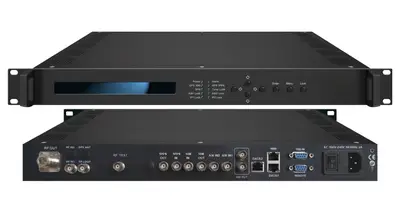
- FUQ-4455B IP QAM modulator — 192 IP inputs and 4 DVB-C carriers on one F-type port, compliant with EN300 429 and ITU-T J.83 A/B/C, with 64 and 256 QAM constellations, a symbol rate of 5.0 to 9.0 Msps in 1 ksps steps and 748 PIDs of remapping per input channel.
- FUQ-4427 — 512 IP inputs, 16 non-adjacent carriers, 16 to 256 QAM, 180 PIDs per channel and an MER of 40 dB or better.
- FUQ-4443 — 1024 IP inputs plus 6 ASI inputs, 16 or 32 carriers, RF range 50 to 960 MHz in 1 kHz steps, output level from minus 20 dBm to plus 10 dBm (87 to 117 dBuV) in 0.1 dB steps and MER of 40 dB or better.
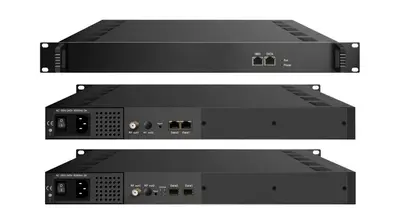
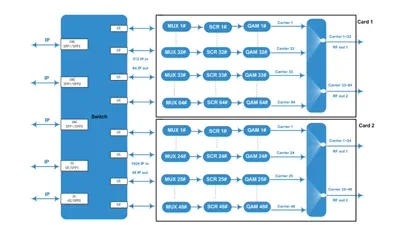
- FUQ-200A — the 10G platform, 64 carriers per daughter QAM card on two F-type ports, with up to 9600 Mbps on each 10G SFP+ input.
- FUQ-4412C — a single-carrier QAM modulator fed by ASI or IP, 30 to 960 MHz, output attenuation from minus 30 dBm to 0 dBm in 0.5 dB steps and 22 W of consumption.
The J.83 suffix matters inside DVB-C. J.83A is the 8 MHz variant used in most cable networks, J.83B is the 6 MHz variant used in North America, and J.83C covers the Japanese cable case. The models above publish J.83A/B, and the FUQ-200A and FUQ-200B class publish A/B/C, so if your plant is a 6 MHz cable network you can be specific about it in the order.
DVB-T and DVB-T2: terrestrial COFDM
DVB-T and DVB-T2 carry several services on many low-rate subcarriers instead of one broad carrier, which is what makes them usable over the air in the presence of reflections. A modulator for this family is what a regional broadcaster, a campus or a mining site buys when the receivers are terrestrial tuners.
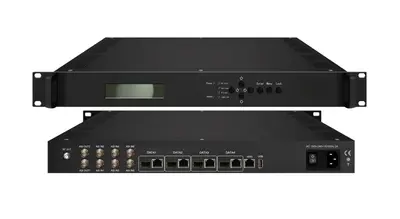
- FUQ-3517X — dual ASI and IP inputs with DVB-T modulation to EN300 744 and DVB-T2 modulation to EN302 755, RF range 150 to 999 MHz in 1 Hz steps, output level minus 15 to plus 5 dBm in 0.1 dB steps, MER above 43 dB and shoulder level above 56 dB.
- FUQ-4419R v2 — 512 or 1024 IP inputs, 8 or 16 non-adjacent carriers to ETSI EN300 744, QPSK, 16QAM and 64QAM constellations, 6, 7 and 8 MHz bandwidths, 2K, 4K and 8K transmission modes, code rates from 1/2 to 7/8 and MER of 40 dB or better.
- FUQ-4419U — 256, 512 or 768 IP streams feeding 8, 16 or 24 carriers, with MER of 40 dB or better and adjacent channel leakage of minus 55 dBc.
- FUQ-4415B — 128 IP inputs and 4 carriers with 6, 7 and 8 MHz bandwidth options, for smaller DVB-T lineups.
- FUQ-3512B — 2 ASI and 2 IP inputs, bandwidths of 5, 6, 7 and 8 MHz, an RF range of 50 to 1000 MHz in 1 Hz steps and MER of 42 dB or better on an N-type 50 ohm output.
Where a network has moved on to DVB-T2 but still has DVB-T receivers in the field, the modulation has to be chosen per carrier, so state the mix when you order rather than after the chassis arrives.
ATSC: the North American terrestrial standard
ATSC uses 8VSB in a fixed 6 MHz channel, and the receivers are the ones sold in the United States, Canada, Mexico and South Korea. Our published ATSC modulator is the single-carrier-per-output type used for lineups and translators as well as for cable-style plants where the sets are ATSC tuners.
FUQ-4419BX takes 256 IP inputs and produces 8 non-adjacent carriers to ATSC A/53, with 8VSB constellation, 6 MHz bandwidth, Reed-Solomon FEC of RS(208, 188) with Trellis coding, an RF range of 50 to 960 MHz in 1 kHz steps, output level from minus 20 to plus 10 dBm in 0.5 dB steps, MER of 40 dB or better and a power consumption of no more than 20 W.
ATSC 3.0 is a different carrier generation, not a firmware setting, so a project that has to transmit NextGen TV cannot be served by an A/53 unit. Tell us the deployment plan and we will confirm what is available for it rather than assume the two are interchangeable.
ISDB-T and ISDB-Tb: Japan, Brazil and Latin America
ISDB-T divides a 6 MHz channel into 13 segments so that fixed and mobile reception can share one carrier, which is why Japanese, Brazilian and several other Latin American networks use it. Our range covers ISDB-T and the Brazilian ISDB-Tb variant at several carrier counts.
- FUQ-4417J — 1024 IP streams and 24 or 48 ISDB-T channels to ARIB STD-B31, QPSK, 16QAM and 64QAM constellations, guard intervals from 1/32 to 1/4, RF range 50 to 960 MHz in 1 kHz steps, output level minus 20 dBm to plus 10 dBm (87 to 117 dBuV), MER of 40 dB or better and ACLR of minus 50 dBc.
- FUQ-4417K — the ISDB-Tb build, 512 or 1024 IP inputs and 8 or 16 non-adjacent carriers to ARIB STD-B31 with MER of 40 dB or better.
- FUQ-4417 — a smaller ISDB-T unit with DQPSK, QPSK, 16QAM and 64QAM constellations, 2K, 4K and 8K transmission modes, MER of 42 dB or better and an output range of 30 to 1000 MHz in 1 kHz steps.
- FUQ-3516R — 2 ASI and 2 IP inputs, 6 MHz bandwidth, hierarchical transmission and MER of 42 dB or better from a 25 W chassis running on 100 to 240 V AC.
DVB-S and DVB-S2: satellite uplink and contribution
Satellite modulators are the other end of the chain from the receivers most projects start with. They are what a teleport or an operator uses to put a transport stream onto an uplink carrier, and their published figures are symbol rate and roll-off rather than carrier count.
FUQ-4514 is a DVB-S2X modulator with 4 ASI inputs and 1 IP input, symbol rates from 0.05 to 45 Msps for QPSK, 8PSK and 16APSK and 0.05 to 40 Msps for 8APSK and 32APSK, with selectable roll-off factors from 0.05 to 0.35 and BCH coding. The FUQ-4513A is the DVB-S2 unit in the same format, with QPSK, 8PSK, 16APSK and 32APSK constellations, BCH and LDPC coding and a 100 to 240 V AC supply.
Match the Medium Before You Match the Model
Medium, not preference, decides the family, and it is normally chosen before the model is. Cable plants and building coax need a QAM carrier, over-the-air distribution needs COFDM or 8VSB, satellite contribution needs a symbol-rate based carrier, and an analog plant needs an analog channel. The table below is the short route from scenario to standard.
| Scenario | What the receivers are | Modulator output | Published model |
|---|---|---|---|
| Hotel or community plant with coax outlets behind the televisions | DVB-C tuners in the rooms | DVB-C QAM carriers | FUQ-4455B for 4 carriers, FUQ-4443 for 16 or 32 |
| Cable-style lineup built from satellite feeds | DVB-C tuners, no individual receivers in the rack | DVB-C QAM, demodulation done in the chassis | FUQ-44105B v3 transmodulator |
| Regional terrestrial network with DVB-T or DVB-T2 receivers | DVB-T or DVB-T2 tuners | DVB-T to EN300 744 or DVB-T2 to EN302 755 | FUQ-3517X, FUQ-4419R v2 |
| North American over-the-air or cable lineup | ATSC tuners | 8VSB carriers to ATSC A/53 | FUQ-4419BX |
| Japanese, Brazilian or Latin American terrestrial network | ISDB-T or ISDB-Tb tuners | ISDB-T carriers to ARIB STD-B31 | FUQ-4417J, FUQ-4417K |
| Teleport or operator uplink | Satellite receivers at the far end | DVB-S2 or DVB-S2X carrier | FUQ-4514, FUQ-4513A |
| Legacy analog plant, PAL or NTSC sets | Analog televisions | Analog RF channels | FUQ-2500E agile modulator, FUQ-2500B |
Modulator, Transmodulator, Encoder Modulator or Transmitter?
These five device types are quoted interchangeably in enquiries, and they are not interchangeable in a rack, because each one sits in a different place in the chain. The difference to check first is what goes in and what comes out, since that single row decides whether the unit replaces an encoder, a receiver, an exciter or nothing at all.
| Device | Input | Output | Choose it when | Published example |
|---|---|---|---|---|
| Modulator | Transport stream over IP or ASI | RF carrier or carrier block | The stream is already encoded and only needs to reach tuners | FUQ-4443, FUQ-4419R v2 |
| Transmodulator | RF tuner inputs, satellite, cable or terrestrial | RF carriers in the output standard | You redistribute incoming feeds and want the demodulation inside the same chassis | FUQ-44105B v3, 24 or 16 tuners to 16 DVB-C carriers |
| Encoder modulator | Baseband video and audio, HDMI, SDI or CVBS | RF carriers, encoding included | One or two local sources have to become channels with no separate encoder | FUQ-4667, one HDMI input to DVB-C carriers |
| Mux modulator | IP and ASI streams, in some models tuner inputs as well | RF carriers, with multiplexing and scrambling built in | The lineup has to be rebuilt and scrambled before modulation | FUQ-200B, FUQ-4455A |
| Transmitter | RF from a modulator or exciter | High-power RF for an antenna | The audience is beyond the reach of your own cabling | FUQ-8351, FUQ-8322, FUQ-8313 |
The transmodulator advantage is integration: a unit that demodulates on its own tuners removes a receiver, an ASI patch and a separate mux from the bill of materials. The FUQ-44105B v3 takes DVB-S/S2 tuner inputs between 950 and 2150 MHz together with 128 IP inputs and 2 ASI inputs, and publishes 16 DVB-C carriers to EN300 429 and ITU-T J.83 A/B with the PSI/SI tables generated automatically, MER of 40 dB or better and an RF range of 50 to 960 MHz in 1 kHz steps.
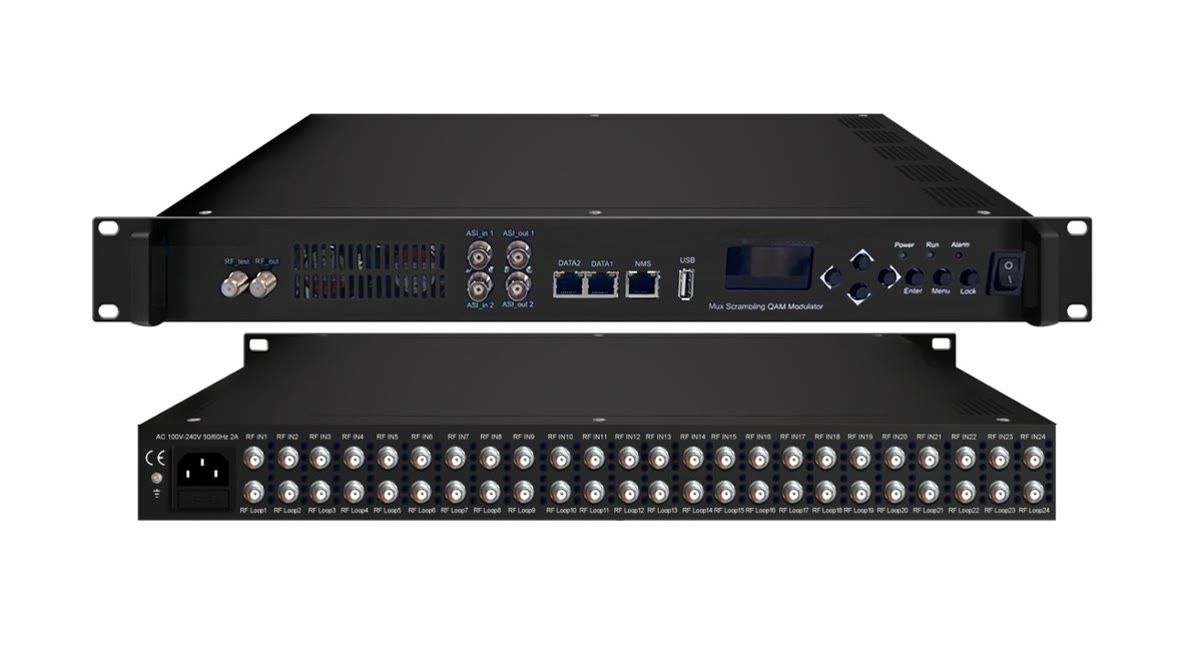
Where a site has to serve two standards at once, the mux modulator route is cheaper than two headends. The FUQ-4455A publishes up to 48 DVB-C, 32 DVB-T or 28 ISDB-T carriers from 128 IP inputs and 2 ASI inputs, with MER of 40 dB or better, and the FUQ-200B combines multiplexing, scrambling to ETR289, ETSI 101 197 and ETSI 103 197, and 32 to 112 QAM carriers in one chassis. Both sit in the multiplexer and scrambler range rather than the modulator range, so search there when a lineup has to be rebuilt as well as carried.
How Many Carriers Do You Need?
One carrier carries one transport stream, so the carrier count follows the way you group services and the bit rate you give each one. It does not follow the number of rooms: a hotel with 300 rooms and 40 channels needs carriers for 40 channels, not for 300 televisions.
The working order is the same in every project:
- Count the services, not the screens. Free-to-air channels, in-house channels, radio services and information loops each take capacity in the lineup.
- Set a bit rate per service. The bit rate you publish per channel is what decides how many services share one carrier, which is why a channel list without bit rates cannot be quoted accurately.
- Check the multiplexing headroom of the model. The published per-channel PID limits show how much can be inserted into one carrier: 180 PIDs per channel on the FUQ-4427 and the FUQ-4419BX, 256 on the FUQ-4443, the FUQ-4417J and the FUQ-4455A, 512 on the FUQ-4459E and 748 per input channel on the FUQ-4455B.
- Decide adjacent or non-adjacent carriers. Several models publish non-adjacent carriers, which lets you place each carrier on a chosen frequency instead of on a fixed block. That matters where part of the spectrum is already occupied.
- Check the output port. On the F-type 75 ohm models the carriers leave combined on one port, so the number of carriers does not automatically mean the number of connectors.
| Carriers published | Published models | Input side |
|---|---|---|
| 4 | FUQ-4455B, FUQ-4415B | 192 IP inputs, 128 IP inputs |
| 8 or 16 | FUQ-4427, FUQ-4419R v2, FUQ-4419BX, FUQ-4417K | 512 IP inputs, 512 or 1024 IP inputs, 256 IP inputs, 512 or 1024 IP inputs |
| 16 or 32 | FUQ-4443 | 1024 IP and 6 ASI inputs |
| 24 or 48 | FUQ-4417J | 1024 IP streams |
| 32 to 112 | FUQ-200B | IP inputs with scrambling included |
| 64 to 128 | FUQ-200A | 10G SFP+ inputs |
RF Figures to Confirm Before You Order
A modulator that matches the standard but not the plant will still fail acceptance, so these are the rows to compare model by model before an order is raised. Every value below is a published value, taken from the product page of the model named beside it.
| Parameter | What it has to satisfy | Published examples |
|---|---|---|
| RF frequency range | Covers the channel plan you are licensed or assigned | 50 to 960 MHz on the FUQ-4443, FUQ-4443 class chassis and the FUQ-4417J; 150 to 999 MHz on the FUQ-3517X; 30 to 1000 MHz on the FUQ-4417; 47 to 870 MHz on the FUQ-2500E |
| Output level and step | Enough level to drive the plant, adjustable in small steps | Minus 20 dBm to plus 10 dBm (87 to 117 dBuV) in 0.1 dB steps on the FUQ-4443; minus 30 dBm to 0 dBm in 0.5 dB steps on the FUQ-4412C; minus 15 to plus 5 dBm on the FUQ-3517X |
| MER | Headroom for splitters, cable loss and amplifiers downstream | 40 dB or better on most of the range; 42 dB or better on the FUQ-3512B, FUQ-3516R and FUQ-4417; above 43 dB on the FUQ-3517X |
| Symbol rate and bandwidth | Matches the receiver scan and the J.83 variant | 5.0 to 9.0 Msps in 1 ksps steps on the FUQ-4455B; 3600 to 7000 Ksps on the FUQ-200B; 6, 7 and 8 MHz bandwidths on the FUQ-4419R |
| FEC | Matches the standard you transmit | RS (204, 188) on the DVB-C models; RS(208, 188) with Trellis on the FUQ-4419BX; code rates 1/2 to 7/8 on the DVB-T and ISDB-T models |
| Connector and impedance | Matches the cable and the combiner | F-type 75 ohm on the cable models; N-type 50 ohm on the FUQ-3512B; 1-5/8 inch on the FUQ-8323 and FUQ-8313 transmitters |
| Scrambling | Needed only where a paid package is sold | ETR289, ETSI 101 197 and ETSI 103 197 on the FUQ-200B, FUQ-4427, FUQ-4443 and FUQ-200A |
| Consumption and rack space | Fits the power and rack budget | 22 W on the FUQ-4412C; 25 W on the FUQ-3516R; no more than 20 W on the FUQ-4419BX; 50 W with one daughter card and 75 W with two on the FUQ-200A; 1U rack chassis on all of them, typically 420 by 440 by 44.5 mm on the multi-carrier models |
Where a value is not published for the model you need, ask for the datasheet rather than accepting a rounded figure from another model. The two are not the same unit.
Which Models Cover Which Standard
The table is the short index for a first shortlist, grouped by the standard each model publishes rather than by price. Model numbers are linked from the sections above, and the full line, with every model page and datasheet, sits on the DVB-T, DVB-C/QAM, ATSC and ISDB-T modulator page.
| Model | Standard published | Inputs | Outputs |
|---|---|---|---|
| FUQ-3517X | DVB-T to EN300 744, DVB-T2 to EN302 755 | 2 ASI and 2 IP | 1 RF, 150 to 999 MHz |
| FUQ-4419R v2 | DVB-T to ETSI EN300 744 | 512 or 1024 IP | 8 or 16 non-adjacent carriers |
| FUQ-4419U | DVB-T to ETSI EN300 744 | 256, 512 or 768 IP streams | 8, 16 or 24 carriers |
| FUQ-4415B | DVB-T | 128 IP inputs | 4 carriers, 6, 7 and 8 MHz |
| FUQ-3512B | DVB-T | 2 ASI and 2 IP | 1 RF, 50 to 1000 MHz |
| FUQ-4419BX | ATSC A/53 | 256 IP inputs | 8 non-adjacent carriers, 6 MHz |
| FUQ-4417J | ISDB-T, ARIB STD-B31 | 1024 IP streams | 24 or 48 channels |
| FUQ-4417K | ISDB-Tb, ARIB STD-B31 | 512 or 1024 IP inputs | 8 or 16 non-adjacent carriers |
| FUQ-3516R | ISDB-T | 2 ASI and 2 IP | 1 RF, 6 MHz |
| FUQ-4455B | DVB-C, EN300 429 and ITU-T J.83 A/B/C | 192 IP inputs | 4 carriers on one F-type port |
| FUQ-4427 | DVB-C QAM | 512 IP inputs | 16 non-adjacent carriers |
| FUQ-4443 | DVB-C, EN300 429 and ITU-T J.83 A/B | 1024 IP and 6 ASI inputs | 16 or 32 carriers |
| FUQ-200B | DVB-C, EN300 429 and ITU-T J.83 A/B/C | IP inputs | 32 to 112 non-adjacent carriers |
| FUQ-200A | DVB-C, ITU-T J.83 A/B/C | 10G SFP+ inputs | 64 carriers per daughter card |
| FUQ-44105B v3 | DVB-S2 tuner input to DVB-C output | 24 or 16 tuners, 128 IP and 2 ASI inputs | 16 DVB-C carriers |
| FUQ-4514 | DVB-S2X | 4 ASI and 1 IP | 1 RF or IF output |
| FUQ-4513A | DVB-S2 | 1 to 4 ASI and IP | 1 RF or IF output |
| FUQ-4455A | DVB-C, DVB-T or ISDB-T from one chassis | 128 IP and 2 ASI inputs | Up to 48, 32 or 28 carriers |
| FUQ-4667 | DVB-C, J.83A and J.83B | 1 HDMI input | 1 RF, 100 to 900 MHz |
| FUQ-2500E | Analog PAL B/G, PAL D/K, NTSC, SECAM | CVBS video and audio | 1 RF, 47 to 870 MHz |
The source end changes the same carrier plan rather than the standard: an installation fed from players and cameras is worked through in the HDMI to coax modulator guide, a studio or camera feed in the SDI to QAM modulator guide, and a market on the Japanese-Brazilian standard in the ISDB-T modulator guide.
When the Job Leaves the Building
Everything above describes distribution inside a site. Once the audience is beyond the reach of your own coax or LAN, modulation is followed by transmission, and transmitters are a separate product family with their own figures: output power, frequency range and MER instead of carrier count.
The FUQ-8351 covers DVB-T, ATSC and ISDB-T at 10, 20, 30, 50 or 100 W over 470 to 806 MHz with an MER of 35 dB or better; the FUQ-8322 is the DVB-T transmitter at 200 to 600 W with a frequency accuracy of plus or minus 100 Hz in a multi-frequency network and plus or minus 1 Hz in a single-frequency network; and the FUQ-8313 is the 800 W class with an MER of 33 dB or better. They sit in the transmitter and receiver range.
Where analog televisions are still in service, a digital carrier is not an option for those sets at all, so the analog range exists for that case: the FUQ-2500E agile modulator covers PAL B/G, PAL D/K, NTSC and SECAM from 47 to 870 MHz with a carrier-to-noise ratio of 62 dB or better, and the FUQ-2500B converts IP, HDMI and AV inputs into up to 64 analog channels.
What to Send Us for a Modulator Quotation
A short, factual brief produces a correct model list on the first reply, and it avoids the round of questions that costs a week. The points below are the ones we have to ask for anyway, so sending them in the first message keeps the quotation to model numbers, datasheets and price.
- The standard the receivers use, and whether DVB-T and DVB-T2 or ISDB-T and ISDB-Tb both have to be served.
- The channel list with a target bit rate and resolution for each service.
- Whether the transport streams arrive as IP, ASI or both, and the protocols in use.
- How many carriers are needed, and whether they have to be non-adjacent.
- The frequency range the plant or the licence allows.
- Whether any carrier has to be scrambled, and for which conditional access system.
- The cable and connector already installed, and the level the plant expects at the input.
- The rack unit and power available in the headend room.
Every unit in this range is built in our Guangzhou factory and run for 72 hours before it ships, so the modulator arrives having already been through a burn-in cycle rather than being powered for the first time on site.
The satellite leg follows the same logic and is worked through separately: the satellite modulator guide covers the DVB-S, DVB-S2 and DVB-S2X carrier and its IF output, the satellite transmodulator guide the receiver-side route onto the coax or the network, and the SMATV system guide the one-building version of the whole chain.
FAQ
Which digital TV modulator standard do I need?
The receivers decide, not the streaming platform. Read the tuner menu or the set-top box nameplate of the televisions you have to serve: a network that scans QAM or DVB-C needs a DVB-C modulator, one that scans DVB-T or DVB-T2 needs a DVB-T modulator, North American over-the-air tuners need ATSC 8VSB, and Japanese or Brazilian receivers need ISDB-T. Where the existing headend can be measured, the standard it outputs is the standard your modulator has to match.
Can I keep the existing coaxial cable and the televisions on it?
Yes, when those televisions are DVB-C tuners. A QAM chassis such as the FUQ-4443 places the new channels on carriers inside the plant, so the cabling, splitters and amplifiers stay in place and the rooms only have to rescan. Where the sets are analog only, the analog modulator range is the route instead, and where the sets are IP devices no modulator is needed at all.
What is the difference between a modulator and a transmodulator?
A modulator takes an already encoded transport stream over IP or ASI and produces RF carriers. A transmodulator receives as well: it demodulates incoming satellite, cable or terrestrial feeds on its own tuner inputs, remultiplexes them and modulates the result onto a new carrier. The FUQ-44105B v3 is an example, taking DVB-S/S2 tuner inputs and publishing 16 DVB-C carriers with the PSI/SI tables generated inside the chassis.
How many RF carriers do I need?
One carrier carries one transport stream, so the count follows how you group the services and the bit rate you give each one. Our published ranges cover single-carrier units up to chassis that generate 112 QAM carriers, and the 10G platform reaches 64 carriers per daughter card. Send the channel list with a target bit rate per channel and the carrier count is sized from it rather than guessed.
Can one chassis output more than one standard?
Not on the same carrier, but a multi-standard chassis covers a mixed site. The FUQ-4455A publishes up to 48 DVB-C, 32 DVB-T or 28 ISDB-T carriers from 128 IP inputs and two ASI inputs, so a building with a cable plant and a terrestrial feed can be built from one unit. Which carrier combinations your order is licensed for is stated on the order.
What do you need to quote a modulator?
Send the standard the receivers use, the number of channels and the bit rate planned for each, whether the transport streams arrive as IP or ASI, how many carriers you want on one output, the frequency range your channel plan allows and the rack unit available. We reply with the model list, the datasheets for each unit and the factory-direct price.
Next Step
Send the receiver standard and the channel list through our contact page and we will reply with the matching modulator, the datasheet for each unit and the factory-direct price. If the standard is still unclear, send one receiver model number and the operator it is connected to, and we will confirm it before the model list is issued.
The full catalogue is under our products, and the neighbouring blocks of the chain are on the modulator range, the encoder modulator range, the multiplexer range and the IP gateway range. If the project has to keep older coax televisions working while the sources are already IP, the mechanics of that conversion are covered in the IP to QAM modulator guide, and the same question for a specific building type is in the hotel headend guide.
Previous
HDMI to Coax Modulator Guide for DVB-C and DVB-T
Next
Hospital IPTV System: Headend Design and Ward Wiring
Talk to the headend engineers before you specify
Send the model number you are looking at — or the channel count and the input and output formats you work with — and we answer with the datasheet, the configuration and a written price. The reply comes from the headend team in Guangzhou, not a sales line.