Satellite Modulator: DVB-S, DVB-S2 and DVB-S2X
How a satellite modulator turns a finished transport stream into an IF carrier for uplink, and the DVB-S, DVB-S2 and DVB-S2X chassis we publish for it. Each model named in this article is one of 190 in the Hanxing catalogue, published with its own specifications and datasheet.
Hanxing Team
Broadcast & IPTV Experts
The path this guide walks
- Transport streama multiplexer, playout server or encoder produces the finished line-up
- ScrambleBISS at the modulator, or a conditional access system one box earlier
- ModulateDVB-S, DVB-S2 or DVB-S2X coding onto a carrier
- IF outa 950 to 2150 MHz output on the chassis
- Upconvertan upconverter and a BUC raise the carrier to the uplink band
- Uplinkthe antenna radiates, and the far end demodulates
Everything ahead of a satellite modulator is standard-agnostic; the coding, the roll-off and the carrier width are all set inside it.
A transport stream that has to leave a building by satellite needs one more box after the multiplexer: a satellite modulator. It takes the finished multiplex on ASI or IP, applies the coding and modulation the operator's carrier requires, and puts the result on an intermediate-frequency output that an upconverter and a dish can radiate. Every figure quoted below is printed on the product page of the model it belongs to. Where a page does not publish a value, this guide says so rather than estimating it, because an uplink is bought on symbol rate, roll-off and coding, and a guessed number only shows up as a link that will not close.
What Is a Satellite Modulator?
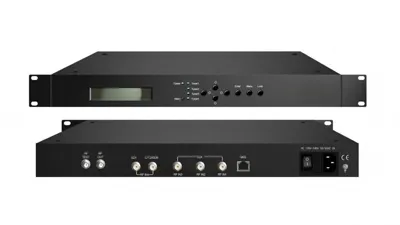
A satellite modulator is the chassis that turns a finished MPEG transport stream into a DVB-S, DVB-S2 or DVB-S2X carrier. It takes the stream on ASI or IP, adds the forward error correction and maps the data onto a QPSK or APSK constellation, then outputs an IF band an upconverter can translate.
It is the last processing stage before the antenna. Symbol rate, roll-off, coding and constellation are all set here, which is why an operator tunes the modulator rather than the dish when a link budget is tight. It is also the one box in the chain whose published figures are rates and ratios instead of carrier counts or port counts.
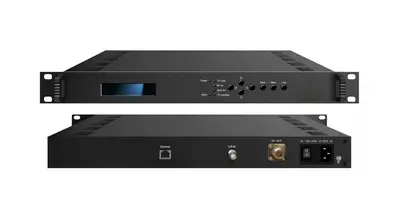
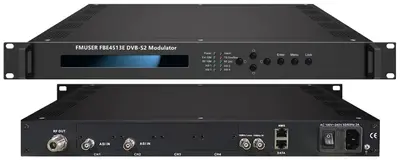
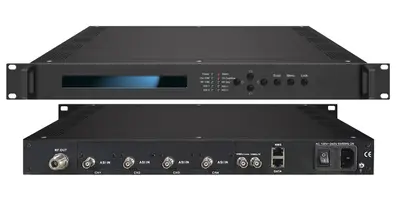
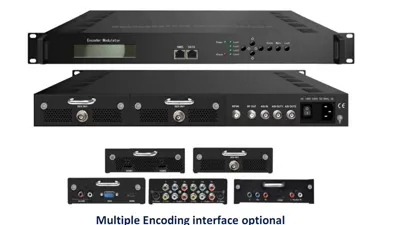
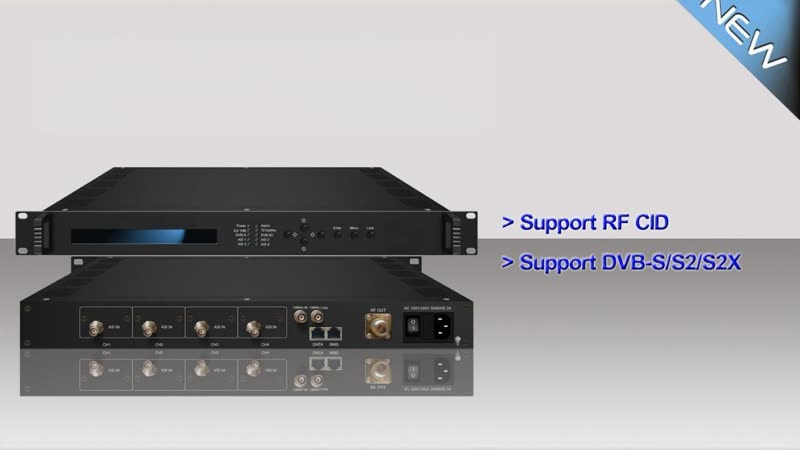
Our catalogue publishes five chassis for that job. The FUQ4512E is the QPSK unit with one ASI input, the FUQ4513A is the DVB-S2 workhorse with one to four ASI ports and an IP input, the FUQ4514 adds DVB-S2X, the FUQ4514G publishes a single IF output for the same job, and the FUQ4515 is a two-way modem rather than a one-way modulator.
Where the Modulator Sits in a Satellite Chain
The modulator is the second half of a headend that faces a satellite: the receive half turns carriers into a line-up, and the transmit half turns the line-up back into a carrier. Between them sit the multiplexer, the scrambler and, where services are sold, the conditional access system.
Read in the direction of travel, the transmit chain is short. A satellite receiver, an encoder or a playout server produces a transport stream; a multiplexer selects the services and rebuilds PSI/SI; a scrambler or the modulator's own BISS stage encrypts what has to be protected; the modulator applies DVB-S, DVB-S2 or DVB-S2X coding and outputs IF; an upconverter and a block upconverter move that IF to the uplink band; the antenna radiates it.
The receive chain that a teleport or a distribution site runs in parallel is the mirror image, and this site covers it in two other guides: the satellite transmodulator guide for sites that re-modulate satellite services onto building coax, and the IRD and decoder guide for sites that tune, descramble and republish them. The multiplexer that feeds the modulator is covered in the transport stream multiplexer guide.
DVB-S, DVB-S2 and DVB-S2X: What Changes Inside the Chassis
The three standards differ in forward error correction, in the constellations they carry and in how much of the transponder the carrier occupies. Each of those differences is visible in the rows our pages publish, which is why the standard is settled before the chassis is chosen.
DVB-S uses Reed-Solomon outer coding with convolutional inner coding and QPSK. DVB-S2 replaces that with BCH and LDPC and adds 8PSK and 16APSK. DVB-S2X keeps BCH and LDPC and adds finer roll-off factors for tighter carriers.
| Standard | Published outer / inner coding | Published constellations | Published roll-off | Published models |
|---|---|---|---|---|
| DVB-S | RS Coding / Convolution | QPSK | Not published on the page | FUQ4512E |
| DVB-S2 | BCH Coding / LDPC Coding | QPSK, 8PSK, 16APSK, 32APSK | 0.2, 0.25, 0.35 | FUQ4513A, FUQ4515 |
| DVB-S2X | BCH Coding / not published on the page | 8APSK, 32APSK, 8PSK, QPSK, 16APSK (published in the symbol-rate row) | 0.05, 0.10, 0.15, 0.2, 0.25, 0.35 | FUQ4514, FUQ4514G |
The practical reading of that table is about spectrum. LDPC in DVB-S2 gives roughly 30 percent more capacity than the convolutional coding of DVB-S at the same carrier quality, and the higher-order APSK constellations buy more bits per symbol at the cost of a higher carrier-to-noise requirement. DVB-S2X extends the same coding chain with roll-offs down to 0.05, which lets a carrier sit closer to its neighbours on a crowded transponder.
The roll-off row is also where two models in the family can be told apart honestly. The FUQ4513A publishes 0.2, 0.25 and 0.35; the FUQ4514 publishes 0.05, 0.10, 0.15, 0.2, 0.25 and 0.35. If the operator's carrier plan was built on a narrow roll-off, that is the row that decides which of the two you buy.
ASI, IP or Both: What Feeds the Modulator
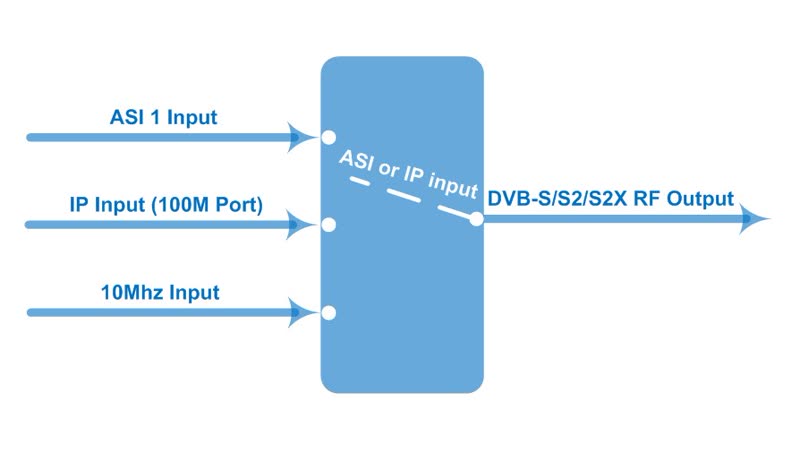
The input side has to match the rack behind the modulator, and the range publishes three different shapes. One model takes a single ASI input, one takes one to four ASI ports plus an IP input, and two take four ASI inputs plus an IP input.
Changing the leg mid-project is one reason the two-input models exist. A playout server or an ASI router feeds the modulator on BNC coax in older installations, while a modern headend built around a multiplexer with IP output feeds it on Ethernet, and the mixed chassis means a stream that already lives on the network needs no converter in front of the modulator.
Our pages publish the input count in the model name and in the description rather than as a separate specification row, so it is worth reading both. The FUQ4514G page, for example, is published as an IF modulator that takes four ASI inputs plus one IP input and converts them to DVB-S, DVB-S2 and DVB-S2X on a single IF output. Where a page carries a full specification table, the number of ports there is the number to quote.
Symbol Rate, Roll-off and Coding: The Rows That Set the Link
A satellite link is designed around the symbol rate the carrier allows and the coding that fits inside it, so the symbol-rate row is the first figure to check on any modulator page. Two models in this range publish it at full length, and both print a lower ceiling for the most demanding constellations than for the simpler ones.
| Model | Published symbol rate | Published roll-off | Published PID handling |
|---|---|---|---|
| FUQ4513A | 0.05~40Msps (32APSK); 0.05~45Msps (16APSK/8PSK/QPSK) | 0.2, 0.25, 0.35 | Maximum PID remapping 128 input per channel |
| FUQ4514 | 0.05~40Msps (8APSK /32APSK) 0.05~45 Msps (8PSK/QPSK/ 16APSK) | 0.05, 0.10, 0.15, 0.2, 0.25, 0.35 | Maximum PID remapping 128 input per channel |
| FUQ4515 | 0.05~40Msps (32APSK); 0.05~45Msps (QPSK/ 8PSK/16APSK) | 0.2, 0.25, 0.35 | Not published on the page |
| FUQ4512E | Not published on the page | Not published on the page | Not published on the page |
Both published tables use the same split, and it is the one to read carefully: the 32APSK carrier stops at 40 Msps while the QPSK, 8PSK and 16APSK carriers run to 45 Msps. On a transponder that is already close to full, that single line decides whether the higher-order modulation is available at all.
Two rows on the same pages are worth quoting for the same reason. The FUQ4513A and the FUQ4514 both publish a maximum PID remapping of 128 input per channel, and the FUQ4513A publishes its multiplexing function as accurate PCR adjusting. Neither number is a marketing figure; both come from the datasheet we publish for that exact model, and both are the sort of value an operator checks when a stream arrives at the modulator already carrying another multiplexer's PID plan.
The IF Output: Frequency, Level and the Chain Behind It
The output of a satellite modulator is an intermediate frequency, not the uplink band itself. The published rows describe a 950 to 2150 MHz block that an upconverter translates upward, which is the same band an LNB produces on the receive side.
That shared band is why one building can distribute receive IF and a modulator's IF through the same kind of splitters and combiners, and why a rack that already handles satellite receive does not need a second set of components when a transmit chain is added beside it.
The FUQ4512E is the model whose output rows are published in full. It prints an RF range of 950~2150 MHz with 10kHz stepping, an output level of -10.0 dBm~-41.5 dBm with 0.5dBm stepping, an MER of at least 26dB, and an N-type connector at 50 ohm impedance. Those four rows are what a link plan needs from the box, and they are the rows to ask for when a page or a quotation arrives without them.
The FUQ4514G publishes the same job in a different package: one IF output carrying DVB-S, DVB-S2 or DVB-S2X. Where a site needs more than one carrier, the usual answer is one chassis plus a combiner rather than a single chassis with several IF ports, because the carriers are combined after translation anyway. Where the site is receiving rather than transmitting, the band is the mirror image of the same number, which is why our receive-side pages print 950-2150MHz on the tuner rows.
BISS Scrambling and Conditional Access at the Modulator
Encryption can sit at the modulator or one box earlier, and the pages in this range show both arrangements. The FUQ4513A, the FUQ4514 and the FUQ4514G are all described on their pages as carrying BISS scrambling for secure distribution, so the transport stream can be protected without a separate scrambler for the common case.
The published row for the scrambling modes is on the FUQ4513A page, which prints Mode 0, mode 1 and mode E. Those are the BISS modes a receiver has to be set to as well, so the mode belongs in the quotation and not in a later email. On the receive side the same standard appears again: the tuner-to-IP gateway we publish for satellite feeds, the FUQ4619C-3, prints BISS descrambling as Mode 1 and Mode E.
Where services are sold rather than shared, BISS is not the right layer at all, and the decision moves to a conditional access system with a subscriber management platform. That comparison is the subject of its own guide, the CAS and SMS headend guide, and it is worth reading before the modulator is specified because the multiplex has to carry the right CA descriptors either way.
The Satellite Modem: Two-Way IP Over Satellite
Not every satellite link carries television, and the same range includes the box for the other case. A satellite modem modulates and demodulates IP traffic over the satellite path in both directions rather than placing a broadcast transport stream on one carrier, which is what a remote site, an enterprise link or an outside-broadcast feed needs.
The published model is the FUQ4515, described on its page as a two-way DVB-S2 satellite modem for IP data transmission that uses TCP acceleration to keep throughput up over a long-delay path. It publishes DVB-S2 with BCH and LDPC coding, QPSK, 8PSK, 16APSK and 32APSK constellations, roll-off factors of 0.2, 0.25 and 0.35, and the same 0.05~40Msps and 0.05~45Msps symbol-rate split as the broadcast modulators.
Its interface is the giveaway that it is a data box rather than a video box: one Ethernet port carries the traffic, and control runs through a web-based NMS with an LCD and keyboard on the chassis. It occupies 482mm×328mm×44mm and runs on AC 100V-220V plus or minus 10 percent at 50 or 60 Hz, so it fits the same 1U slot as the modulators beside it in a rack that has to mix video and data links.
Which output standard that carrier is chosen against is compared in the DVB-C, DVB-T and ATSC modulator guide; at the receiving end the same IF chain is described from the building side in the satellite transmodulator guide and in the SMATV system guide that distributes it to the sockets.
The Receive Side: How the Signal Comes Back Into the Headend
The receiving end of a satellite project is usually specified first, because the tuner count and the descrambling decide the rest of the rack. Three published boxes cover that work in our catalogue, and the rows to compare are the tuner count, the tuner band, the descrambling method and the IP output.
| Model | Published tuners | Published band | Published descrambling | Published output |
|---|---|---|---|---|
| FUQ3902B-2 | 2 RF tuner inputs | 950-2150MHz on DVB-S, DVB-S2 and DVB-S2X | BISS Mode 1, Mode E | IP output over UDP/RTP, 32 IP inputs |
| FUQ4619C-3 | 24 tuners inputs +2 ASI inputs +1 USB inputs | 950~2150MHz on DVB-S and DVB-S2, J.83A(DVB-C), J.83B, J.83C on cable | BISS Mode 1, Mode E | IP streams over UDP/RTP, web based management |
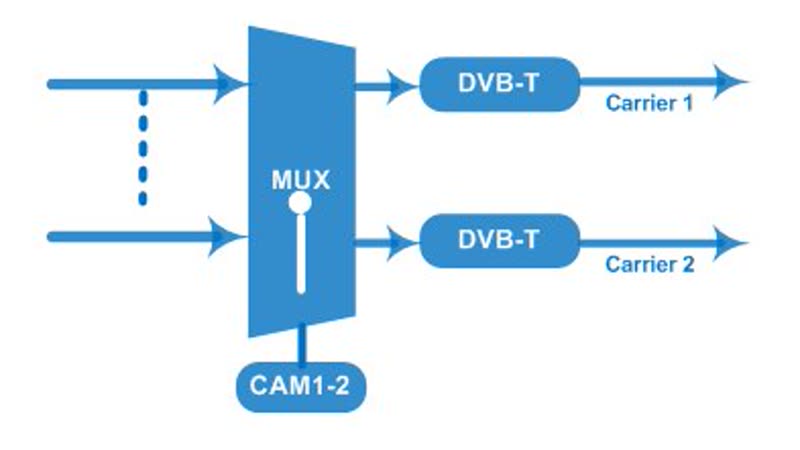
| FUQ41013K | 2 DVB-S/S2/S2X tuners | 950~2150MHz | 2 sets of CAM/CI | Two DVB-T carriers to EN300744 |
The second row is the one to read twice. The FUQ4619C-3 is a tuner-to-IP gateway rather than a demodulator, and the same chassis publishes cable tuning to J.83A, J.83B and J.83C beside its satellite tuners, which means a site with both a dish and a cable feed can be turned into IP by one box instead of two. The third row, the FUQ41013K, is the satellite-to-terrestrial route: two tuners with two CAM slots and two DVB-T carriers on the output, which is the shape a building uses when the receivers are ordinary televisions.
Which Satellite Modulator Should You Ask Us For?
Choosing between the five chassis comes down to four questions in a fixed order: does the link carry video or IP data, which standard does the operator's carrier use, what does the stream arrive on, and how wide a carrier is allocated?
| Model | Published job | Published input | Published standard | Choose it when |
|---|---|---|---|---|
| FUQ4512E | QPSK modulator with RF output | 1 ASI input | DVB-S | The carrier is a legacy DVB-S link and one ASI feed is all the rack produces |
| FUQ4513A | DVB-S2 modulator, RF output | 1 to 4 ASI ports and IP input | DVB-S2 to EN302307 | The operator runs DVB-S2 and the stream arrives on either leg |
| FUQ4514 | DVB-S/S2/S2X modulator, RF output | 4 ASI inputs and 1 IP input | DVB-S2X | The carrier plan uses the 0.05 to 0.15 roll-offs or 8APSK and 32APSK |
| FUQ4514G | DVB-S2X IF modulator, single IF output | 4 ASI inputs and 1 IP input | DVB-S, DVB-S2 and DVB-S2X | The rack wants an IF output to feed an existing upconverter chain |
| FUQ4515 | Two-way DVB-S2 satellite modem | 1 Ethernet port | DVB-S2 | The traffic is IP data rather than a broadcast multiplex |
The upper half of that table is where most television projects land. A DVB-S2 carrier is still the common case for contribution and distribution, and the FUQ4513A covers it with one to four ASI ports plus an IP input, so a site that is moving from an ASI router to a network does not have to choose between them on day one. The FUQ4514 and the FUQ4514G are the same decision one generation forward, and the difference between them is the output package rather than the modulation.
Rack, Power and Environment
Everything in the range is a 1U rack chassis, and the published dimensions and power rows are close enough that the rack plan rarely changes between models. What does change is which rows a given page carries, so a quotation should confirm the row rather than assume it.
| Model | Published dimensions | Published power | Published temperature |
|---|---|---|---|
| FUQ4512E | Not published on the page | Not published on the page | 0~45℃ (operation), -20~80℃ (storage) |
| FUQ4513A | 482mm×410mm ×44mm | 100-240VAC±10 %, 50Hz-60Hz | 0~45℃ (operation), -20~80℃ (storage) |
| FUQ4514 | 482mm×410 mm×44mm | Not published on the page | 0~45℃ (operation), -20~80℃ (storage) |
| FUQ4515 | 482mm×328mm×44mm (W× L× H) | AC 100V-220V±10%, 50/60Hz | 0~45℃ (work), -20~80℃ (storage) |
Three reading notes go with that table. The FUQ4513A and the FUQ4514 publish slightly different dimension strings, so they are quoted here exactly as printed rather than normalised. The FUQ4515 prints its temperature row as work rather than operation, which is the same test with a different label. And the FUQ4512E page publishes a temperature row but no dimension, weight or power row, which is a gap in the page rather than a guarantee about the chassis: ask for the datasheet and we confirm the values for the exact unit.
Every chassis in this range is built and tested in our own factory in Guangzhou, and each unit runs a 72-hour burn-in before it ships. We ship to 200+ countries.
What to Send Us for a Satellite Modulator Quotation
A satellite modulator is quoted against the carrier, not against a wish list. The message that gets a price fastest carries four facts: the standard the operator's carrier uses, the symbol rate and roll-off the operator allows, the input leg and port count, and the output type the rack needs.
Send those four and we return the model confirmation with the datasheet for that exact chassis, the price, the lead time and the shipping options. If the modulator is one stage of a larger uplink or turn-around room, say so in the same message: the multiplexer, the scrambler and the receive-side tuners are quoted together far more cheaply than they are added later, and the chain guides linked above name the boxes that fit each stage.
Two extras are worth mentioning in the same email because they change the quotation. If the stream has to be protected, name the scrambling mode rather than the word BISS, because Mode 0, mode 1 and mode E are different answers on the same chassis. If the site will later add a second carrier, say that too, so the combiner and the rack space are planned now instead of being improvised at commissioning.
Frequently Asked Questions
What is a satellite modulator?
A satellite modulator turns a finished MPEG transport stream into a carrier that a satellite dish can transmit. It takes the stream on ASI or IP, applies forward error correction and maps the data onto a QPSK or APSK constellation, and outputs the result on an IF band that an upconverter moves to the uplink frequency. It is the last processing stage before the antenna.
What is the difference between DVB-S, DVB-S2 and DVB-S2X?
The coding and the constellations. DVB-S uses Reed-Solomon and convolutional coding with QPSK; DVB-S2 replaces that with BCH and LDPC coding and adds 8PSK and 16APSK; DVB-S2X keeps BCH and LDPC and adds roll-off factors down to 0.05 with 8APSK and 32APSK. Our pages print each model's own coding, constellation and roll-off rows, so the standard a carrier needs is the row to compare.
Which model converts ASI or IP to a DVB-S2 carrier?
The FUQ4513A is published as a DVB-S2 modulator taking one to four ASI ports and an IP input to a DVB-S or DVB-S2 RF output, with modulation following EN302307. The FUQ4514 takes four ASI inputs plus one IP input to DVB-S, DVB-S2 and DVB-S2X, and the FUQ4514G publishes the same inputs to a single IF output.
Do I need a satellite modulator or a satellite modem?
The payload decides. A modulator places a broadcast multiplex on a carrier, which is what a teleport, a contribution link or a distribution feed needs. A modem moves IP data both ways over the satellite path, which is what a remote site or an enterprise link needs. The FUQ4514 is a modulator; the FUQ4515 is published as a two-way DVB-S2 satellite modem with one Ethernet port.
What output does a satellite modulator give me?
An IF signal, not the uplink band. The FUQ4512E publishes an RF range of 950~2150 MHz with 10kHz stepping and an output level of -10.0 dBm~-41.5 dBm with 0.5dBm stepping, which is the band an upconverter expects. The FUQ4514G publishes a single IF output for the same purpose. The upconverter, the block upconverter and the antenna are the stages after the modulator.
Do you supply the datasheet and a factory-direct quotation?
Yes. Send the carrier standard, the symbol rate and roll-off the operator allows, the input leg and port count, and the output type you need, and we return the model confirmation with the datasheet for that exact chassis and a quotation. Every unit is built in our Guangzhou factory, runs a 72-hour burn-in before dispatch, and we ship to 200+ countries.
If the modulator is one stage of a larger project, the transport stream multiplexer guide covers the line-up that feeds it, the IRD and decoder guide covers the receive side, and the satellite transmodulator guide covers the building that re-modulates satellite services onto coax. The modulators are listed together on the modulator and modem page, the receive-side boxes on the IP gateway page, and the solutions pages show the chains end to end. Tell us the carrier and the input leg and we will match the chassis and quote it — the fastest route is the contact form, and the FAQ answers the commercial questions first.
Previous
Hotel TV System: Sources, Headend and Distribution
Next
SDI to ASI and QAM: Headend Signal Paths
Talk to the headend engineers before you specify
Send the model number you are looking at — or the channel count and the input and output formats you work with — and we answer with the datasheet, the configuration and a written price. The reply comes from the headend team in Guangzhou, not a sales line.