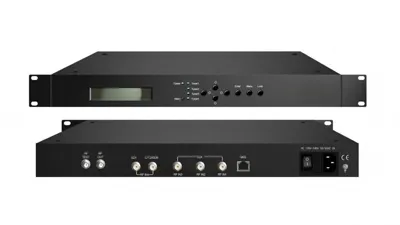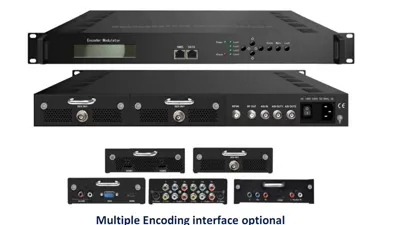
Transport Stream Multiplexer Guide for Headends
How a transport stream multiplexer combines IP, ASI or tuner inputs into one MPTS or SPTS output — PID budgets, PSI/SI tables and published specs. Each model named in this article is one of 190 in the Hanxing catalogue, published with its own specifications and datasheet.
Hanxing Team
Broadcast & IPTV Experts
The path this guide walks
- Sourcesencoders, gateways or tuners
- Input sideIP, ASI or RF tuners
- Transport stream multiplexerprogram select, PID remap, PSI/SI rebuilt
- Multiplexer scrambler (optional)DVB conditional access on the output
- Modulator, transmitter or IP legRF carrier or UDP / RTP multicast
- ScreensSTB, smart TV or existing TVs
The multiplexer settles the line-up; everything downstream can only carry what it was configured to send.
A digital TV headend is a chain of stages, and the multiplexer is the stage where separate services become one broadcast stream. It is also the stage most often bought on guesswork, because what is being chosen — a bit-rate budget, a PID plan and a table set — is invisible in a product photograph.
Every figure in this guide is printed on the product page of the model it belongs to. Where a model does not publish a value, this article says so and sends you to its datasheet rather than estimating the number, because a multiplexer is bought on input counts, PID budgets and scrambling standards, and a guessed figure fails at commissioning.
What Is a Transport Stream Multiplexer?
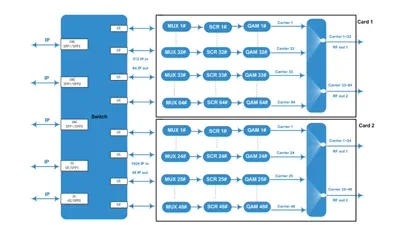
A transport stream multiplexer combines several MPEG transport streams into one output stream, remapping PIDs and rebuilding the PSI/SI tables so that every receiver can find each service. It works on streams that are already encoded: the multiplexer re-packages and re-times programs, it does not encode or re-encode video.
The unit of work is the 188-byte transport packet defined by MPEG-2 systems, ISO/IEC 13818-1, the same packet that DVB links carry in the 204-byte form with Reed-Solomon forward error correction appended. A multiplexer reads those packets from each input, keeps the ones the operator asked for, writes a new PID where the plan requires it, and interleaves the result at a constant output rate so that whatever follows it — a modulator, a transmitter or an IP distribution layer — receives a stable stream.
Four jobs happen inside the chassis on every stream that passes through it:
- Program selection — services are cherry-picked out of a larger multiplex and grouped into the new line-up.
- PID remapping — a service that arrived on one PID is renumbered, which is what stops two inputs colliding on the same PID.
- Table rebuilding — the PAT, the PMT and the DVB service information tables are regenerated so a receiver can see the new line-up.
- Re-timing and rate control — PCR is corrected and the output is padded to a constant bit rate.
Where the box sits in the chain is fixed, and it is worth writing down because the stages around it are routinely confused with it.
| Stage | What arrives | What leaves | Published example |
|---|---|---|---|
| Encoder | HDMI or SDI video | one single-program stream per input | FUQ4339KN, 48 HDMI inputs |
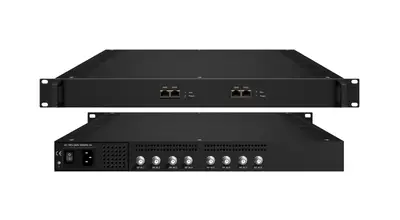
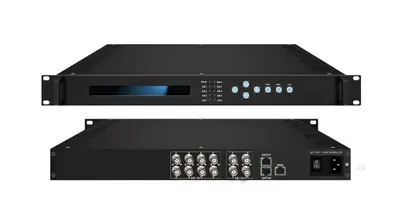
| Multiplexer | several streams over IP, ASI, or from tuners | one multi-program stream with rebuilt tables | FUQ4218B, 8 ASI and 512 IP inputs |
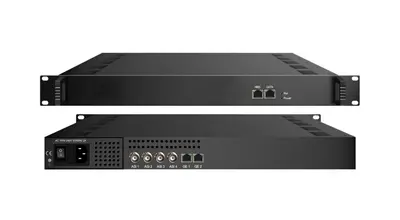
| Scrambler | a multi-program stream | the same stream with conditional access applied | FUQ3514, scramble standard ETR289, ETSI 101 197, ETSI 103 197 |
| Modulator | a multi-program stream | an RF carrier | FUQ44105R, DVB-T modulator |
| Gateway | an RF carrier | transport streams over IP | FUQ4619C, 24 RF tuner inputs |
A multiplexer is not a modulator, and it is not a gateway. It never produces an RF carrier of its own, and it never demodulates one; it takes streams that are already digital and already compressed, and settles what the line-up will be. That is why the PID plan and the table set are decided at this box rather than further down the chain, and why the modulator that follows it can only carry what the multiplexer was configured to send.
IP, ASI or Tuner Inputs: Which Multiplexer Do You Need?
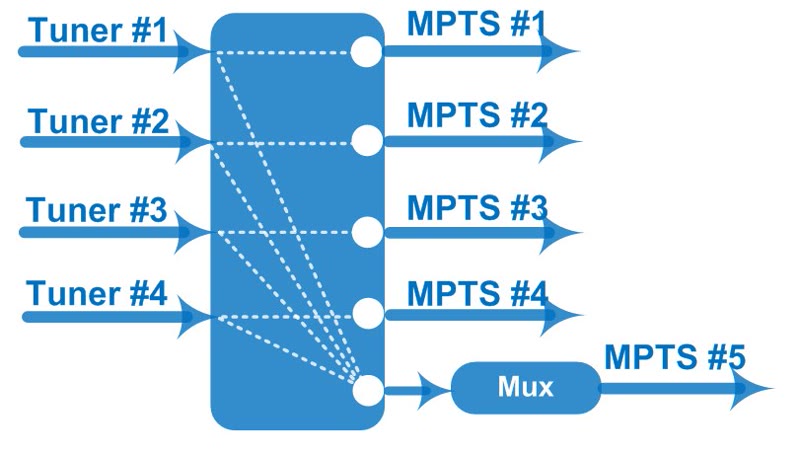
The input side decides the model, and it is the first question a datasheet answers. A site that has moved to IP needs IP inputs; a site still running an ASI rack needs ASI inputs; and a headend that has to receive carriers in the same chassis as the IP line-up needs tuner inputs.
Our multiplexer and scrambler range publishes 15 models across those three input types, and the table below lists a published row for each.
| Input side | Published model and rows |
|---|---|
| IP, 512 inputs | FUQ4214: 2 x IP ports (unicast/multicast), UDP protocol (up to 230Mbps) |
| IP, 768 inputs | FUQ3504: 4 ASI inputs and outputs, 768 UDP/RTP IP inputs, 4 MPTS outputs |
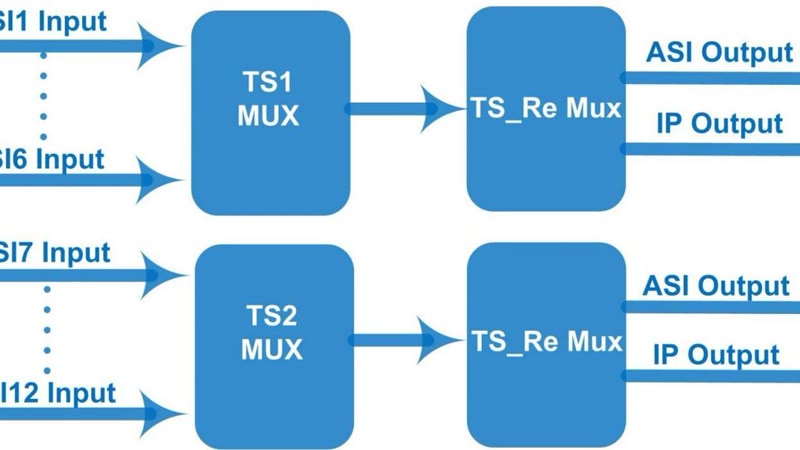
| ASI, 12 inputs | FUQ4213J-2: 12 ASI inputs, 2 ASI outputs and 2 gigabit IP ports |
| ASI, 12 inputs, ISDB-T | FUQ4216B: dual-channel ISDB-T multiplexer, 12 ASI inputs, 2 IP UDP outputs |
| ASI and IP in one chassis | FUQ4823C-2: 8 ASI inputs and 64 IP inputs over UDP |
| Tuners | FUQ4218K: 16 tuner inputs plus 2 ASI inputs |
| Tuners, satellite | FUQ4823C: 4 tuner inputs, DVB-S2X QPSK/8PSK/16APSK 0.5~45 Msps |
| Multiplexing and modulation in one chassis | FUQ4455A: 128 IP and 2 ASI inputs, up to 48 DVB-C, 32 DVB-T and 28 ISDB-T carriers |
Three models in this range publish a description but no specification rows at all — FUQ4213J, FUQ4216B and FUQ4216B-2. Their own pages still describe the chassis, and FUQ4213J is described as a 1U unit holding up to 3 independent cards, each card taking 512 SPTS or MPTS inputs and driving 512 SPTS outputs with CA filtering and PSI/SI editing. For the rows those pages do not print, ask us for the datasheet of that exact model rather than scaling a figure from a neighbour in the same family.
Two input-side details are worth confirming before the order, because both are cheap to check and expensive to discover late. The first is the packet format: the FUQ3504 publishes 204/188 self-adaption on the input and a settable 204/188 on the output, which is the row that decides whether an existing ASI chain can be dropped into it unchanged. The second is the transport protocol: the FUQ4455A publishes TS over UDP/RTP with unicast and multicast and IGMP V2/V3, which is what a building network needs before a multicast line-up will behave.
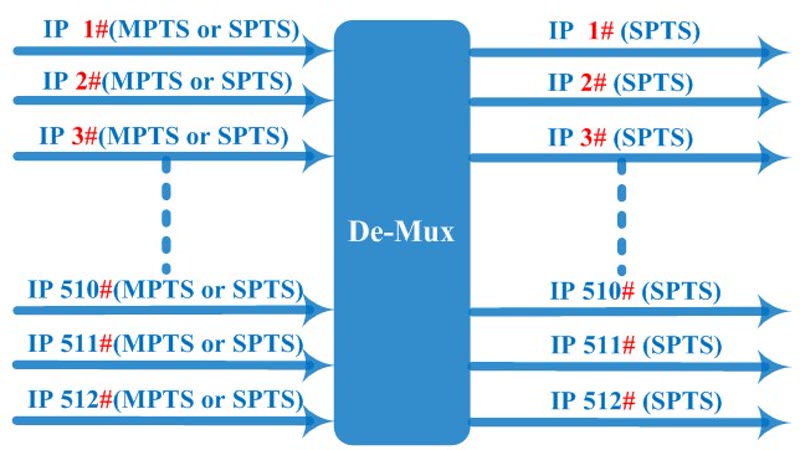
How Many Programs and PIDs Can One Multiplexer Carry?
The ceiling that decides a line-up is the PID budget, not the channel count. Every service spends PIDs on its video, on one or more audio tracks, on subtitles and on data, and the shared tables spend more again, so the published output PID count of the model is the figure the design is checked against.
| Published row | Value | Model |
|---|---|---|
| Amount of output PID | 512 | FUQ4823C-2 and FUQ4823D |
| Max PIDs | 512 per channel | FUQ3514 |
| Max PIDs | 256 per channel | FUQ4455A |
| Max PID numbers | 748 PID numbers for GE1 | FUQ3504 |
| Output range | 0x0000 to 0x1FFF | FUQ4823C-2 |
| PID transparent | Any PID transparent and mapping achievable | FUQ3514 |
| Functions | PID re-mapping | FUQ3504 |
The budget is worked out in the same order every time. List the services, add the audio tracks, subtitles and data each one carries, add the table overhead, and compare the total with the output PID count published for the model in question. Where a page publishes a maximum PID figure per channel rather than per chassis — as the FUQ3514 and FUQ4455A do — the check is per output stream, so a four-output model is checked four times and not once.
We publish no programs-per-multiplexer figure, because that number depends entirely on the bit-rate of the services involved: a line-up of low-rate standard-definition channels and a line-up of high-rate HD channels can differ by a factor of five in the same PID budget. Send the channel plan with the bit-rate of each service and we will work the count out from the actual multiplexes rather than from an average.
MPTS or SPTS: What Has to Come Out of the Multiplexer?
The output side is a client-device decision rather than a headend one. MPTS carries a group of services in a single stream and is what a modulator, a transmitter or a second headend expects to receive; SPTS gives every service its own stream and is what a set-top box or a hotel gateway joins.
Most of this range publishes MPTS output, and the models that publish an ASI and an IP output in parallel are the ones that suit an upgrade where both legs stay in service.
| Output question | What the published rows say |
|---|---|
| ASI output groups | FUQ4218B and FUQ4823D: 2 groups separate outputs (each group has 2 channels) |
| IP output | FUQ4218B: MPTS over UDP, RTP/RTSP output (RJ45), 1000Mbps Ethernet, DATA 1 and DATA 2 |
| IP output rate | FUQ4214: 2 x IP ports, UDP protocol (up to 230Mbps) |
| Output TS mode | FUQ3504: bytes/packets |
| Ethernet ports | FUQ4823C-2: 10/100M/1000M self adaption |
| TS bit-rate on ASI | FUQ4214: 2 x independent channels of ASI output (each channel has 2 ports) (up to 210Mbps) |
A model that publishes both legs — the FUQ4218B with 8 ASI and 512 IP inputs and 4 ASI and IP outputs, or the FUQ4823C-2 and FUQ4823D with 8 ASI and 64 IP inputs — lets the old ASI chain and the new IP chain run from one line-up during a migration, which removes the weekend cut-over that headend upgrades usually carry. Where the IP leg feeds set-top boxes rather than a modulator, the platform section of the site covers what happens to the stream next on the IP gateway side, and the DVB to IP gateway guide walks through the direction of conversion in detail.
Do You Need a Multiplexer with Scrambling Built In?
Scrambling and multiplexing are two jobs that are often sold in the same chassis, and the difference decides whether a conditional access system is needed as a separate purchase. A multiplexer-scrambler applies the DVB conditional access layer to the services in the multiplex and edits the CA descriptors; entitlements, smart cards and billing sit in a system above it.
| Model | Published scrambling row |
|---|---|
| FUQ3514 | Scramble Standard: ETR289, ETSI 101 197, ETSI 103 197 |
| FUQ4823D | Scrambling standard: ETR289, ETSI 101 197, ETSI 103 197 |
| FUQ4823C-2 | Output range 0x0000 to 0x1FFF, amount of output PID 512, connection local/remote |
ETR289, ETSI 101 197 and ETSI 103 197 are the DVB conditional-access and SimulCrypt standards, so a chassis that publishes them is built to sit in front of a commercial CA system rather than beside it. What such a system still needs — the CAS server, the subscriber management platform, the smart cards and the entitlement messages — is described in our conditional access and SMS guide, and the multiplexer is only the point in the chain where the scrambled descriptors are written.
Where the site has no commercial CA requirement but still needs protection on a contribution feed, that is a different layer again: BISS descrambling appears on the gateway side of the headend rather than the multiplexer side, as the gateway guide sets out.
What Goes Wrong in a Transport Stream Multiplex?
Most multiplex faults are not video faults at all. They are timing and table faults, and they reach the screen as pixelation, as a frozen picture, or as a channel that exists in the design document and nowhere on the receiver. The four classes below cover most of the calls an integrator brings to us.
- Continuity-count errors — a packet was lost between input and output, so the counter in the transport packet header no longer runs in sequence. On screen this reads as block artefacts or a short freeze.
- PCR jitter — the program clock reference was re-stamped badly or not at all, so the receiver's decoder cannot lock its time base to the encoder's. Symptoms grow worse as the chain gets longer.
- Output rate overflow — the line-up asks for more than the carrier or the output interface can carry. The stream leaves anyway, and everything downstream degrades at once.
- Table conflicts — two inputs arrive carrying the same PID, or a table set is only partly rebuilt, so the receiver sees a service list that does not match what is actually in the multiplex.
The pattern to work to is to measure at the output of the multiplexer first, before the network or the modulator is blamed, because a fault attributed to the wrong stage costs a return visit. The FUQXB transport stream analyzer covers 1x ASI and 1x RF (DVB-C) input with real-time TS analysis at 160Mbps, handles 188/204-byte packets automatically and supports offline capture up to 120Mbps, which covers the stream check and the carrier check beside it.
For a line-up that is carrying but still unwatchable, the causes tend to move off the headend and onto the network. The room-level sequence for testing a headend in signal order — rack, cable, configuration, stream, carrier, client — is in the headend installation checklist.
What Should You Send Us to Quote a Transport Stream Multiplexer?
Every unit is built in our own factory in Guangzhou, which has produced broadcast and headend equipment since 1994 on a 15,893 square metre site, and each unit is burned in for 72 hours before packing. Units ship to more than 200 countries, so a multiplexer is priced as a configuration rather than as a box.
An enquiry is answered fastest when it arrives as a site description instead of a model number. The list we work through is short.
- Sources: how the streams arrive today — IP, ASI, or RF from tuners — and how many of each.
- Line-up: the services to be carried, with the bit-rate of each one, and the spare capacity wanted for later additions.
- Output: MPTS or SPTS, the number of output streams, and the rate the carrier or the interface allows.
- Scrambling: whether the multiplex has to leave the headend protected, and which CA system it will sit in front of.
- Site: rack space and power, since the units in this range that publish a physical row are 1U rack-mount chassis, and their published consumption runs from under 25W to 40W.
With those details we return the model list with a datasheet for each exact model, the rack layout the units were designed for, and a written factory-direct price. The FAQ answers the commercial questions, the solutions page shows the vertical layouts these units are specified into, and the contact page starts the enquiry. For the boxes either side of the multiplexer, read the headend equipment guide.
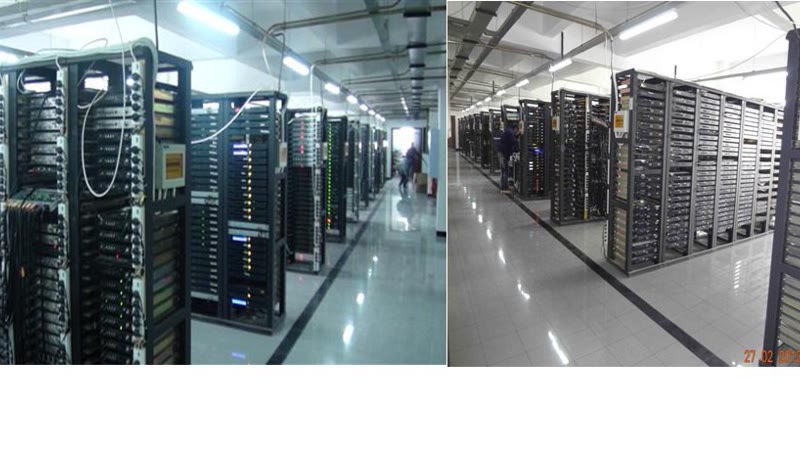
Where this stage sits in the rack: the headend core guide follows the same stream from the receiver, through the multiplexer covered here, to the CAS and SMS that protect it.
Frequently Asked Questions
What is a transport stream multiplexer?
It combines several MPEG transport streams into one output stream, remapping PIDs and rebuilding the PSI/SI tables so that receivers can find every service in the new line-up. It operates on streams that are already encoded, so it re-packages and re-times programs instead of encoding or re-encoding video. In a digital headend it sits between the encoders or gateways and the modulator, transmitter or IP distribution layer.
What is the difference between a multiplexer, a modulator and a gateway?
The stage of the chain each one owns. A multiplexer takes several digital streams and settles what the line-up will be; a modulator turns that line-up into an RF carrier; a gateway does the opposite of both by demodulating a carrier and republishing the services as transport streams over IP. Our pages publish an example of each: the FUQ4218B re-multiplexer with 8 ASI and 512 IP inputs, the FUQ44105B DVB-T modulator, and the FUQ4619C gateway with 24 RF tuner inputs.
Should I choose an IP, ASI or tuner input multiplexer?
Match the input side to the sources the site already has, because that is what the model is built around. A site that has moved to IP needs IP inputs, one that still runs an ASI chain needs ASI inputs, and a site that must receive satellite or terrestrial carriers inside the headend needs tuner inputs. The range publishes all three: the FUQ4214 with 512 IP inputs, the FUQ4823C-2 with 8 ASI and 64 IP inputs, and the FUQ4218K with 16 tuner inputs plus 2 ASI inputs.
How many programs can one multiplexer carry?
The limit to check first is the published output PID count, because every service spends PIDs on its video, its audio tracks, its subtitles and its data, and the shared tables spend more. The figures our pages publish are 512 output PIDs on the FUQ4823C-2 and FUQ4823D, 512 PIDs per channel on the FUQ3514, 256 PIDs per channel on the FUQ4455A and 748 PID numbers for GE1 on the FUQ3504. Service counts depend on the bit-rate of the streams, so we work them out from your carrier plan rather than from an average.
Does a multiplexer need to be a scrambler as well?
Only when the multiplex has to leave the headend protected. Several models in this range combine both jobs in one 1U chassis and publish the DVB conditional-access standards: the FUQ3514 and the FUQ4823D print ETR289, ETSI 101 197 and ETSI 103 197, and the FUQ4823C-2 publishes PID transparency across the output range 0x0000 to 0x1FFF. The entitlement, smart-card and billing layer above them is a separate system, described in our conditional access and SMS guide.
What causes pixelation or a channel that will not appear after multiplexing?
Four classes of fault cover most cases: continuity-count errors from a dropped packet, PCR jitter from a stream that was re-stamped badly, output rate overflow when the line-up exceeds the carrier rate, and table conflicts when two inputs arrive carrying the same PID. Measure at the multiplexer output before blaming the network, using a transport stream analyzer, and check the PAT and PMT of the actual output stream rather than the input plan on paper.
What do you need from me to quote a transport stream multiplexer?
The sources and their counts, the way they arrive (IP, ASI or tuners), the services to be carried, the output mode wanted (MPTS or SPTS) and the output rate the carrier allows, whether the multiplex has to be scrambled, and the rack space and power available. With those details we return the model list, the datasheet for each exact model and a factory-direct quotation. Where a page does not publish a row your design depends on, ask for the datasheet instead of assuming a value.
Previous
Professional IRD and Decoder Guide for Headends
Next
DVB to IP Gateway Guide: Tuner, ASI and SPTS/MPTS
Talk to the headend engineers before you specify
Send the model number you are looking at — or the channel count and the input and output formats you work with — and we answer with the datasheet, the configuration and a written price. The reply comes from the headend team in Guangzhou, not a sales line.