Professional IRD and Decoder Guide for Headends
How a professional IRD receives, descrambles and republishes channels, plus the receiver, decoder and transcoder models and the specs their pages publish. Each model named in this article is one of 190 in the Hanxing catalogue, published with its own specifications and datasheet.
Hanxing Team
Broadcast & IPTV Experts
The path this guide walks
- Feedssatellite, cable or terrestrial carriers
- IRD / receivertune, select services, optional descramble
- Decode or repackbaseband video, or a transport stream over IP / ASI
- Headend rackmultiplexer, modulator or encoder
- DistributionIP multicast or an RF carrier
- ScreensSTB, smart TV or existing TVs
The IRD is the front door: what the rest of the rack can carry is decided by what comes out of it.
A digital headend has a front door, and for most sites that door is an IRD. Satellite, cable and terrestrial carriers arrive already encoded and already carrying several services, and something has to receive them, take out the services the site wants and hand them on in a form the rest of the rack can use.
This guide covers the receive and decode stage: integrated receiver decoders, stream decoders and transcoders. Every figure quoted below is printed on the product page of the model it belongs to. Where a page in the range does not publish a value, this article says so and sends you to the datasheet rather than estimating the number, because an IRD is bought on tuner standard, descrambling method and output format, and a guessed figure fails at commissioning.
What Is an IRD Decoder?
An IRD decoder is an integrated receiver decoder: one chassis that tunes a digital television carrier, demultiplexes the services a site wants, optionally descrambles them and then either republishes them as transport streams over IP or ASI or decodes them to SDI, HDMI or CVBS. Tuning, demultiplexing and decoding sit in one unit.
Two behaviours live under that one name, and the difference decides which model a site needs.
The first keeps the video compressed. The unit tunes the carrier, filters the services out of the multiplex, optionally descrambles them, and republishes them as transport streams over IP or ASI. Nothing is decoded, so nothing is lost and nothing has to be re-encoded — this is turnaround work, where a satellite or terrestrial feed is received at the headend and sent on to the rest of the plant unchanged.
The second decodes to baseband. The output is SDI, HDMI or composite video, which is what a local monitor, a contribution link or an encoder wants as its input. A decoder in this range can also be fed from IP rather than from a tuner, which is the case when the site already distributes streams and simply needs them back in baseband.
Either way the box sits at the front of the chain. It follows the dish, the aerial or the cable drop, and it precedes the multiplexer, the modulator or the encoder in the rack.
IRD vs Set-Top Box: Which One Belongs in the Headend?
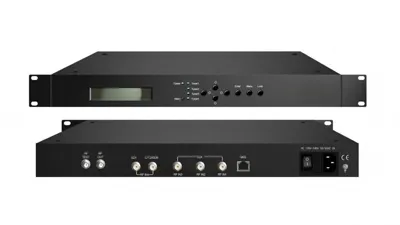
A set-top box is a consumer IRD built for one screen. A professional IRD is built to hand channels to the rest of a rack: transport streams out over IP or ASI, baseband out over SDI, descrambling inside the chassis, and a rack-mount case that a facilities team can service.
| Requirement | Consumer set-top box | Professional IRD |
|---|---|---|
| Output to the plant | typically HDMI to one display | transport streams over IP or ASI, baseband SDI, HDMI or CVBS |
| Descrambling | card paired to one subscription | common-interface slot for a CAM, plus BISS on published models |
| Rack and service access | shelf or wall mount | 1RU chassis between 44 mm and 45 mm high, front-panel service |
| Chosen by | the resident | the headend design: tuner standard, carrier count, output format |
If the site's question is how rooms are served once the channels are in the rack — set-top boxes, Smart TV apps or both — that decision belongs to the set-top box versus Smart TV app guide, not to the receive stage.
IRD, Decoder or Transcoder: Which One Does Your Headend Need?
The three names describe three operations on the same stream: receive it, decode it, or re-encode it. An IRD receives and can decode; a decoder only decodes what it is given over IP or ASI; a transcoder decodes in order to re-encode into a different codec or bit-rate.
| Job | What arrives | What it does |
|---|---|---|
| IRD (integrated receiver decoder) | a DVB-S/S2/S2X, DVB-C or DVB-T carrier | tunes, demultiplexes, optionally descrambles, optionally decodes |
| Receiver / stream receiver | one or more carriers | tunes and republishes the services without decoding |
| Decoder | a transport stream over IP or ASI | decodes to baseband |
| Transcoder | an encoded transport stream | decodes and re-encodes into another codec or bit-rate |
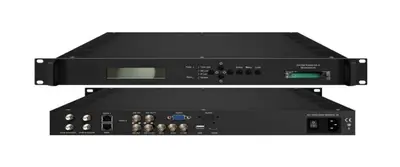
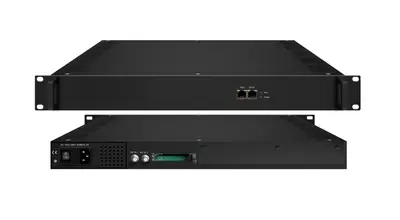
The published models map onto those four rows. The FUQ41086D is an IRD with 8 tuner inputs and DVB-S, DVB-S2 and DVB-S2X tuning; the FUQ3902B is a receiver with 2 tuner inputs and 32 IP stream outputs over UDP/RTP; the FUQ4825B is a decoder with 8 IP inputs to 4 HDMI outputs; and the FUQ4359 is a transcoder for MPEG-2 to H.264 conversion.
A gateway is the fourth relation and the one most often confused with these three. A DVB to IP gateway also tunes and republishes, and it is the right box when a carrier has to become multicast streams for an IP network — the DVB to IP gateway guide follows that path through the chain. An IRD adds descrambling and optional decoding on top, which is what a site needs when the feeds are encrypted or when baseband output is required.
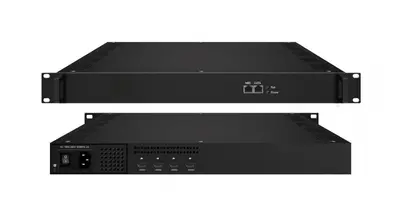
Where the job is conversion rather than reception, the published transcoding rows are precise: the FUQ4359 and FUQ4359B publish 4*MPEG2 HD → 4*MPEG2/H.264 HD, 4*MPEG2 HD → 4*MPEG2/H.264 SD and 8 *MPEG2 SD → 8 *MPEG2/H.264 SD, the FUQ4354 converts AVS+ to MPEG2/H.264, and rate control is published as CBR/VBR.
Which Inputs Does a Headend IRD Have to Read?
The input side is decided by what the site already receives, not by preference: satellite needs DVB-S/S2/S2X tuners, cable plants need DVB-C, terrestrial feeds need DVB-T, DVB-T2 or ISDB-T, and a headend that has already moved to IP can take streams directly. The tuner count then follows the number of carriers the site has to receive.
| Model | Published input side | Published tuner and demodulator rows |
|---|---|---|
| FUQ41086D | 8 tuner inputs, DVB-S/S2/S2X | DVB-S 950-2150MHz; DVB-S2X QPSK/8PSK/ 16APSK: 0.5~45 Msps; 8APSK/32APSK: 0.5~40 Msps |
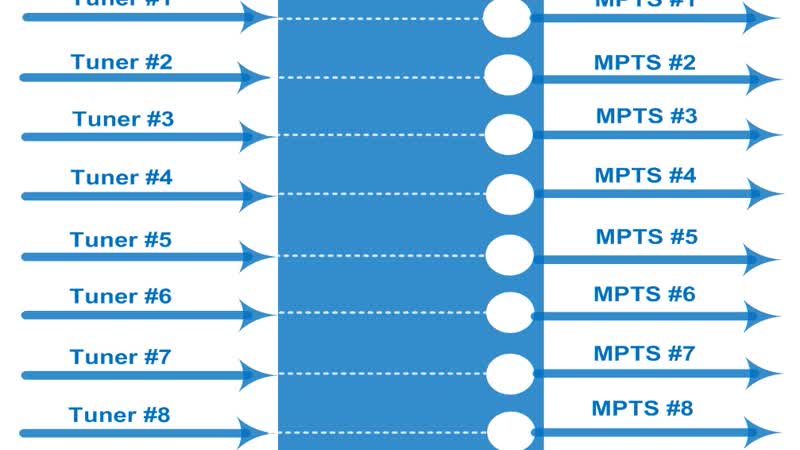
| FUQ3908 | 8 DVB-S-S2-S2X Tuner Input Receiver, 8 MPTS | DVB-S 950-2150MHz |
| FUQ4696 CI Receiver 8 Tuner Inputs | 8 tuner inputs, CI | multi-mode tuners switchable 60 ~890 MHz; QPSK/8PSK/ 16APSK: 0.5~45 Msps |
| FUQ4696-2 CI Receiver 2-4 Tuner Inputs | 2-4 tuner inputs, DVB-C-T-ISDB-T | multi-mode tuners switchable 60 ~890 MHz |
| FUQ4109Y | multi-source input | DVB-C J.83A(DVB-C), J.83B, J.83C; DVB-S and DVB-S2 950-2150MHz |
| FUQ3904C | receiver card, 4 tuner inputs, 5 MPTS output | DVB-S 950-2150MHz; signal strength -65 ~ -25dBm |
| FUQ3902B | 2 tuner inputs, 32 IP stream outputs over UDP/RTP | DVB-S 950-2150MHz; DVB-S2 950-2150MHz; DVB-S2X 950-2150MHz |
Two models in the line publish no usable specification table. The FUQ467B series SD IRD is described as a dual RF, ASI and IP input receiver, but its page prints no specification rows at all; the FUQ41015 quad decoder publishes only its power requirement. For both, ask for the datasheet — input and output counts are exactly what a design depends on. The full line, all 21 models with their published rows and datasheets, sits on the IRD, decoder and transcoder page.
The line also carries an audio-only receiver. The FUQ4349S takes 8 FM inputs across 76-108 MHz and compresses them to MPEG1 Layer 2, which is what a site needs when it re-broadcasts radio services rather than television.
How Does an IRD Descramble CI, CAM and BISS Channels?
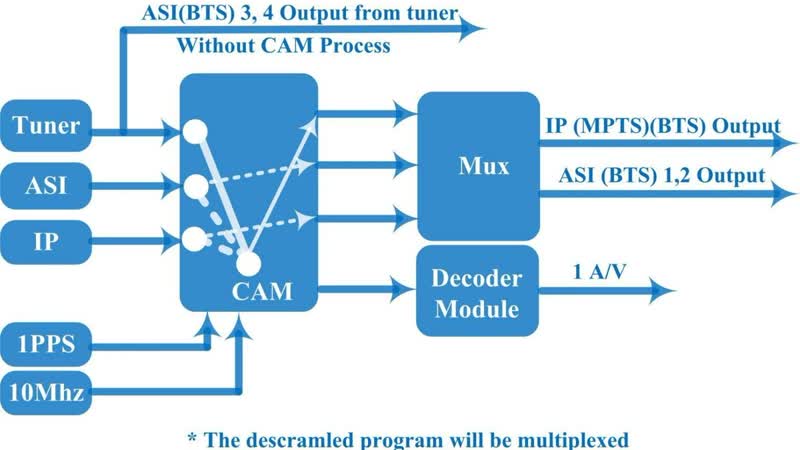
Encrypted feeds have to be descrambled at the receive stage, and there are two ways: BISS, used for contribution and satellite links, and a common-interface slot for conditional-access systems that hand a CAM to the receiver. Both are published per model, and the pair a site needs follows from the encryption its feeds use.
The models published as CI receivers carry the common-interface slot, and the range publishes two tuner counts: the FUQ4696 CI receiver with 8 tuner inputs and the FUQ4696-2 CI receiver with 2-4 tuner inputs, both printing their multi-mode tuner range as 60 ~890 MHz. In the transcoder group, the FUQ4359B publishes a 4* ASI or Tuner Input row and a CAM/CI row, which means the same chassis can receive, descramble and convert.
BISS is published on the receiver side. The FUQ3902B-2 prints its BISS Mode as Mode 1, Mode E; up to 120Mbps, alongside 256 PIDs per input channel of PID remapping, accurate PCR adjusting and automatic PSI/SI table generation.
Above the receive stage sits the entitlement layer: subscriber management, smart cards and billing, which decide who is allowed to watch what. That is a separate system from the receiver, and the conditional access and SMS guide covers it. Where a model page does not publish a CA standard, this article does not invent one — ask for the datasheet.
What Outputs Can an IRD Publish: SDI, HDMI, CVBS, IP or ASI?
The output side decides whether the unit feeds an encoder, a monitor, a contribution link or the headend network. A unit that keeps the stream compressed publishes transport streams over IP; one that decodes publishes baseband. The published output rows are the ones to compare: port count and format are what the rack behind it has to accept.
| Output wanted | Model | Published output row |
|---|---|---|
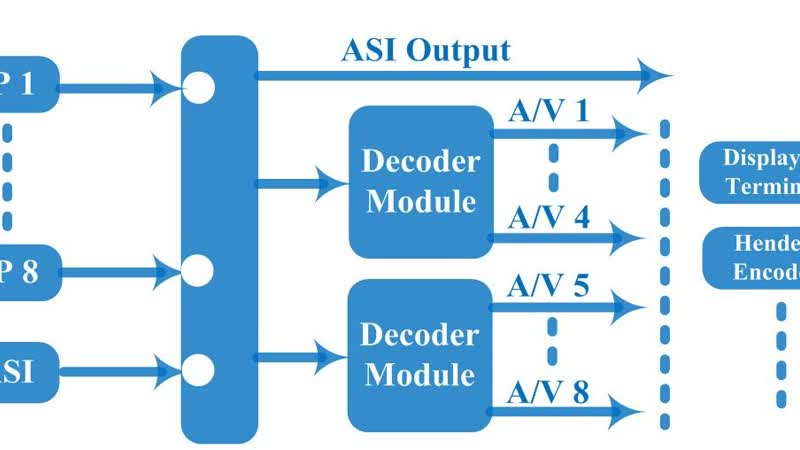
| 2 SDI outputs | FUQ3702 | HD decoder, 2 IP and 2 ASI inputs, 2 SDI outputs; video format MPEG-2, MPEG4 AVC/H.264 |
| 4 HDMI outputs | FUQ4825B | IP decoder, 8 IP inputs to 4 HDMI outputs; 4* HDMI interface; input max bitrate 900Mbps |
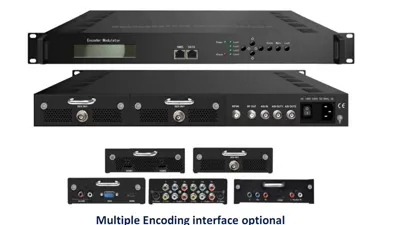
| 8 CVBS outputs | FUQ4019J | 8 IP and 1 ASI input to 8 CVBS outputs; input IP protocol UDP and RTP; video format MPEG-2/H.264/AVS+ |
| 8 CVBS outputs | FUQ41019J | 8 IP and 1 ASI input to 8 CVBS outputs; video resolution 576i@25fps, 480i@29.97fps |
| Transport stream over IP | FUQ3902B | 2 tuner inputs, 32 IP stream outputs over UDP/RTP; maximum PID remapping 256 PIDs per input channel |
| Stereo or two mono audio | FUQ4354 | audio output 1*Stereo /2*mono, HDMI/SDI; audio sampling 48kHz |
The same decoder function is published in an IP-only variant: the FUQ3702-2 HD IP decoder takes dual IP inputs, video format MPEG-2 and MPEG4 AVC/H.264, and the same 2 SDI output stage. Audio formats on the decode side are published as MPEG 1 Layer2, LC-AAC and HE-AAC on the FUQ4825B, with one stereo audio embedded in each HDMI port.
What happens to the stream after the receiver is covered in the transport stream multiplexer guide and the conditional access and SMS guide, and the whole middle of the rack in the headend core guide.
How Is an IRD Installed and Commissioned?
Commissioning a receiver is five checks, in this order: lock every carrier, bring the descrambling up, remap the PIDs into the output streams, verify what each port publishes, and record the carrier plan. Skipping the last step is how a rack becomes unserviceable a year later.
- Lock the carriers. Each tuner is pointed at one transponder or multiplex and its level read. Satellite tuners on this range are published for 950-2150MHz; the FUQ4696 and FUQ4696-2 print a switchable 60 ~890 MHz range for cable and terrestrial work, and the FUQ3904C publishes signal strength -65 ~ -25dBm as the window to land inside.
- Bring descrambling up. CAMs go into the common-interface slots and the entitlements are confirmed against the head-end system before anything downstream is touched; BISS keys are entered on the models that publish BISS, such as the FUQ3902B-2 at up to 120Mbps.
- Remap the PIDs. Filter out the services the site does not carry and label what stays. Published limits are the ceiling: 256 PIDs per input channel on the FUQ3902B and FUQ3902B-2.
- Verify every output. Read back what each port actually publishes — 32 IP stream outputs over UDP/RTP on the FUQ3902B, 8 MPTS on the FUQ3908, 4 HDMI or 8 CVBS on the decoder models — and check it against the wiring schedule rather than the order form.
- Record the plan. Carrier, tuner, service list, output addresses and each chassis serial, kept with the rack.
Which Rack, Power and Load Rows Decide the Model?
Once the function is chosen, the physical rows decide whether the unit fits the rack: chassis size, weight, supply voltage and power draw. These are the entries a facilities team asks for first, and they are published unevenly across this range, so they are worth collecting model by model rather than assuming one size for the line.
| Model | Published dimensions | Published weight | Published power |
|---|---|---|---|
| FUQ4359 | not published | 4.8 Kg | 20W |
| FUQ4359B | 430mm×405mm×45mm | 4.8 Kg | 20W |
| FUQ4354 | 430mm×405mm×45mm | 4.8 Kg | AC 200V-240V, 50/60Hz, 2A |
| FUQ3904C | 482mm×328mm×44mm | 3.5kg | ≤40W |
| FUQ3902B-2 | 482mm×328mm×44mm | not published | not published |
| FUQ4825B and FUQ3702 | 328mm×482mm×45mm | not published | <25W |
| FUQ41015 | not published | not published | AC 90~220V, 50/60Hz, 25W |
Every published chassis height above sits between 44 mm and 45 mm, one rack unit, so the receive group can be planned as a single rack level per unit. Where a weight or a power row reads not published, the model page does not carry it and the datasheet is the place to ask for it.
None of these pages publishes a dual redundant power supply row, so a site that needs hot-swap redundancy on the receive stage should raise it at the quotation stage instead of assuming it is standard. Each unit is built and tested in our Guangzhou factory, and every chassis is given a 72-hour burn-in before it ships — the receive stage is the part of the headend that never gets switched off, so it is the last place to accept a sample that was not run in.
What Does an IRD Decoder Cost?
There is no list price for an IRD decoder, because the chassis is configured to the site: tuner standard and count, CI slots, decode or passthrough, output format, redundancy and branding all move the number. We quote per unit against a written requirement.
Four things drive the price, and all four are visible on the datasheets:
- Tuner count and standard. A single DVB-S tuner and an 8-input DVB-S2X front end are different products; the published input rows on this page show the spread.
- Descrambling. Models with a common-interface slot or published BISS cost more than free-to-air receivers of the same size.
- Output stage. Transport stream only, or decoded SDI, HDMI and CVBS in the same 1RU case.
- Site extras. Redundancy, firmware options and branding are confirmed with the quotation, not assumed.
Send the carriers, the encryption and the output the plant needs through the contact form and the reply is the matching model list with the datasheet for each exact model. The commercial questions — minimum quantity, lead time, warranty — are answered the same way on the FAQ page.
What Do You Need to Send for an IRD Quotation?
Five things make a quotation exact: the carriers and how many, the encryption on each feed, the services to be carried, whether the output should be baseband or a transport stream, and the rack space and power available. With those we return the model list, the datasheet for each exact model and a factory-direct quotation.
Where the receive stage belongs in a wider project, the headend installation checklist runs the order of work, the hospital IPTV system guide and the hotel IPTV headend guide cover the site-side decisions, and the solutions pages map the whole chain from feed to screen. The receive end in context: the headend core guide shows how the receivers covered here feed the multiplexer and the CAS and SMS that follow them.
Frequently Asked Questions
What is an IRD decoder?
An IRD decoder is an integrated receiver decoder: a headend unit that tunes a digital television carrier, takes the services the site wants out of the transport stream inside it, optionally descrambles them, and either republishes them as transport streams over IP or ASI or decodes them to SDI, HDMI or CVBS. Tuning, demultiplexing and decoding are integrated in one chassis.
Is a professional IRD the same as a set-top box?
No. Both are integrated receiver decoders, but a set-top box is built to terminate one service at one screen, while a professional IRD is built to hand channels to a rack: transport streams over IP or ASI, baseband over SDI, a common-interface slot for a CAM, and a 1RU chassis between 44 mm and 45 mm high.
What is the difference between an IRD, a decoder and a transcoder?
The operation each one performs on the stream. An IRD receives a carrier and can decode it or republish it; a decoder takes a transport stream over IP or ASI and decodes it to baseband video and audio; a transcoder decodes in order to re-encode into a different codec or bit-rate. Our pages publish one of each: the FUQ41086D IRD with 8 tuner inputs, the FUQ4825B decoder with 8 IP inputs to 4 HDMI outputs, and the FUQ4359 transcoder.
Do I need a gateway or an IRD?
A gateway when the carrier has to become multicast IP streams and no descrambling or baseband output is needed, an IRD when it is. Many headends use both: receivers handle the encrypted feeds and the feeds that have to come back as baseband, while a gateway turns the rest of the line-up into IP for the building network.
Can an IRD descramble encrypted channels?
Models published as CI receivers carry a common-interface slot for a CAM, and several models publish BISS. The FUQ4696 CI receiver takes 8 tuner inputs and the same receiver is published in a 2-4 tuner input version, while the FUQ3902B-2 publishes its BISS Mode as Mode 1, Mode E; up to 120Mbps. Entitlement, smart cards and billing sit above the receive stage and are covered in our conditional access and SMS guide.
How many channels can one receiver handle?
It follows the published tuner, PID and output counts rather than a rule of thumb: 8 tuner inputs on the FUQ41086D and the FUQ3908, 4 tuner inputs with 5 MPTS output on the FUQ3904C, 2 tuner inputs with 32 IP stream outputs over UDP/RTP and 256 PIDs per input channel on the FUQ3902B. How many services ride inside each carrier depends on the multiplex inside that carrier, so we work the line-up out from your carrier plan.
What outputs can I expect from a decoder?
Two SDI outputs on the FUQ3702, four HDMI outputs on the FUQ4825B, eight CVBS outputs on the FUQ4019J and the FUQ41019J, and stereo or two mono audio over HDMI or SDI on the FUQ4354. Published audio formats on these pages include MPEG 1 Layer2, LC-AAC and HE-AAC.
What does an IRD decoder cost?
There is no list price. The chassis is configured to the site — tuner standard and count, CI slots, decode or passthrough, output format, redundancy and branding — so the quotation follows a written requirement. Send the carriers, the encryption and the output needed through the contact form and the reply is the matching model list, the datasheets and a per-unit quotation.
Previous
IPTV Encoder Guide: HDMI, SDI and CVBS to IP
Next
Transport Stream Multiplexer Guide for Headends
Talk to the headend engineers before you specify
Send the model number you are looking at — or the channel count and the input and output formats you work with — and we answer with the datasheet, the configuration and a written price. The reply comes from the headend team in Guangzhou, not a sales line.