IPTV Encoder Guide: HDMI, SDI and CVBS to IP
How to choose an IPTV encoder: HDMI, SDI and CVBS inputs, H.264 vs H.265, channel count and rack space, with the rows each model page publishes. Each model named in this article is one of 190 in the Hanxing catalogue, published with its own specifications and datasheet.
Hanxing Team
Broadcast & IPTV Experts
The path this guide walks
- Sourcesset-top box, camera, player, playout
- Video encoderHDMI, SDI or CVBS in, H.264 or H.265
- Transport streamMPTS or SPTS out over IP, ASI or both
- Gateway or multiplexerline-up and PID handling
- DistributionIP multicast, or an RF carrier
- ScreensSTB, smart TV app or existing TVs
The encoder decides the load: its per-channel bit rate is what every link behind it has to carry.
A headend starts with the video a site already has: a set-top box, a camera, a playout server, a satellite receiver or a wall of AV sources. An IPTV encoder is the box that turns that video into a stream the network can carry, and it is usually the first unit a buyer specifies, because it decides what every box behind it is able to do.
Everything quoted in this guide is printed on the product page of the model it belongs to. Where a page does not publish a value, this guide says so and sends you to the datasheet rather than estimating it, because an encoder is bought on input type, codec, channel count and rack space, and a guessed figure only shows up at commissioning.
What Does an IPTV Encoder Do?
An IPTV encoder takes a baseband video and audio source, compresses it with a codec such as MPEG-2, H.264 or H.265, wraps the compressed result into a transport stream and sends it out over Ethernet as unicast or multicast IP. It sits at the front of a headend, ahead of the gateway, multiplexer or modulator.
The compression step is what makes IP distribution possible at all. Uncompressed 1080p video is measured in gigabits per second, and no building network carries that for every channel in a line-up. Encoding brings each service down to a few megabits, and the network planning that follows works on those numbers rather than on the camera output.
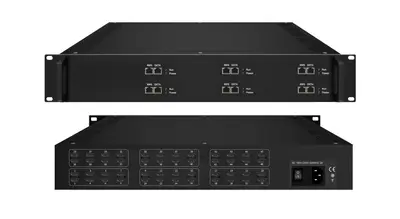
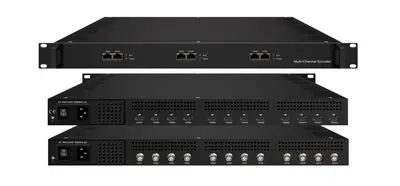
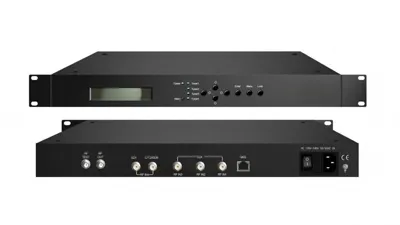
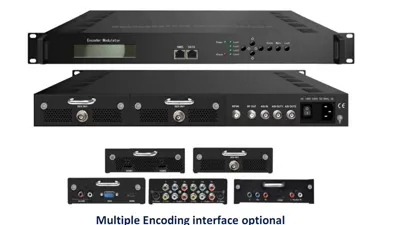
The encoders we build cover the range from a single HDMI source to 48 HDMI inputs in one chassis, and every model page prints its own input count, codec, bit rate and rack height. Our IPTV and broadcast video encoders are listed together on that page, and the ones that also modulate onto coax sit on the HDMI and SDI encoder modulator page.
Encoder, Encoder Modulator or Gateway: Three Boxes, Three Outputs
These three boxes accept similar sources and produce three different outputs, and the output is what decides which one a project needs. An encoder produces IP streams, an encoder modulator produces RF carriers, and a gateway converts a carrier or an ASI feed into IP streams without re-encoding.
| Box | Input side | Output side | Choose it when |
|---|---|---|---|
| Encoder | HDMI, SDI, CVBS, YPbPr or ASI | transport streams over IP: UDP, RTP, SRT, RTMP or HLS | the line-up is distributed over a building network |
| Encoder modulator | HDMI, CVBS, a tuner or IP | one or more DVB-C, DVB-T, ATSC or ISDB-T carriers | the screens are ordinary televisions on existing coax |
| Gateway | DVB-S/S2, DVB-T/T2, DVB-C tuners or ASI | SPTS or MPTS over UDP / RTP | a carrier has to become multicast with no re-encoding |
| IRD or receiver | a DVB carrier, and any encryption on it | a transport stream over IP or ASI, or baseband | feeds are encrypted, or baseband output is needed |
The DVB to IP gateway guide covers the third row, and the IRD and decoder guide covers the fourth. The first two rows are the ones that involve encoding, and the split between them is simple: if the far end is a computer, a set-top box or a smart TV app, you want an encoder; if the far end is a television that scans DVB-C or DVB-T channels, you want an encoder modulator.
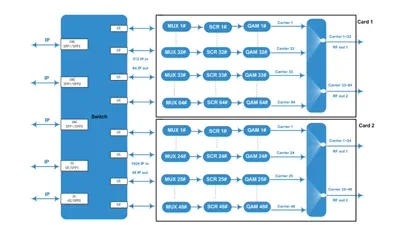
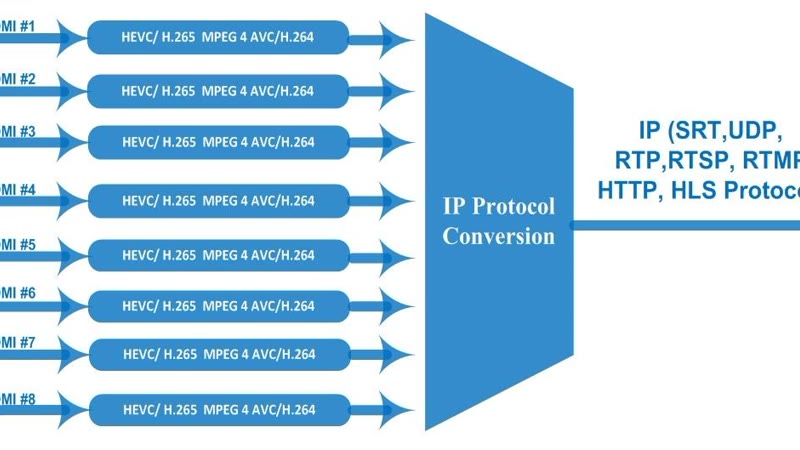
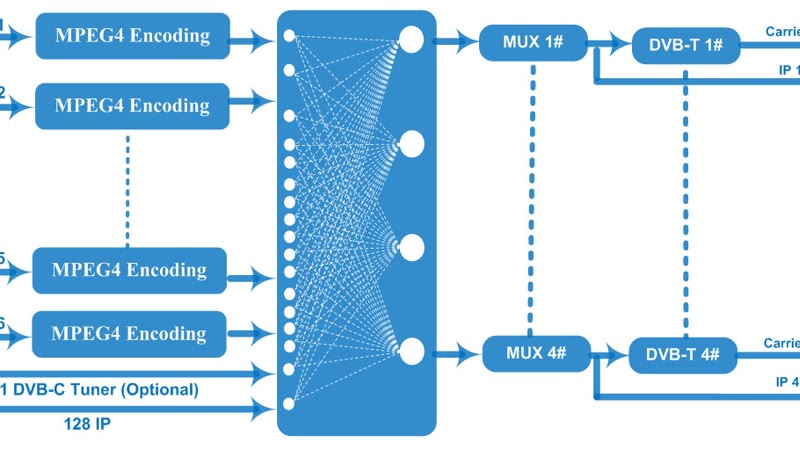
The FUQ4339KN V2 is an encoder in the first row: 48 HDMI inputs in a 2-U chassis, encoding HEVC/H.265 and MPEG-4 AVC/H.264, streaming over UDP, SRT, RTSP, RTMP, HTTP and HLS. The FUQ4655K is the other shape: 12 HDMI inputs and up to 256 IP inputs encoded to MPEG-2 or H.264, then modulated onto DVB-C, DVB-T/ATSC or ISDB-T carriers, with IP I/O over UDP/RTP/RTSP in the same chassis.
Which Input Do You Need: HDMI, SDI, CVBS or ASI?
The input side follows the sources on site rather than preference: HDMI covers set-top boxes, players, cameras and laptops, SDI covers broadcast cameras and long cable runs, CVBS covers legacy analog equipment, and an ASI input lets a chassis remultiplex transport streams that arrive already compressed.
| Input | Model | What the page publishes |
|---|---|---|
| 48 HDMI | FUQ4339KN V2 network encoder | 48 HDMI inputs; HEVC/H.265 and MPEG-4 AVC/H.264; UDP, SRT, RTSP, RTMP, HTTP and HLS |
| up to 24 HDMI | FUQ4339RN IP streaming encoder | 8/16/24 HDMI inputs; H.264 video and AAC audio; UDP, SRT, RTMP and HLS |
| 8/16/24 HDMI | FUQ4339R HDMI encoder | scalable 8/16/24 HDMI inputs; each module outputs 1 MPTS and 8 SPTS |
| 4/8/12 HDMI | FUQ4335X-2 network encoder | 4, 8 or 12 HDMI inputs with HDCP 1.4; HEVC/H.265 or H.264; SRT, RTP, RTSP, RTMP, HTTP or HLS |
| 4/8/12 HDMI | FUQ5315K encoder | 4/8/12 HDMI inputs; H.264; LC-AAC or HE-AAC; UDP, RTSP, RTMP, HTTP and HLS |
| 12 HDMI + 32 IP | FUQ4655L multi-channel encoder | 12 HDMI inputs, 12 CC inputs and 32 IP inputs over UDP/RTP; MPEG-2 and H.264 |
| 4-8-12 HD-SDI or HDMI | FUQ4335X HD-SDI encoder | 4-8-12 HD-SDI or HDMI inputs; HEVC-H.265 or H.264; UDP, RTP and RTSP |
| 4-8-12 HD-SDI and HDMI | FUQ3224KFUQ encoder | 4-8-12 channel HD-SDI and HDMI 1.4; HEVC-H.265 or H.264; Gigabit IP output |
| HDMI, SDI, YPbPr, CVBS | FUQ4322C HD encoder | 4 inputs across HDMI, SDI, YPbPr and CVBS; MPEG-2 and H.264; TS output over ASI or IP |
| 1 HDMI + 1 HD-SDI | FUQ4322AB HD encoder | 2 inputs into one transport stream; HEVC/H.265 and H.264; ASI or IP output |
| 2 or 4 CVBS / SDI | FUQ3214C SD encoder | 4-8-12 channel versions taking CVBS and SDI inputs; MPEG-2 or H.264 |
| 4 CVBS | FUQ3214B encoder | 4 CVBS inputs; MPEG-2; MPTS or SPTS over UDP/RTP |
| CVBS, S-Video, SD-SDI | FUQ4312D SD encoder | 4 inputs; MPEG-2 SD; ASI or UDP/IP transport stream output |
| 4 CVBS / S-Video / YPbPr | FUQ4315B 4-channel encoder | MPEG-2 video and MPEG-1 Layer II audio; one ASI input for multiplexing |
| 8/12/24 CVBS | FUQ4653L encoder | 8/12/24 CVBS inputs; encoding and multiplexing on board; MPEG-2 and MPEG1 Layer II or AC3 |
| up to 48 CVBS | FUQ4337SB SD video encoder | up to 48 CVBS inputs in three modules; H.264; MPTS and SPTS over IP and ASI |
| 8-channel audio | FUQ4349 audio encoder | 8 pairs of unbalanced stereo inputs; MPEG1 Layer 2; ASI and IP outputs |
| dual unbalanced stereo | FUQ4344 audio encoder | one stereo input backing up the other; MPEG-1 Layer II; ASI and IP over UDP |
| analog or AES audio | FUQ4313B audio encoder | dual-channel encoding in MPEG1 Layer 2 or AAC; ASI and IP/UDP/RTP output |
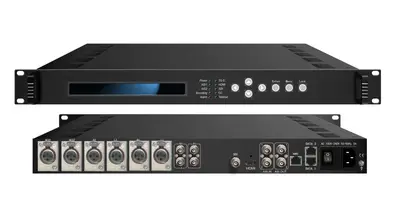
The audio-only models are worth a note, because they are not video encoders with the picture switched off. The FUQ4349 takes eight pairs of unbalanced stereo inputs at 482mm × 455mm × 44mm and compresses them to MPEG1 Layer 2 for ASI and IP output; the FUQ4344 is a smaller desktop unit at 164mm × 128mm × 45mm on 12 V DC, and the FUQ4313B accepts analog balanced and AES/EBU digital audio over XLR and publishes hot-pluggable dual or single power supply options. Sites that re-broadcast radio channels over a television headend use them for the audio leg.
Two models publish an ASI input on the encoder itself. The FUQ4322C and the FUQ4322AB each print two ASI input ports for remux alongside their HDMI and SDI inputs, plus two ASI output ports on BNC, which is how a chassis takes an existing transport stream, adds its own encoded services to it and hands the result on without a separate multiplexer.
H.264 or H.265: What the Published Rows Say
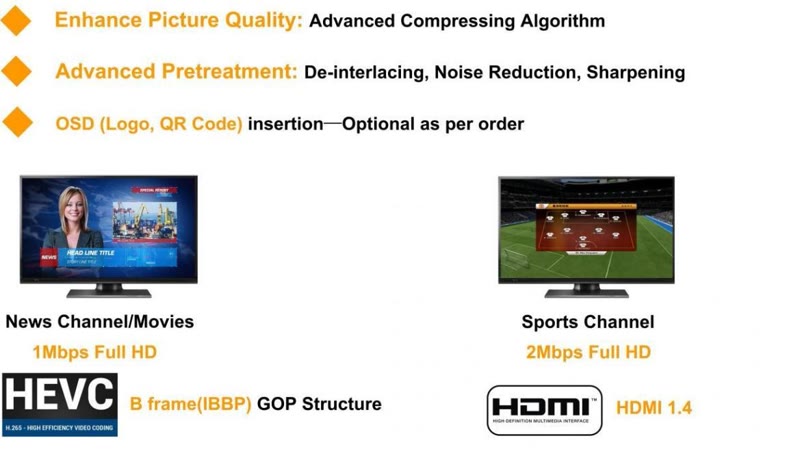
The codec decides two things at once: how much network each channel occupies and which receivers can play it. H.265, or HEVC, was designed to deliver the same picture quality at roughly half the bit rate of H.264, and the pages that publish both codecs inside one chassis show how the two ranges sit.
| Model | Published codec row | Published bit rate |
|---|---|---|
| FUQ4322AB | HEVC/H.265 HD; MPEG-4 AVC/H.264 HD | HEVC/H.265: 0.5 – 20.00 Mbps; MPEG-4 AVC/H.264: 4 – 20.00 Mbps |
| FUQ4335X-2 network encoder | HEVC/H.265, MPEG 4 AVC/H.264 | 0.5Mbps~20 Mbps (each channel) |
| FUQ4339KN V2 | H.264/H.265 | 1~13Mbps each channel |
| FUQ4339RN | MPEG-4 AVC/H.264 | 1~13Mbps each channel |
| FUQ4322C | MPEG-2 HD/SD, MPEG-4 AVC/H.264 HD/SD | 2.5 – 19.00 Mbps |
| FUQ3214C | MPEG-2, MPEG4 AVC/H.264 | 0.5~5Mbps |
| FUQ4653L | MPEG-2 | 0.5Mbps~8Mbps each channel |
| FUQ4337SB | MPEG4 AVC/H.264 (HP/MP/BP) | 1Mbps~66Mbps each channel |
| FUQ4655K | MPEG2 & MPEG4 AVC/H.264 | 0.8~19Mbps for H.264 encoding, 1~19Mbps for MPEG-2 encoding |
The FUQ4322AB is the cleanest illustration in the range because it prints both codecs with their own bit-rate rows in one chassis: HEVC/H.265 from 0.5 to 20.00 Mbps and H.264 from 4 to 20.00 Mbps. Those two rows are the same trade a buyer makes everywhere else — the HEVC floor is far lower for the same picture, and the ceiling is set by the chassis rather than the codec.
MPEG-2 is still published on a number of encoders, including the FUQ3214B, the FUQ4653L, the FUQ3214C and the FUQ4322C. That is not an oversight: a site with an estate of older set-top boxes that decode only MPEG-2 needs a chassis that still speaks it, and several of these models publish a choice of MPEG-2 or H.264 rather than one or the other.
The other half of the decision is on the receiving side, and it is the one that catches people out. HEVC needs a decoder that supports HEVC, so a site planning H.265 for bandwidth reasons should confirm its set-top boxes and televisions can decode it before ordering. Where a page publishes only H.264, as the FUQ4339RN and the FUQ5315K do, that is the codec available on that model and the datasheet is the place to confirm the exact profile.
How Many Channels Can One Chassis Handle?
Channel count comes from the input card rather than a rule of thumb, and the published pages carry what a buyer needs to size a rack: 4 to 12 HDMI inputs in a one-rack-unit chassis, 24 and 48 HDMI inputs in one frame, and up to 48 CVBS inputs in a modular chassis.
| Model | Published channel count | Published chassis |
|---|---|---|
| FUQ5315K | 4/8/12 HDMI inputs | 482mm × 328mm × 44mm |
| FUQ4335X-2 network encoder | 4, 8 or 12 HDMI inputs | 482mm × 328mm × 44mm, 5 kg |
| FUQ4339RN | 8/16/24 HDMI inputs | 482mm × 328mm × 44mm |
| FUQ4339KN V2 | 48 HDMI inputs | 482mm × 328mm × 88mm; the page's rack row reads 1-U = 2-U |
| FUQ4655L | 12 HDMI, 12 CC and 32 IP inputs | 482mm × 440mm × 44mm |
| FUQ4653L | 8/12/24 CVBS inputs | 482mm × 410mm × 44mm, 8 kg |
| FUQ4337SB | up to 48 CVBS inputs, three modules in the frame | modular 1U chassis |
| FUQ4339R | scalable 8/16/24 HDMI inputs | each module outputs 1 MPTS and 8 SPTS |
Two patterns are worth reading off that table. The first is that density is bought in the input card, not in the box: the same 44 mm chassis holds 4 HDMI inputs or 24, and the difference is the module fitted and the price that follows it. The second is that only the 48-input HDMI model goes to two rack units; everything else in the encoder range publishes a height of 44 to 45 mm.
The modular frames take the idea further. The FUQ4337SB holds up to three standalone modules in a 1U chassis and scales to 48 CVBS inputs, which is the shape a site wants when analog sources are spread across several racks and only some of them are being converted in the first phase.
Output Protocols and the ASI Remux Path
The output has to match whatever receives the stream: a middleware server and the building network, or an ASI input on the multiplexer behind the encoder. Most models publish their IP protocols in the page description rather than as a specification row, so they are quoted here from that description.
- FUQ4339KN V2: UDP, SRT, RTSP, RTMP, HTTP and HLS
- FUQ4339RN: UDP, SRT, RTMP and HLS
- FUQ4335X-2 network encoder: SRT, RTP, RTSP, RTMP, HTTP or HLS
- FUQ4335X HD-SDI encoder: UDP, RTP and RTSP
- FUQ5315K: UDP, RTSP, RTMP, HTTP and HLS
- FUQ4655L: 32 IP inputs and IP output over UDP/RTP
- FUQ4655K: IP I/O over UDP/RTP/RTSP
Two models publish the IP output as a specification row rather than in prose, and both are worth knowing because the row states the stream count as well as the protocol:
| Model | Published output row | Chassis |
|---|---|---|
| FUQ4353 dual-channel encoder | IP (1 MPTS and 2 SPTS) over UDP, RTP/RTSP, RJ45 1000M | 1RU, pluggable HDMI, 3G-SDI, YPbPr and CVBS inputs |
| FUQ4454B 4-channel encoder modulator | 4 MPTS IP over UDP out, RJ45 1000M, unicast or multicast | 1RU, 4 CVBS, YPbPr or S-Video inputs |
Protocol support is not a marketing list to collect; it is a fit question. UDP multicast is what most building networks use, SRT matters when the stream crosses a site boundary or a lossy link, and RTMP or HLS matter when the same feed also has to reach a phone or a CDN. If the target is a specific middleware platform, send us the protocol list it requires and we will confirm the exact model against it rather than assuming the whole range speaks everything.
Where the next box in the rack takes ASI, the remux inputs published on the FUQ4322C and the FUQ4322AB are the ones to use: two ASI inputs for remux and two ASI outputs on BNC. The FUQ4315B publishes one ASI input for multiplexing, and the FUQ4653L publishes PID remapping on board, which means the streams can be picked apart and re-labelled before they leave the chassis.
Sizing the Encode Load: Bit Rate per Channel
Network load is the sum of the per-channel bit rates an encoder is configured for, so the published ranges are the numbers to add up. A 24-channel chassis set to the published 1 to 13 Mbps per channel occupies between 24 and 312 Mbps of video payload before transport overhead.
| Model | Published bit rate |
|---|---|
| FUQ4339KN V2 and FUQ4339RN | 1~13Mbps each channel |
| FUQ4335X-2 network encoder | 0.5Mbps~20 Mbps (each channel) |
| FUQ4322AB | HEVC/H.265 0.5 – 20.00 Mbps; H.264 4 – 20.00 Mbps |
| FUQ4322C | 2.5 – 19.00 Mbps |
| FUQ4337SB | 1Mbps~66Mbps each channel |
| FUQ3214B, FUQ4653L and FUQ4655BC | 0.5Mbps~8Mbps each channel |
| FUQ3214C | 0.5~5Mbps |
| FUQ4655K | 0.8~19Mbps for H.264, 1~19Mbps for MPEG-2 |
Rate control is published as CBR or VBR on most of these pages, and the choice is the same one broadcasters have always made: a constant bit rate gives the network a predictable budget per channel and a variable bit rate lets the quality follow the picture, which is worth having on a sports channel and worth avoiding on a link that is already close to full.
PID handling sits next to bit rate in the planning. The FUQ4655L publishes a maximum of 180 input PIDs remapped per channel, and the FUQ4655BC publishes the same 180 input per channel figure, with PID remapping either automatic or manual. Where the line-up shares PIDs across services, that ceiling is what decides whether the streams can be merged inside the encoder or need a separate multiplexer behind it.
Rack Space, Power and Environment
Once codec and channel count are fixed, the physical rows decide whether a unit fits the rack and the power budget. Most encoders in this range stand 44 to 45 mm high, one rack unit, the 48-input chassis publishes two, and weight and consumption are printed model by model where the page carries them.
| Model | Published dimensions | Published weight | Published power |
|---|---|---|---|
| FUQ4339RN | 482mm × 328mm × 44mm | not published | AC 110V ± 10%, 50/60Hz, AC 220V ± 10%, 50/60Hz |
| FUQ4339KN V2 | 482mm × 328mm × 88mm | not published | AC 110V ± 10%, 50/60Hz, AC 220V ± 10%, 50/60Hz |
| FUQ4335X-2 network encoder | 482mm × 328mm × 44mm | 5 kg | not published |
| FUQ4322C | 482mm × 405mm × 44.5mm | not published | 16W |
| FUQ4349 | 482mm × 455mm × 44mm | 4 kg | AC 100V-220V ± 10%, 50/60Hz, 25W |
| FUQ4653L | 482mm × 410mm × 44mm | 8 kg | 20W |
| FUQ4315B | 482mm × 300mm × 44.5mm | 3.5 kg | AC 100V~240V, 25W |
| FUQ5315K | 482mm × 328mm × 44mm | not published | AC 100-240V 50/60Hz 2A |
| FUQ4344 | 164mm × 128mm × 45mm | 1 kg | DC 12V |
Every one of these units is built and tested in our own factory in Guangzhou, and each chassis runs a 72-hour burn-in before it ships, so a headend that is never switched off does not start its life on an untested sample. Working and storage temperatures are published on most of the pages as 0 to 45 °C working and -20 to 80 °C storage, and where a weight or a power row reads not published above, the model page genuinely does not carry it — ask for the datasheet and we will confirm the value for the exact configuration.
Frequently Asked Questions
What is the difference between an IPTV encoder and an encoder modulator?
The output. An encoder compresses video and sends transport streams over IP — UDP, RTP, SRT, RTMP or HLS — for a network, a set-top box or a smart TV app. An encoder modulator does the same encoding and then puts the result onto RF carriers such as DVB-C, DVB-T, ATSC or ISDB-T, for televisions that tune channels on the coax already in the building. The FUQ4339KN V2 is an encoder; the FUQ4655K is an encoder modulator.
Should I choose H.264 or H.265 for an IPTV headend?
H.265, or HEVC, was designed to deliver the same picture quality at roughly half the bit rate of H.264, which saves network and storage wherever the receivers support it. The trade is decoder support: every set-top box and television in the estate has to decode HEVC. Where both codecs are published in one chassis the difference is visible — the FUQ4322AB prints HEVC/H.265 from 0.5 to 20.00 Mbps and H.264 from 4 to 20.00 Mbps.
How many channels can one IPTV encoder handle?
It follows the published input count of the model rather than a rule of thumb. The range publishes 4 to 12 HDMI inputs on the FUQ5315K and the FUQ4335X-2 network encoder, 8/16/24 HDMI inputs on the FUQ4339RN, 48 HDMI inputs on the FUQ4339KN V2 in a 2-U chassis, and up to 48 CVBS inputs on the FUQ4337SB. Tell us the channel count you need and we match it to the input cards that cover it.
Do I need HDMI or SDI inputs?
HDMI for consumer and prosumer sources — set-top boxes, players, cameras and laptops — and SDI where the sources are broadcast cameras or the cable runs are long, because SDI locks mechanically and carries further over coax. Several models take both: the FUQ4335X HD-SDI encoder is published with 4-8-12 HD-SDI or HDMI inputs, and the FUQ4322C accepts HDMI, SDI, YPbPr and CVBS on one chassis.
Can an encoder output IP and ASI at the same time?
On some models, yes. The FUQ4353 publishes IP output of 1 MPTS and 2 SPTS over UDP, RTP/RTSP alongside 2 ASI outputs on BNC carrying the same transport stream as MPTS or SPTS, and the FUQ4322C and the FUQ4322AB each publish two ASI output ports next to their IP output. Where a page does not list an ASI output, treat the unit as IP only and confirm on the datasheet.
How much bandwidth does each encoded channel need?
Use the bit rate published for the model and multiply by the channel count. The FUQ4339KN V2 and the FUQ4339RN publish 1~13Mbps per channel, the FUQ4335X-2 network encoder 0.5Mbps~20 Mbps per channel, the FUQ3214C 0.5~5Mbps and the FUQ4655K 0.8~19Mbps for H.264. A 24-channel chassis at 1 to 13 Mbps per channel occupies between 24 and 312 Mbps of video payload before transport overhead.
Do you supply the datasheet and a factory-direct quotation?
Yes. Send the input type and count, the codec, the channel count, the output protocol or RF standard, and the rack height available, and we return the model list with the datasheet for each exact model and a quotation. Every unit is built in our Guangzhou factory, runs a 72-hour burn-in before dispatch, and we ship to 200+ countries.
If the encoder sits inside a bigger project, the headend equipment guide maps the whole chain, the hotel IPTV headend guide and the hospital IPTV system guide cover the site side, and the transport stream multiplexer guide picks up where the encoder output reaches the mux. The full lines are listed on the IPTV and broadcast video encoder and HDMI and SDI encoder modulator pages, and the solutions pages show the chain end to end. Tell us the sources, the codec and the channel count and we will match the model and quote it — the fastest route is the contact form, and the FAQ answers the commercial questions first.
Previous
ISDB-T Modulator Guide: Brazil, Japan and LatAm
Next
Professional IRD and Decoder Guide for Headends
Talk to the headend engineers before you specify
Send the model number you are looking at — or the channel count and the input and output formats you work with — and we answer with the datasheet, the configuration and a written price. The reply comes from the headend team in Guangzhou, not a sales line.