ISDB-T Modulator Guide: Brazil, Japan and LatAm
How to choose an ISDB-T or ISDB-Tb modulator for Brazil, LatAm and Japan networks: input, carrier count, SFN and the rows each model page publishes. Each model named in this article is one of 190 in the Hanxing catalogue, published with its own specifications and datasheet.
Hanxing Team
Broadcast & IPTV Experts
The path this guide walks
- Carriers insatellite, terrestrial or cable tuners
- Gateway or IRDtune and republish as IP or ASI
- Multiplexerselect programs, rebuild PSI/SI
- ISDB-T modulatorARIB STD-B31 carrier on RF
- Transmitterraise to radiated power
- ScreensISDB-T televisions and set-top boxes
The modulator decides the standard: everything ahead of it is standard-agnostic, and everything behind it inherits the carrier.
ISDB-T is the terrestrial digital television standard that Japan developed and Brazil then carried across most of South America, and an ISDB-T modulator is the unit that turns finished transport streams into the RF carrier that standard defines. If the project is in Brazil, Peru, Chile, Argentina, the Philippines or Japan, the modulator is the one box in the headend that has to match the national standard: everything in front of it can be standard-agnostic, and nothing behind it can repair the wrong carrier.
This guide covers what an ISDB-T modulator does, where ISDB-T and ISDB-Tb are in service, how the standard differs from DVB-T, ATSC and DTMB, and which of the modulators we build fits which job. Every figure quoted below is printed on the product page of the model it belongs to. Where a page does not publish a value, this guide says so and sends you to the datasheet rather than estimating it, because a modulator is bought on carrier count, input format and RF output, and a guessed number only shows up at commissioning.
What Is an ISDB-T Modulator?
An ISDB-T modulator takes transport streams — over ASI or over IP using UDP, RTP or RTSP — and modulates them onto an RF carrier built to the ISDB-T standard, ARIB STD-B31. Its output is a VHF or UHF channel that either drives a transmitter or feeds the distribution network.
The standard itself is why the modulator exists as a separate box. ISDB-T splits a 6 MHz television channel into 13 segments, so one carrier can carry a full high-definition service for fixed receivers and, in the same channel, a lower-rate layer for mobile receivers — the layer known as One-Seg. Hierarchical transmission of that kind has to be assembled at the modulation stage, with a transmission mode, a guard interval, a code rate and a constellation chosen for the coverage the network is aiming at.
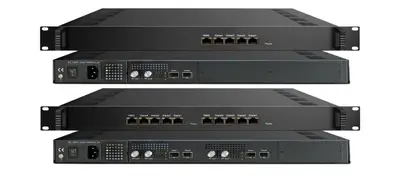
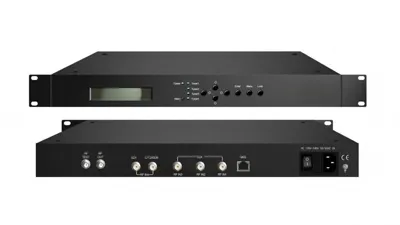
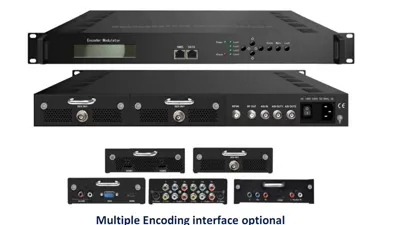
In a small terrestrial site the modulator is also the exciter. One of our ISDB-T modulators outputs at around -30 to -10 dBm, which is the level an external transmitter expects at its input, while a chassis such as the FUQ4417J is used where a headend has to produce many carriers at once. The output level row on each model page is the fastest way to tell which job a unit is built for.
What a modulator is not is a transmitter. The modulator decides the standard, the carrier and the transport stream contents; the transmitter decides the radiated power. The FUQ8351-2 is the transmitter side and accepts DVB-T, ATSC or ISDB-T input, so the same modulator family can feed it.
Where ISDB-T and ISDB-Tb Are Deployed
ISDB-T launched in Japan in 2003, and the Brazilian adaptation, ISDB-Tb, was then adopted across much of South America. The same standard family is in service in the Philippines, Botswana and the Maldives. For a buyer the practical point is that the delivered modulator has to match the national standard, because an ISDB-T television cannot decode a DVB-T carrier.
| Market | Standard in service | What it means for the modulator |
|---|---|---|
| Japan | ISDB-T, ARIB STD-B31 | 6 MHz channel, full-segment and One-Seg layers |
| Brazil | ISDB-Tb (ISDB-T International) | Same RF standard, national standards govern the services carried |
| Argentina, Peru, Chile and much of South America | ISDB-T / ISDB-Tb | Confirm the regulator's designation per country |
| Philippines | ISDB-T | 6 MHz channel, UHF planning |
| Botswana, Maldives | ISDB-T | First ISDB-T deployment in Africa was Botswana |
The list is short on purpose. Most countries that have completed a digital terrestrial transition did so on DVB-T, DVB-T2 or ATSC, so the correct move is to confirm the designation with the local regulator or the system integrator before ordering, then send us the country so the configuration is confirmed against it.
ISDB-T vs DVB-T vs ATSC: Which Standard for Which Market
The four terrestrial standards in service today are not interchangeable at the RF layer: DVB-T and DVB-T2 use COFDM across 6, 7 or 8 MHz channels, ISDB-T uses a 6 MHz channel divided into segments, and ATSC 1.0 uses a single 8VSB carrier in 6 MHz. A modulator built for one cannot be reflashed into another.
| Standard | Where it is deployed | Channel bandwidth | Defining feature | Example in our range |
|---|---|---|---|---|
| DVB-T and DVB-T2 | Europe, Africa, Asia-Pacific, Australia | 6, 7 or 8 MHz | COFDM, MFN and SFN operation | FUQ4415B (DVB-T 6M, 7M, 8M) |
| ISDB-T and ISDB-Tb | Japan, Brazil, most of South America, Philippines | 6 MHz | 13 segments, hierarchical layers, One-Seg mobile | FUQ4417K, FUQ4417J |
| ATSC 1.0 (A/53) | United States, Canada, South Korea, Mexico | 6 MHz | Single 8VSB carrier | FUQ4419BX (ATSC A/53, 8VSB) |
| DTMB | China and neighbouring states | 8 MHz | Single-frequency network focus | Not published in our range |
| DVB-C and QAM cable | Cable networks worldwide | 6 or 8 MHz | QAM on coax, not terrestrial | FUQ4459B (DVB-C modulator) |
The channel bandwidth row is the one that trips projects up. A DVB-T site can be planned on 7 or 8 MHz, while ISDB-T is published as 6 MHz across our range — the FUQ3516R page prints a bandwidth row of 6MHz, and the FUQ4455A prints 6MHz for its ISDB-T carriers. Matching a 6 MHz plan to an 8 MHz modulator, or the reverse, is a planning error that shows up as unusable spectrum rather than as a defective unit.
ISDB-T or ISDB-Tb: What Changes in the Modulator
ISDB-T is the Japanese standard and ISDB-Tb is its Brazilian, or International, adaptation — and on our pages both are published against the same modulation standard, ARIB STD-B31. The FUQ4417K is listed as an ISDB-Tb modulator and the FUQ3516R as an ISDB-T modulator, and each prints ARIB STD-B31 in its specification table.
That matters commercially because buyers search for both names. If a tender in South America says ISDB-Tb and a Japanese project says ISDB-T, the RF section is specified on the same standard, and the questions that separate two configurations are the carrier count, the input format and the network mode rather than the name on the front panel.
Which is also why we do not swap the two silently. Send the destination country with the enquiry, and the model confirmation is returned against that market's designation, the transport stream the site will feed it, and the carrier plan the transmitter needs. Where a detail is not settled by the published rows, it is settled on the datasheet for the exact model before the order is placed.
Choosing an ISDB-T Modulator: The Rows That Decide
Five published rows decide most ISDB-T modulator selections: the input format, the carrier count, the modulation parameters, the RF output and the chassis. Everything else — the PID handling, the control interface, the temperature range — follows the site rather than the standard, and every one of them is printed on the model page.
| Row | What it tells you | Published values across the range |
|---|---|---|
| Input | What the headend upstream has to deliver | IP over UDP, RTP and RTSP; dual ASI plus dual IP; 2 ASI and 128 IP |
| Output carriers | How many RF channels one chassis produces | 8 or 16; 24 or 48; 16/20/24/28 (license gradable) |
| Constellation | The modulation depth offered | DQPSK, QPSK, 16QAM, 64QAM |
| Transmission mode | The carrier mode of the standard | 2K, 4K, 8K |
| Guard interval | Multipath tolerance trade-off | 1/4, 1/8, 1/16, 1/32 |
| Code rate | Forward error correction ratio | 1/2, 2/3, 3/4, 5/6, 7/8 |
| MER | Headroom in the output signal | ≥40dB or ≥42dB depending on model |
| RF output | Frequency range and level | 30~1000MHz and 50~960MHz ranges, 1kHz stepping |
| Chassis | Rack space and weight | 44.5mm front panels, 2.3kg to 5.5kg |
The carrier count is the first commercial decision. Eight or sixteen non-adjacent carriers on one chassis suits a regional transmitter site, while twenty-four or forty-eight suits a national or multi-region rollout where each carrier is a separate television channel. Non-adjacent output is the normal requirement on terrestrial networks because adjacent channels in the same band interfere with each other on the receiver side.
The MER row is the second. A published MER of 40 dB or better is the headroom figure that a transmitter vendor will ask for, because the modulator output has to survive the transmitter's own distortion budget. Our ISDB-T pages print ≥40dB on the FUQ4417K and the FUQ4417J, and ≥42dB on the FUQ4417 and the FUQ3516R.
The transmission mode, guard interval and code rate are a set, not independent choices: the mode sets the carrier structure, the guard interval sets how much multipath the receiver tolerates, and the code rate trades payload for robustness. Every model in our ISDB-T range publishes all three, so the planning figures come off the page rather than from a conversation.
The ISDB-T Modulators We Publish
Our ISDB-T range covers a single 6 MHz carrier for a local site up to forty-eight carriers in one rack unit. The table below is built from the rows each model page publishes; where a row is absent from a page, it is marked as not published rather than estimated, and the datasheet for that exact model fills the gap.
| Model | Published headline | Output carriers | Input | MER | RF output |
|---|---|---|---|---|---|
| FUQ4417K | ISDB-Tb modulator, 8-16 non-adjacent | 8 (or 16) | 512 (or 1024) IP input channels | ≥40dB | Not published on the page |
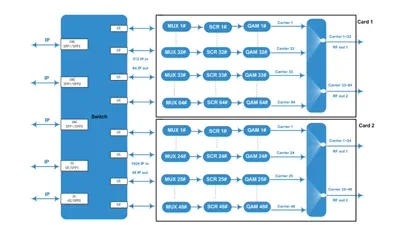
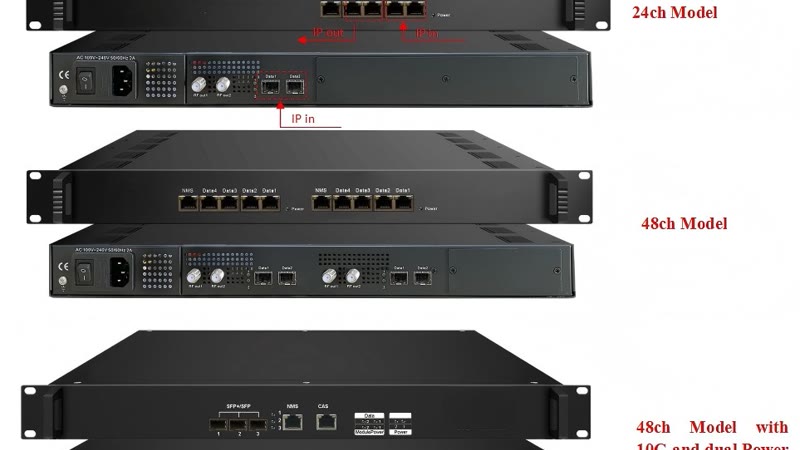
| FUQ4417J | ISDB-T modulator, 24-48 channels | 24 (or 48) | 1024 IP streams, max 840Mbps per GE input | ≥40dB | 50~960MHz, 1kHz step; -20dBm~+10dBm |
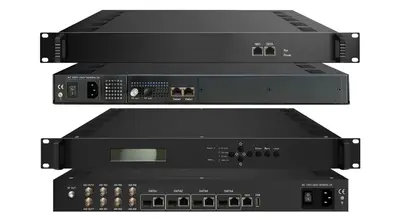
| FUQ4417 | IP to ISDB-T modulator, 4 IP inputs | Not published on the page | 4 IP streams through a 1000M port | ≥42dB | 30~1000MHz, 1kHz step; -30~-10dBm |
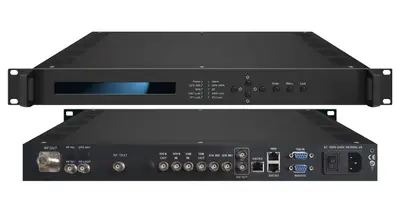
| FUQ3516R | ISDB-T modulator, dual ASI and dual IP | Not published on the page | Dual ASI + dual IP | ≥42dB | Not published on the page |
| FUQ4455A | 28 ISDB-T, 32 DVB-T and 48 DVB-C carriers | 16/20/24/28 (license gradable) | 128 IP + 2 ASI | ≥40dB | 50~960MHz, 1kHz |
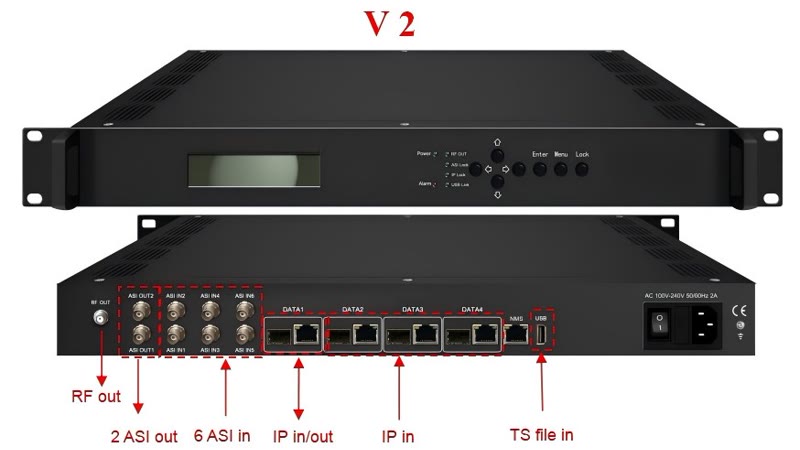
Two of those models are worth explaining. The FUQ4417 is the small end: an IP to ISDB-T modulator that takes four IP streams through a 1000M port, built for broadcast transmission and for the television and radio industries, where a site is adding one carrier rather than a network. It is published at 2.3kg, the lightest of the ISDB-T models above.
The FUQ4455A is the multi-standard end. One chassis accepts 128 IP inputs and 2 ASI inputs and outputs up to 28 ISDB-T, 32 DVB-T and 48 DVB-C carriers, with the carrier count licensed in steps of 16/20/24/28. Where a site has to serve both terrestrial ISDB-T households and a cable head, that single unit replaces two racks.
A note on what the pages do not say. The FUQ4417K and the FUQ3516R do not publish an RF output range or level row, so those figures are given on the datasheet for the exact model rather than assumed from a sibling. Every value in the table above is taken from the page named in the same row.
SFN and MFN: What Our Pages Publish
A multi-frequency network runs each transmitter on its own channel, while a single frequency network runs every transmitter on the same channel and depends on tight timing between them. Which one a site needs changes the modulator specification, so the honest answer is what the model page publishes — and for ISDB-T in our range, that differs by model.
The FUQ3516R page states that its output is compliant with ARIB STD-B31 and supports single frequency network (SFN) and multi-frequency network (MFN) operation, with network-based control through a WEB interface, LCD and keyboard. The FUQ8351-2 transmitter publishes frequency accuracy of MFN ±100Hz and SFN ±1Hz alongside its 10W, 20W, 30W, 50W and 100W output options.
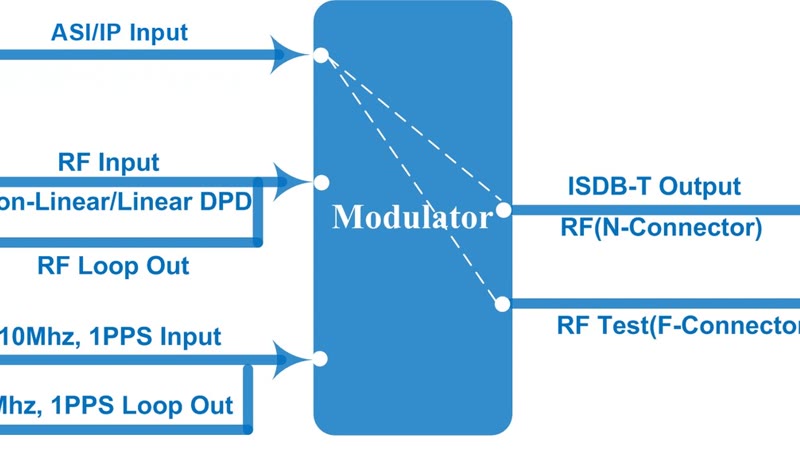
The other modulator pages in the range do not print an SFN or MFN row. On the FUQ4417K, the FUQ4417 and the FUQ4417J, the published rows stop at the modulation parameters, the RF output and the general specifications, so this guide does not claim a network mode for them. If an SFN rollout is the requirement, say so with the enquiry and the confirmation comes back against the model that carries the row.
The same chassis job on other standards is compared in the DVB-C, DVB-T and ATSC modulator guide, and the satellite carrier version of the RF stage in the satellite modulator guide.
The Rest of the ISDB-T Chain
The modulator is one box in an ISDB-T chain that starts at the tuner and ends at the transmitter. Our range covers the other stages on the same standard, and their published roles are what the table below records — so a project can be specified end to end from one supplier rather than assembled from separate vendors.
| Stage | Model | Published role |
|---|---|---|
| Tune carriers to IP | FUQ4619C-5 | 16-tuner IP gateway, DVB-S/S2/S2X, DVB-C/T/T2 and ISDB-T, multi-mode tuners 60~890MHz |
| Receive and decode | FUQ4696-2 | CI receiver with 2-4 tuner inputs, DVB-C/T/ISDB-T, multi-mode tuners 60~890MHz |
| Multiplex the services | FUQ4216B | ISDB-T dual multiplexer, 12 ASI inputs, 2 IP UDP outputs, PSI/SI |
| Modulate onto RF | FUQ4417K and the models above | ISDB-T and ISDB-Tb carriers, ARIB STD-B31 |
| Radiate | FUQ8351-2 | Digital transmitter, DVB-T, ATSC and ISDB-T input, 10W to 100W output |
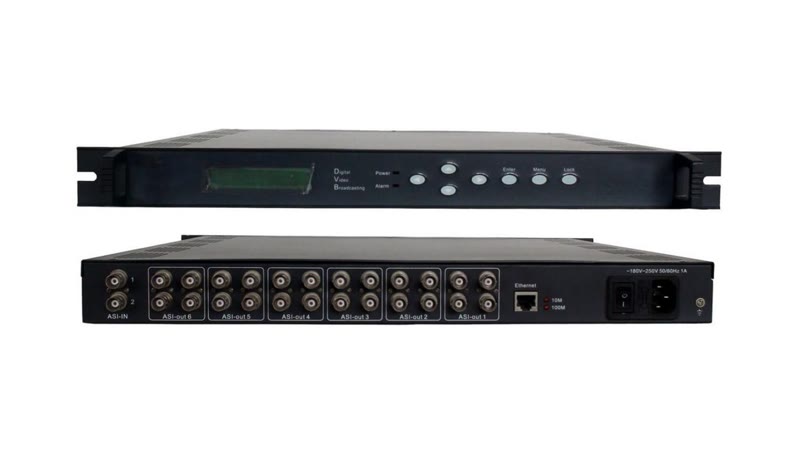
Wiring the chain is straightforward once the standards match. The tuner side takes the carriers the site already receives and republishes programs as IP or ASI; the multiplexer settles the line-up and rebuilds PSI/SI; the modulator puts the result on the RF carrier; the transmitter raises it to the radiated power. Where a site is also used for receiver testing, one published use is worth knowing: the FUQ3516R page lists its application as broadcasting network setup and set-top box testing in South American markets such as Brazil and Argentina, which is the same unit a receiver bench uses to feed a demodulator under test.
If the project is IP-distributed rather than terrestrial, the same tuner and multiplexer stages feed an IP leg instead, and the DVB to IP gateway guide covers that route.
Frequently Asked Questions
What is an ISDB-T modulator?
An ISDB-T modulator takes transport streams — over ASI or over IP — and modulates them onto an RF carrier built to the ISDB-T standard, ARIB STD-B31, for terrestrial digital television in Japan, Brazil and the other countries that adopted it. Our FUQ4417K is published as an ISDB-Tb modulator with 8 or 16 non-adjacent output carriers.
What is the difference between ISDB-T and ISDB-Tb?
ISDB-T is the Japanese standard and ISDB-Tb, also called ISDB-T International, is the variant deployed in Brazil and adopted across much of South America. On our pages both are published against ARIB STD-B31: the FUQ4417K is listed as an ISDB-Tb modulator and the FUQ3516R as an ISDB-T modulator, and each prints ARIB STD-B31 in its specification table. Send the destination country with the enquiry and we confirm the configuration for that market.
Which countries use ISDB-T?
Japan, where the service launched in 2003, plus Brazil and most of South America — Argentina, Peru and Chile among them — the Philippines, Botswana and the Maldives. If the project is in a country not on that list, confirm the national standard before ordering: the modulator has to match it, and DVB-T, DVB-T2, ATSC and DTMB modulators are different products.
How many carriers can one ISDB-T modulator drive?
It follows the published output count rather than a rule of thumb. Our range prints 8 or 16 non-adjacent carriers on the FUQ4417K, 24 or 48 carriers on the FUQ4417J, and 16/20/24/28 ISDB-T carriers on the FUQ4455A multi-standard unit. Send the channel count and the rack height available and we match the card configuration.
Does an ISDB-T modulator support SFN?
It has to be confirmed per model. The FUQ3516R page states that its output supports single frequency network (SFN) and multi-frequency network (MFN) operation, and the FUQ8351-2 transmitter publishes frequency accuracy of MFN ±100Hz and SFN ±1Hz. The pages for the FUQ4417K, FUQ4417 and FUQ4417J do not publish an SFN row, so ask for the datasheet rather than assuming it.
Does an ISDB-T modulator take IP or ASI input?
Both appear in the range, so the answer is the input format the site already has. The FUQ4417 is an IP to ISDB-T modulator that takes 4 IP streams through a 1000M port, the FUQ4417K accepts 512 or 1024 IP input channels over UDP, RTP and RTSP, and the FUQ3516R takes dual ASI and dual IP inputs on one chassis.
Do you supply the datasheet and a factory-direct quotation?
Yes. Send the destination country, the input format and channel count, the carrier count and the RF output level the site needs, and we return the model confirmation with the datasheet for that exact model and a quotation. Every unit is built in our Guangzhou factory, runs a 72-hour burn-in before dispatch, and we ship to 200+ countries.
If the ISDB-T modulator sits inside a larger project, the headend equipment guide maps the whole chain, the DVB-C, DVB-T and ATSC modulator guide covers the standards on either side of it, and the transport stream multiplexer guide picks the line-up up before it reaches the RF. The modulators are listed together on the modulator and modem page, the transmitters on the transmitter and receiver page, and the solutions pages show the chains end to end. Tell us the country, the input format and the carrier count and we will match the model and quote it — the fastest route is the contact form, and the FAQ answers the commercial questions first.
Previous
Satellite Transmodulator: DVB-S2 to DVB-C/DVB-T
Next
IPTV Encoder Guide: HDMI, SDI and CVBS to IP
Talk to the headend engineers before you specify
Send the model number you are looking at — or the channel count and the input and output formats you work with — and we answer with the datasheet, the configuration and a written price. The reply comes from the headend team in Guangzhou, not a sales line.