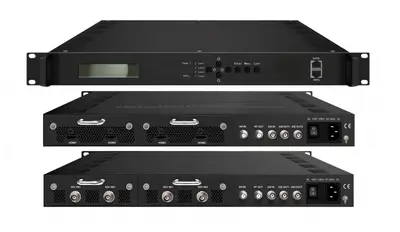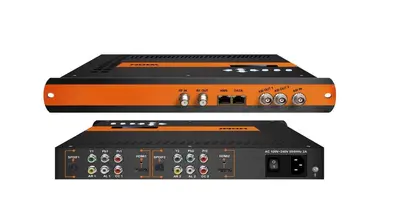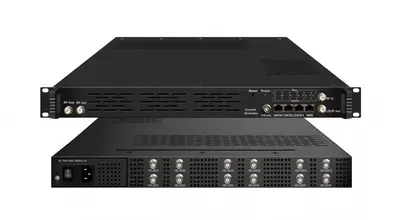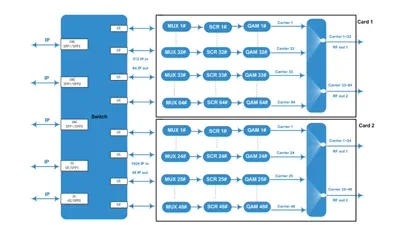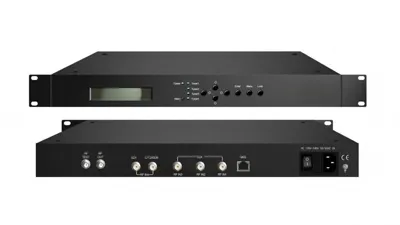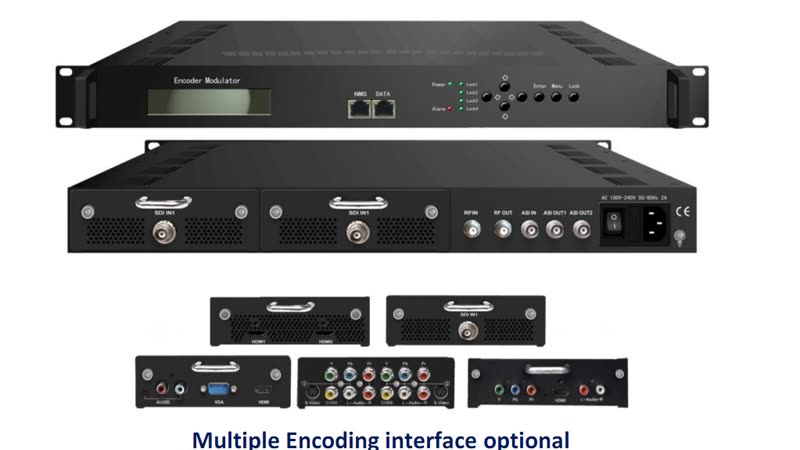
SDI to RF Modulator: SDI, HDMI and CVBS to QAM
Which chassis takes SDI, HDMI or CVBS and puts it on a DVB-C, DVB-T, ATSC or ISDB-T carrier, and why an SDI to RF modulator is the same unit as SDI to QAM. Each model named in this article is one of 190 in the Hanxing catalogue, published with its own specifications and datasheet.
Hanxing Team
Broadcast & IPTV Experts
The path this guide walks
- SDI sourcea camera, playout server or switcher on a 75-ohm BNC cable
- Encodethe same chassis compresses it to MPEG-2, H.264 or HEVC
- Multiplexthe encoded services join an ASI or IP stream inside the box
- Modulatethe multiplex goes onto a J.83A, J.83B, J.83C or DVB-T carrier
- Combinethe carriers are combined onto the building coax
- Televisiona set with a QAM or DVB-T tuner scans the channel it is given
The encoding and the modulation happen in one chassis here; the decision that settles the model is the carrier the television at the far end can already scan.
An SDI source is the easiest kind of video to produce and the hardest kind to distribute: a camera, a playout server or a vision mixer puts an uncompressed signal on a BNC cable, and 75 metres later nothing on an ordinary television can tune it. An SDI to RF modulator solves that in 1U of rack space, because it compresses the SDI feed into an MPEG transport stream and puts it on a QAM carrier in one chassis, so a television with a DVB-C tuner finds it by scanning. The arithmetic underneath is simple: uncompressed 1080i HD-SDI runs at about 1.485 Gbps, while one 8MHz carrier at 256QAM holds roughly 38Mbps of payload.
This guide is about that box in the SDI case: which chassis accepts SDI, what the QAM side actually has to publish, how many carriers a coax plan needs, and what has to be checked on the television before anything is ordered. Buyers ask for it under two names — an SDI to RF modulator and an SDI to QAM modulator — and the section below settles why the two labels describe one unit. It is written for engineers and buyers who have to specify the model, not for a catalogue page.
Every figure below is printed on the product page of the model it belongs to, and every model page linked here publishes its own rows. Where a page does not publish a value, this guide says so and sends you to the datasheet rather than carrying a number over from a sibling model, because an SDI to QAM chain is bought on input level, output standard and carrier count, and a guessed figure only shows up after the rack is wired and the televisions are scanning.
What Is an SDI to QAM Modulator?
An SDI to QAM modulator is one chassis that compresses an SDI source into an MPEG transport stream and then places that stream on a QAM carrier, so a television with a QAM tuner can find it by scanning. It replaces two boxes — an encoder and a modulator — with one 1U unit.
The reason the two stages belong together is the interface between them. An encoder produces a transport stream, a modulator consumes one, and where the two are separate boxes that stream travels as ASI on a BNC cable or as IP on Ethernet. Inside one chassis it never leaves the board, which removes a cable pair, a power supply and a point of failure from the rack.
QAM itself is the modulation family used by cable networks: the carrier carries several bits per symbol rather than one, which is how an 8MHz channel reaches a payload that an uncompressed SDI feed could never fit into. That is why the modulation rows — standard, constellation, symbol rate, bandwidth and MER — decide whether the chain works, and why the input rows decide whether your camera can connect to it at all.
| What the buyer asks | Where the answer is published | Example row |
|---|---|---|
| Does the chassis take my SDI camera? | the input rows of the model page | "4x HDMI/SDI and optional ASI inputs" on the FUQ4653B |
| What will the television scan? | the standard and constellation rows | "J.83A (DVB-C), J.83B, J.83C" on the FUQ4653D |
| How strong is the carrier? | the RF output level row | "-30~-10dBm (77~97 dBµV), 0.1dB step" on the FUQ4653D |
| How clean is it? | the MER row | "≥40dB" on the FUQ4653D |
| Does it fit the rack? | the dimension and power rows | "333*232*44mm" and "AC 100V~240V" on the FUQ4653D |
The distinction that matters commercially is between an encoder modulator and a plain modulator. A plain modulator accepts a transport stream — over ASI or IP — and does not accept baseband video at all, so an SDI camera cannot connect to it directly. The FUQ4412B, for example, is published as a QAM modulator for TS and ASI inputs with RF output in a 482mm×300mm×44mm chassis drawing 22W. If your source is SDI, you are buying an encoder modulator, or an encoder plus one of those modulators.
Is an SDI to RF Modulator the Same Thing as an SDI to QAM Modulator?
Yes. In this range the two labels name one chassis: the modulated carrier leaves the box as RF on the coax output, so an engineer asking for an SDI to RF modulator and a page written as SDI to QAM describe the same unit. The rows that decide the model are identical either way.
The difference is only in which half of the job each buyer is naming. A broadcast engineer names the modulation family, because the standard and the constellation are what the television has to lock onto. An integrator or AV contractor names the output, because the question on site is what arrives at the combiner. One warning belongs here: a domestic product sold as an RF modulator takes one composite video input and puts it on a fixed UHF channel for an aerial socket, with no encoding stage and no transport stream, so it can never join a headend line-up.
| What the buyer says | What it names | Published row that answers it |
|---|---|---|
| SDI to RF modulator | the output stage: SDI in, carrier out | "J.83A (DVB-C), J.83B, J.83C" on the FUQ4653B |
| SDI to QAM modulator | the modulation family in the same chassis | "64/ 256 QAM" and "5.000~9.000 Msps adjustable" on the FUQ4653D |
| HD-SDI to RF modulator | the SDI level at the input, not the output | "SMPTE 292M Standard" on the FUQ204B |
| CVBS to RF modulator | the input family that replaces SDI | "8-24 CVBS inputs and 4 RF outputs" on the FUQ4653H |
So the wording of the page never decides the purchase; the input rows and the output rows do. Where the carrier has to land on a standard the site already runs, the comparison between the DVB-C, DVB-T and ATSC carriers is set out in our modulator standard comparison guide, and the same decision for an HDMI source is worked through in the HDMI to coax modulator guide.
SD, HD or 3G: Which SDI Level Has to Be Checked First?
The SDI level is the first row to settle, because it decides which chassis can accept the camera at all. SD-SDI, HD-SDI and 3G-SDI all use the same BNC connector and 75-ohm cable, and they are not interchangeable — a chassis published for HD-SDI is not published for 3G-SDI.
The three levels are defined in the SMPTE documents, and the rows are published on our pages where a model depends on them. Our FUQ204B capture card, which is the interface between SDI and a server rather than a modulator, publishes the levels themselves — "SMPTE 424M Standard" for 3G-SDI, "SMPTE 292M Standard" for HD-SDI and "SMPTE 259M Standard" for SD-SDI — next to "DVB-ASI EN50083-9" on the transport stream side.
| SDI level | Published standard | Typical source | What to check on the modulator page |
|---|---|---|---|
| SD-SDI | "SMPTE 259M Standard" on the FUQ204B | legacy SD cameras, older playout servers | that the chassis publishes an SD input module or a CVBS/SD path |
| HD-SDI | "SMPTE 292M Standard" on the FUQ204B | HD cameras, broadcast servers | that the page names SDI on the input side, not only HDMI |
| 3G-SDI | "SMPTE 424M Standard" on the FUQ204B | 1080p60 cameras, 3G routers | that the specific model page publishes the level, not the family |
That last column is the one that causes trouble, and it is worth stating plainly: our encoder modulator pages publish SDI as an input type, and where a page does not name the SDI level of a particular module, the level is not published on that page. Ask for the datasheet of the exact chassis and we confirm the level against our own specification document rather than assuming that every SDI port in the range behaves the same way.
Two consequences follow. The first is for cabling: an SDI run is point-to-point and has a practical length limit that depends on the data rate, so 3G-SDI needs a shorter cable or a repeater where SD-SDI would arrive easily. The second is for the audio and captions carried inside the SDI stream, because how much of that survives the encode is decided by the encoder stage and not by the modulator, and the audio rows are published model by model: the FUQ4655AB-2 page is the one that lists "AC3 (2.0/5.1) passthrough" next to its MPEG audio options, so a project that has to keep embedded Dolby starts its check there.
Which Chassis Takes SDI and Puts It on a Carrier?
Three route families exist in our range: encoder modulators with an SDI input module, encoders that produce a transport stream for a separate modulator, and high-density frames that take many SDI inputs and produce many carriers. The input count, the output standard and the rack width decide which one is right.
The table below is the short list for an SDI project, with the rows each page actually publishes. Nothing here is estimated. Where a cell says that a page does not publish a row, the model page genuinely does not carry it and the datasheet is the way to confirm it.
| Published model | Published input side | Published encoding | Published output side |
|---|---|---|---|
| FUQ4653 | "Modular input modules accept HDMI and SDI, and outputs include ASI and IP" | encoding "MPEG2; MPEG4 AVC/H.264", audio in "MPEG1 Layer II;MPEG 2-AAC; MPEG 4-AAC and Dolby Digital AC3 2.0" | "DVB-C (Optional) J.83A (DVB-C), J.83B, J.83C" and "DVB-T (Optional) 6M, 7M, 8M" |
| FUQ4653B | "4x HDMI/SDI and optional ASI inputs" | "MPEG-2/MPEG-4 AVC encoding" with audio in "MPEG1 Layer II;MPEG 2-AAC; MPEG 4-AAC and Dolby Digital AC3 2.0(optional)" | "J.83A (DVB-C), J.83B, J.83C", "ARIB STD-B31" for ISDB-T, "ATSC A/53" listed as under development; RF output across "47-862MHz" |
| FUQ4654E | "HDMI/SDI/YPbPr" on pluggable modules, plus an ASI input for re-multiplexing | "HEVC/H.265; MPEG-4 AVC/H.264" | DVB-S/S2/S2X encoding and modulation, with low-latency modes |
| FUQ4655AB-2 | 12 HD-SDI, plus a DVB-C tuner and up to 512 IP inputs | "MPEG2 & MPEG4 AVC/H.264" | 16 carriers, with optional DVB-T, ATSC or ISDB-T and ASI mirroring |
| FUQ4353B | "four SDI or HDMI inputs" | "MPEG-2 or MPEG-4 AVC/H.264", audio in MPEG-2, MPEG-2 AAC, MPEG-4 AAC or DD AC3 | transport stream only — ASI and IP as MPTS or SPTS, no RF stage |
| FUQ4653C | "HDMI*4" with YPbPr and CVBS | "CVBS /YPbPr MPEG2; MPEG4 AVC/H.264" | "DVB-T (Optional) DVB-T" |
| FUQ4635 | HDMI and CVBS | MPEG-4 AVC/H.264 | DVB-T RF output |
Two published differences inside that table decide real projects. The first is whether the chassis has an ASI input for re-multiplexing: the FUQ4653B is published with optional ASI inputs, which means an existing multiplex can be fed in and carried on the same carrier as the encoded SDI services instead of being carried alongside it. The second is the latency budget where the SDI feed is being monitored or used for live commentary, and there the FUQ4653B page publishes latency holding "under 85ms" in selectable modes.
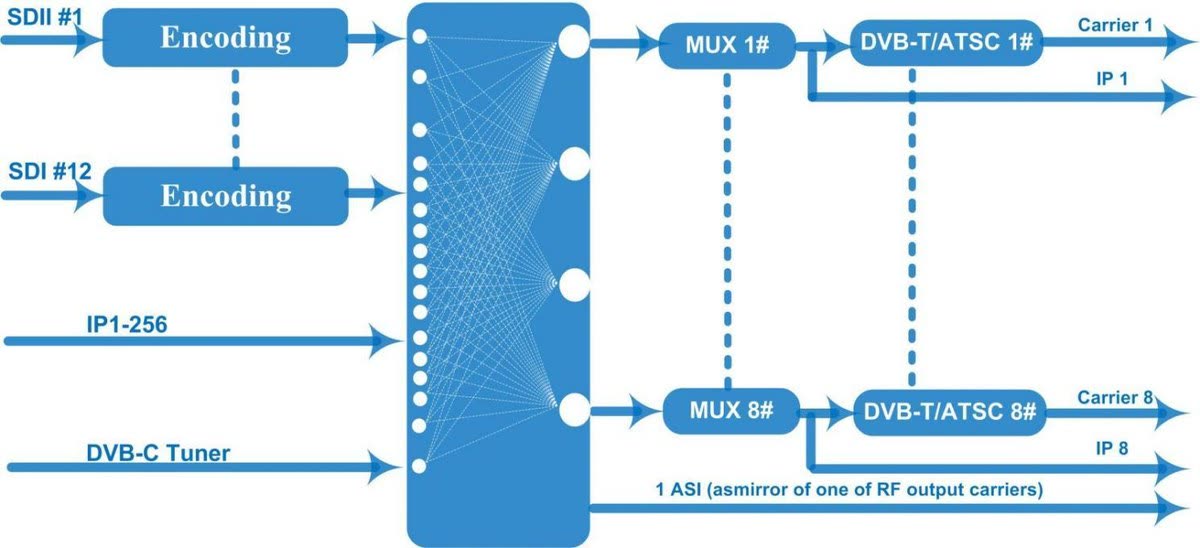
Where the sources are HD-SDI and there are many of them, the FUQ4655AB-2 is the chassis that publishes the widest input block: its page is built around 12 HD-SDI inputs, a DVB-C tuner, up to 512 IP inputs and 16 carriers, with an ASI mirror of one of the RF carriers so the same line-up can be taken off the rack as a transport stream. That mirror row is what makes a dense chassis usable in a mixed plant, because the services can be sent to the IP leg or to a separate modulator bank without another encode.
One Box or Two: Encoder Modulator vs Encoder Plus Modulator
The combined chassis is not always the right answer. Where the rack already holds a modulator bank, or where the encoding has to happen somewhere else in the building, the two-stage route costs less and is easier to grow. The decision comes down to where the transport stream has to exist as a signal.
Two published routes achieve the same RF result. In the first, an encoder modulator does both stages in one 1U chassis, as the FUQ4653B and the FUQ4653 do. In the second, an SDI encoder produces a transport stream and a modulator places it on a carrier: the FUQ4353B encodes "four SDI or HDMI inputs" and publishes its output as ASI and IP in MPTS or SPTS form, and the FUQ4412B takes a TS or ASI input and produces RF.
| Published route | Chassis | Transport between the stages | When it wins |
|---|---|---|---|
| One box | FUQ4653B, FUQ4653, FUQ4653D | none — on the board | one or two channels per site, no existing modulator bank, minimum rack space |
| Encoder plus modulator | FUQ4353B plus FUQ4412B | ASI on BNC, or IP | an existing modulator bank that must be reused, or encoding that has to sit near the source |
| Encoder plus IP QAM bank | FUQ4335X or FUQ3224K plus a chassis such as the FUQ4419U | IP over Ethernet | many services, where the encoding and the carrier plan are sized separately |
| High-density combined | FUQ4655AB-2 | none — 16 carriers in one frame | a plant built once with many HD-SDI sources |
The intermediate case is worth understanding before the order, because it is where most growth happens. The FUQ4335X takes "4-8-12 HD-SDI or HDMI inputs" and publishes HEVC/H.265 and MPEG-4 AVC/H.264 encoding at "0.5Mbps~20 Mbps (each channel)" with IP output only, and the FUQ3224K publishes the same input count with "0.5Mbps~20 Mbps (HEVC/ H.265)" and "4 Mbps~20Mbps (MPEG 4 AVC/H.264)". Neither has an RF stage, so both need a carrier to be produced downstream — which is exactly what an IP QAM modulator such as the FUQ4419U is for, and the coax side of that decision is worked through in our IP to QAM modulator guide.
Where the SDI source has to travel between buildings before it is encoded, the transport stream leg is the one to check first, and the interface choices between SDI, ASI and IP are set out in our SDI to ASI headend guide.
When the Sources Are HDMI, CVBS or IP Instead of SDI?
Most sites mix input types, and the encoder modulator does not care which of them arrives as long as the chassis publishes a module for it. The questions that change are the channel count, the encoding standard and whether the source is high definition at all.
Four input families appear in real projects: HDMI from set-top boxes, media players and cameras; CVBS and YPbPr from older equipment, analogue cameras and legacy modulators; SDI from production; and IP from a network source. Each has a published chassis in the range, and the differences that matter are the input count and the encoding standard rather than the brand of the box at the source end.
| Published source family | Published chassis | Published input count | Published encoding |
|---|---|---|---|
| HDMI and CVBS, small site | FUQ4633B | "HDMI*1" | MPEG2, "1.000~20.000 Mbps" |
| HDMI and CVBS, ISDB-T area | FUQ4633C | "HDMI*1" | "H.264 MP@L 3.0/3.1/4.0", "1.000~18.000 Mbps" |
| HDMI with CVBS and SDI modules | FUQ4654C | modular HDMI with CVBS and SDI modules, one HDMI input for backup | "MPEG2; MPEG4 AVC/H.264" encoding, DVB-S/S2 RF output |
| CVBS at 8 to 24 channels | FUQ4653H | "8-24 CVBS inputs and 4 RF outputs", or CVBS plus a tuner | MPEG-2, "0.5Mbps~8 Mbps each channel" |
| CVBS at 8 to 24 channels with IP output | FUQ4653AB | 8-24 CVBS inputs | "MPEG-2, MPEG4 AVC/H.264", "0.5~5Mbps" |
| Many HDMI plus IP | FUQ4655K | 12 HDMI inputs and 256 IP inputs | "MPEG2 & MPEG4 AVC/H.264", "0.8~19Mbps for H.264 encoding 1~19Mbps for MPEG-2 encoding" |
Two published rows in that table are easy to misread. The first is the difference between a chassis that produces a carrier and one that only produces streams: the FUQ4653AB page publishes a cable-ready encoder with 0.5~5Mbps MPEG-2 and MPEG-4 AVC encoding and an IP output, while the FUQ4653H publishes the same 8-24 CVBS input count with "4 RF outputs" on DVB-C, DVB-T or ISDB-T and its input side listed as "8/12/24 CVBS" or "CVBS plus 1 DVB-C/T/(T)/ISDBT tuner".
The second is the satellite case, which looks like an SDI project from the outside and is not one. Where the source is already an LNB feed or a satellite receiver output and the destination is a terrestrial channel, the route is a transmodulator rather than an encoder: the FUQ4654C converts audio/video into "DVB-S/S2 RF output" from modular HDMI, CVBS, SDI and YPbPr inputs with an ASI input and ASI plus IP outputs, and the 1 IN-1 OUT chassis published as a 1 IN-1 OUT encoder modulator is published for converting DVB-S2 to DVB-T for hotel and broadcast integration. That chain is covered in more depth in our satellite transmodulator guide.
Reading the QAM Rows Before You Order
Five rows decide whether an SDI feed lands on a carrier your televisions can find: the standard, the constellation, the symbol rate, the RF level window and the MER. They are independent rows on the page, and a model can be strong on one and silent on another.
The standard row is the first check because it is the one a television cannot be adapted around. DVB-C networks use J.83A, J.83B or J.83C depending on the region and the plant, and a receiver built for one is not built for the other two. The constellation, symbol rate and bandwidth rows then decide how much payload each carrier carries, and the level and MER rows decide whether the receiving tuner locks comfortably.
| Published model | Published standard | Published constellation | Published symbol rate | Published RF level | Published MER |
|---|---|---|---|---|---|
| FUQ4653D | "J.83A (DVB-C), J.83B, J.83C" | "64/ 256 QAM" | "5.000~9.000 Msps adjustable" | "-30~-10dBm (77~97 dBµV), 0.1dB step" | "≥40dB" |
| FUQ4653B | "J.83A (DVB-C), J.83B, J.83C" | not published on the page | not published on the page | not published on the page | not published on the page |
| FUQ4667 | "J.83A (DVB-C), J.83B" | "16/32/64/128/ 256 QAM" for J.83A and "64/ 256 QAM" for J.83B | "5.000~7.000Msps adjustable" | "-63~ -16dBm, 1dB step" | "≥40dB" |
| FUQ4667XX | "J.83A (DVB-C), J.83B" | "16/32/64/128/ 256 QAM" for J.83A and "64/ 256 QAM" for J.83B | "5.000~7.000Msps adjustable" | "-20~ -5dBm, 1dB step" | "≥40dB" |
| FUQ4633B | "J.83A (DVB-C), J.83B" | not published on the page | not published on the page | "-63~ -16dBm, 1dB step" | "≥35dB" |
| FUQ4454B | "EN300 429/ITU-T J.83A/B/C" | "16/32/64/128/ 256QAM" | "5.0Msps~9.0 Msps, 1ksps stepping" | not published on the page | "≥40db" |
| FUQ4653XY | "EN300 429/ITU-T J.83A/B" | not published on the page | not published on the page | not published on the page | not published on the page |
| FUQ4637TB | "EN300 429/ITU-T J.83A/B" inside the DVB-C row | not published on the page | "5.0Msps~7.0 Msps, 1ksps step" | "-20~+3dBm (87~110 dBµV), 0.1dB step" | "MER: ≥40dB" |
The RF frequency rows are separate from the level rows and are worth checking against the plant you already run. The FUQ4653D publishes "30~960MHz, 1kHz step", the FUQ4667 publishes "100-900MHz, 1kHz step", and the FUQ4633C publishes "150~950MHz, 0.1MHz step" for its ISDB-T output. A modulator whose band starts above the channel you need, or whose step is coarser than the channel plan, cannot be moved to the right carrier afterwards.
One row in that table is not about the modulator at all: the FUQ4637TB publishes scrambling standards of "ETR289, ETSI 101 197, ETSI 103 197" alongside its four DVB-C non-adjacent carriers. Where the line-up has to be scrambled, that row is what decides whether the box can talk to the conditional access system already in the plant, and it is the reason a cheap modulator is not interchangeable with this one.
How Many Carriers Does the Coax Plan Need?
One carrier carries one multiplex, so the carrier count follows the number of transport streams you intend to run, not the number of services. A site with sixty services at 4Mbps each fits comfortably in eight carriers; the same sixty at 15Mbps do not.
The arithmetic is done on published rows. An 8MHz DVB-C carrier at 256QAM holds roughly 38Mbps of payload as a standard-defined figure, an 8MHz DVB-T carrier at 64QAM with a 2/3 code rate and a 1/32 guard interval holds roughly 19.9Mbps, and a 6MHz ATSC carrier at 8VSB holds roughly 19.4Mbps. Those are ceilings; what a site actually carries is decided by the per-service bit rate set at the encoder, which is why the encoder rows matter to the carrier plan.
| Published carrier count | Model | Published shape of the output |
|---|---|---|
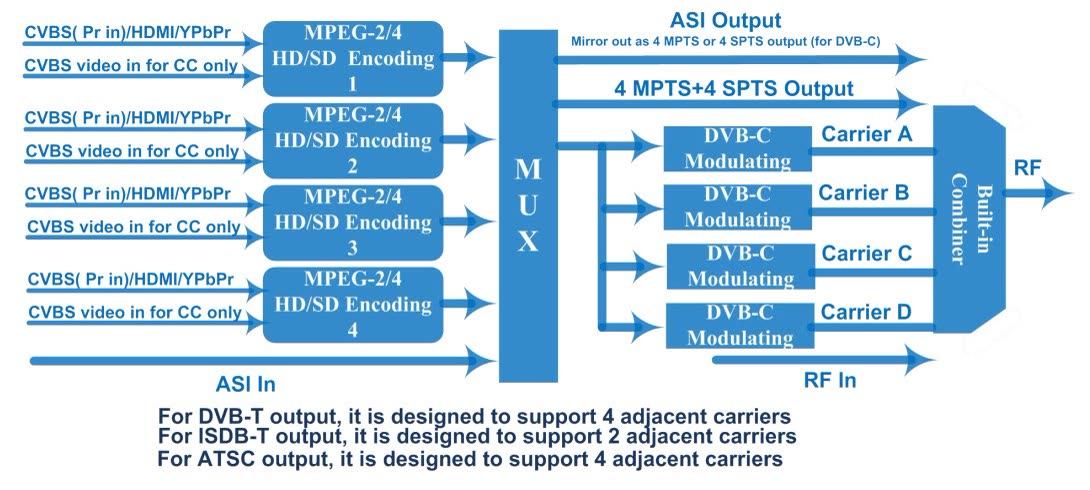
| 4 combined DVB-C carriers | FUQ4653XY | "4*RF DVB-C out (4 carriers combined output)" |
| 4 DVB-C non-adjacent carriers | FUQ4637TB | "4* DVB-C non -adjacent carriers", symbol rate "5.0Msps~7.0 Msps, 1ksps step" |
| 4 adjacent ATSC carriers | FUQ4653D | "4*ATSC adjacent carriers combined output" |
| 8 or 16 or 24 carriers | FUQ4419U | "8 (or 16, or 24)" carriers on GE/SFP ports, from "512 IP streams" or "768 IP streams" |
| 16 non-adjacent DVB-C carriers | FUQ4655BC | "16 non-adjacent carriers output", MPEG-2 at "0.5Mbps~8Mbps per channel", DVB-T to "EN300744" |
| 16 carriers from 12 SDI inputs | FUQ4655AB-2 | 16 carriers, and "optional DVB-T, ATSC or ISDB-T RF output runs fewer carriers with ASI mirroring" |
The word to watch in those rows is adjacent. Adjacent carriers sit next to each other in the band and can be combined and amplified as one block, which is what a site does when it fills a band in one go. Non-adjacent carriers are spread across the spectrum and need a combiner that can handle the spacing, but they fit around carriers that are already occupied by another system. Both appear in the range, and the FUQ4653D and the FUQ4655BC are published on opposite sides of that choice.
The number of carriers per chassis is not the same as the number of channels on the coax. Where a plant already carries services from another system, the SDI-derived carriers have to be placed in the gaps, and that plan is built before the order: the band the modulator can reach, the step it can be tuned in, and the level window it can be set to all have to match the combiner and the amplifiers downstream.
Rack Space, Power and Control Rows
Once the carrier plan is settled, the physical rows decide whether the units fit the equipment room. In this range the SDI-capable encoder modulators span a compact chassis and a full 1U frame, and both classes publish their dimensions and power rather than leaving them to be measured on site.
The compact class is built for one or two channels where the rack is a wall cabinet: the FUQ4653D publishes "333*232*44mm", "2.5 kg" and "AC 100V~240V", the FUQ4633C publishes "183*110*50 mm", "< 1kg" and "DC 12V", and the FUQ4667XX publishes "160*120*52mm" on "DC 12V". The full-width class is built for density: the FUQ4653AB publishes "482mm×410mm ×44mm" at "8kg" and "20W", and the FUQ4454B publishes "482mm×300 mm×44.5mm" at "3.7kg" and "25W".
| Published row | Compact chassis | Full-width 1U chassis |
|---|---|---|
| Dimensions | "333*232*44mm" on the FUQ4653D | "482mm×410mm ×44mm" on the FUQ4653AB |
| Weight | "2.5 kg" on the FUQ4653D | "3.7kg" on the FUQ4454B, "8kg" on the FUQ4653AB |
| Power supply | "AC 100V~240V" on the FUQ4653D, "DC 12V" on the FUQ4667XX | "AC 100V±10%, 50/60Hz; AC 220V±10%, 50/60Hz" on the FUQ4454B |
| Consumption | not published on the FUQ4653D page | "25W" on the FUQ4454B, "20W" on the FUQ4653AB |
| Temperature | "0~45℃" on the FUQ4653D | "0~45℃ (operation), -20~80℃ (storage)" on the FUQ4454B |
| Control | "LCD + control buttons" and "Web NMS" on the FUQ4653D | web management on the FUQ4653 series |
Control is the row that decides how much of the commissioning happens at the front panel. A chassis published with an LCD and control buttons can be set up on site with nothing but a technician and a channel plan; a chassis published with web management only needs a laptop and a management port, which is what most sites prefer once there are more than two carriers to name. Where a device is published with both, as the FUQ4667 is with "Web-GUI, LED+Keyboard", the choice is made on site rather than at the order.
The RF level window has to be read together with the rack rows, because it decides whether an attenuator or an amplifier is needed between the modulator and the combiner. The FUQ4653D publishes a range of "-30~-10dBm (77~97 dBµV)" in "0.1dB step", the FUQ4667XX publishes "-20~ -5dBm, 1dB step", and the FUQ4637TB publishes "-20~+3dBm (87~110 dBµV), 0.1dB step", which is a wider and higher window and suits a plant with a long feeder run to the first tap.
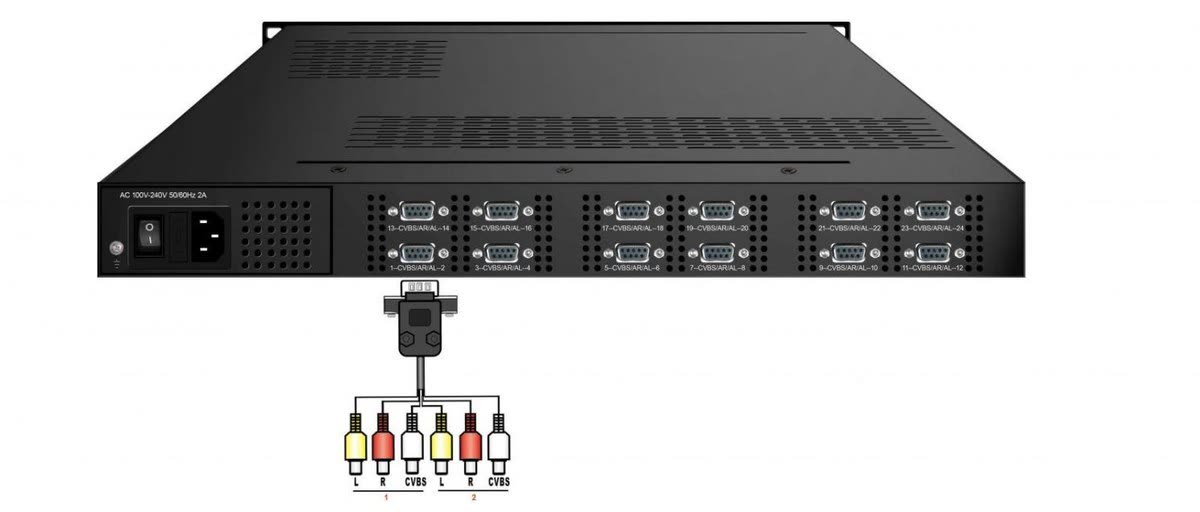
Commissioning: What to Check Before You Leave the Rack
Commissioning an SDI to QAM chain is four measurements in a fixed order, and each one is taken at a different point in the chain. Skipping the order is what turns a working modulator into a service call, because the same symptom — no picture on the television — is produced at every stage.
The order is source, stream, carrier, outlet. At the source, confirm that the SDI or HDMI signal the encoder receives is the standard the chassis is published for. At the stream, confirm that the encoder is producing the services you intended, at the bit rate you set. At the carrier, confirm the frequency, the level and the MER. At the outlet, confirm what the television actually sees when it scans.
| Published tool | Published role | Published rows |
|---|---|---|
| FUQXB transport stream analyzer | reads the transport stream and the RF carrier in the field | "1x ASI and 1x RF (DVB-C) input", real-time analysis at "160Mbps", automatic handling of "188/204-byte packets", offline capture to "120Mbps" |
| FUQ-XQR TS player | feeds a known-good stream into a modulator, switcher or receiver | USB 2.0 input, "108Mbps" through a "DVB-ASI/BNC output" |
| FUQ3515 ASI TS switcher | automatic failover with monitored stream integrity | "1 main plus 2 backup ASI inputs and 2 independent ASI outputs", switching on "bitrate, sync and continuity", "15W" |
| FUQ4713 DVB-ASI distributor | replicates one stream to many units | "2 inputs and 24 outputs" in 6×4 groups, "1-216Mbps", LCD and "SNMP-based NMS" |
| FUQ4619C-2 tuner to IP gateway | brings an existing RF or satellite line-up onto the network | "16 tuner inputs, pairing 2 ASI inputs with a single IP MPTS output", BISS descrambling and PSI/SI management |
| FUQ-10 IP gateway | moves programs between IP protocols without re-encoding | conversion between "SRT, HTTP, UDP, RTP/RTSP, HLS and RTMP", "8-12 HD/SD programs at 8Mbps each", anti-jitter processing, "180×110×40mm" |
The MER and level readings are taken at the modulator output first, then at the last tap, because a carrier that measures clean in the rack and badly at the outlet is a passive-plant problem rather than a modulator problem. The FUQXB covers both the RF and the ASI side of that check with one USB-powered unit, which is the reason it is on the list here: the alternative is to carry a rack modulator to the trouble spot.
Where the coaxial plant is shared with another operator, the level window matters more than the peak level. A carrier set at the top of the modulator's published range and then combined with a plant that is already hot will intermodulate, and the symptom appears on other channels rather than on the new one. The published windows are wide enough to avoid this: the FUQ4653D can be set anywhere between "-30~-10dBm (77~97 dBµV)" and the FUQ4637TB between "-20~+3dBm (87~110 dBµV)", both in 0.1dB steps.
What to Send Us for an SDI to QAM Quotation
A quotation for an SDI to QAM chain is quick when seven facts are on the table, because each one maps to a published row and removes a round of questions. Send them and we return the model list with the datasheet for each exact chassis.
We do not publish list prices. Every quotation is put together against the configuration you confirm, because two sites with the same channel count usually need different input counts, different standards and different rack space.
- The source list: how many SDI sources, at which level — SD-SDI, HD-SDI or 3G-SDI — with the frame rate and resolution of each, and whether any of them are HDMI, YPbPr or CVBS instead.
- The receivers: whether the screens are televisions with a DVB-C, DVB-T, ATSC or ISDB-T tuner, or set-top boxes and players on a network.
- The output standard and the channel plan: which QAM standard your plant uses, which frequencies are free, and how many carriers you intend to run.
- The audio: whether it is embedded in SDI or analogue, whether a Dolby stream has to be passed through, and whether closed captions have to survive the encode.
- Whether the line-up is scrambled, so the conditional access row of the modulator is checked before a model is proposed.
- The rack and the room: units of height available, the mains supply, the ambient temperature, and whether the plant needs an adjacent or a non-adjacent carrier layout.
- The scale you expect in three years, because the difference between a single-channel chassis and a 12-input frame is the decision that is expensive to revisit.
Every unit is built in our Guangzhou factory and runs a 72-hour burn-in before dispatch, and we ship to 200+ countries. Where a page in this range does not publish a row you need — the SDI level of a particular module, or the consumption of a compact chassis — ask for the datasheet and we confirm the figure for that exact model instead of carrying one over from a sibling.
Frequently Asked Questions
What is an SDI to QAM modulator?
An SDI to QAM modulator is one chassis that compresses an SDI source into an MPEG transport stream and modulates that stream onto a QAM carrier, so a television with a QAM tuner finds it by scanning. The FUQ4653B is published with "4x HDMI/SDI and optional ASI inputs" and DVB-C options of "J.83A (DVB-C), J.83B, J.83C", which is that combination in one 1U unit.
Is an SDI to RF modulator the same as an SDI to QAM modulator?
Yes. The modulated carrier leaves the chassis as RF on the coax output, so the unit a page calls an SDI to QAM modulator is the one a buyer asks for as an SDI to RF modulator. The FUQ4653B is published with "4x HDMI/SDI and optional ASI inputs" and DVB-C options of "J.83A (DVB-C), J.83B, J.83C", which is both descriptions in one 1U chassis.
Can I connect an SDI camera straight to a QAM modulator?
Not to a plain modulator, which accepts a transport stream over ASI or IP and has no video input at all. The FUQ4412B is published as a QAM modulator for TS and ASI inputs with RF output, so an SDI camera needs an encoder in front of it. An encoder modulator such as the FUQ4653 takes the SDI source directly, because the encoding stage is inside the same chassis.
Which of your models takes SDI and outputs QAM?
The chassis published with both an SDI input module and a J.83A, J.83B or J.83C output are the FUQ4653, published with modular HDMI and SDI input modules and "DVB-C (Optional) J.83A (DVB-C), J.83B, J.83C", and the FUQ4653B, published with "4x HDMI/SDI" inputs and the same three QAM options. Where the plant carries DVB-T rather than DVB-C, the same two pages publish DVB-T modulation as an option.
What do J.83A, J.83B and J.83C mean on a specification sheet?
They are the three annexes of the ITU-T J.83 standard used for cable QAM, and a plant uses one of them. A receiver built for one annex is not built for the others, which is why the FUQ4653D publishes all three — "J.83A (DVB-C), J.83B, J.83C" — while the FUQ4667 publishes only "J.83A (DVB-C), J.83B" and the FUQ4454B publishes the underlying standard as "EN300 429/ITU-T J.83A/B/C".
How many SDI channels can one chassis encode and modulate?
It follows the published input count of the model rather than a rule of thumb. The FUQ4653B publishes four HDMI/SDI inputs, the FUQ4655AB-2 publishes 12 HD-SDI inputs with 16 carriers, and the encoders that only produce streams publish 4-8-12 inputs on the FUQ4335X and the FUQ3224K. Tell us the channel count and we match it to the input cards that cover it.
Do I need a separate encoder if the receivers are televisions on coax?
No, if the chassis you buy has the encoding stage inside it. Televisions on coax need a carrier, and that carrier can be produced by an encoder modulator in one box or by a modulator fed from a separate encoder. The two-box route wins where an existing modulator bank has to be reused; the one-box route wins where the rack is new, which is why the FUQ4653D publishes four combined adjacent carriers in a "333*232*44mm" chassis with "AC 100V~240V" power.
What should I check on the television before I order the modulator?
The standard it can tune, because that decides the modulator. A television that scans DVB-C cannot find a DVB-T carrier, and the opposite is equally true, so the receiver list is the first document in the project. The comparison between the standards, including ATSC and ISDB-T, is set out in our modulator standard comparison guide.
What do you need to quote an SDI to QAM system?
The SDI level and count of the sources, the standard and tuner capability of the receivers, the QAM standard and the free frequencies in your plant, whether audio and captions have to survive the encode, whether the line-up is scrambled, the rack space and power available, and the channel count you expect in three years. Send that list through the contact form and we return the model confirmation with a datasheet for each model and a quotation.
If the SDI stage is one part of a bigger headend, the SDI to ASI headend guide covers the interface and transport side of the same chain, the IP to QAM modulator guide works through the coax leg where the sources arrive as IP, the HDMI to coax modulator guide handles the HDMI input family in the same depth, and the headend installation checklist covers rack, cabling and commissioning. The encoder modulator, modulator, encoder and supporting devices pages list the lines these models come from, and the solutions pages show the chains end to end.
Previous
SMATV System Design: Components and Headend Choices
Next
Campus IPTV System: Headend and Dorm Distribution
Talk to the headend engineers before you specify
Send the model number you are looking at — or the channel count and the input and output formats you work with — and we answer with the datasheet, the configuration and a written price. The reply comes from the headend team in Guangzhou, not a sales line.