SDI to ASI and QAM: Headend Signal Paths
SDI to ASI, SDI to QAM and ASI to IP: the encoders, modulators, distributors and gateways that carry broadcast signals through a headend. Each model named in this article is one of 190 in the Hanxing catalogue, published with its own specifications and datasheet.
Hanxing Team
Broadcast & IPTV Experts
The path this guide walks
- SDI sourcea camera, playout server or switcher on a 75-ohm BNC cable
- Encodean SDI, HDMI or CVBS encoder compresses it into a transport stream
- ASI or IPthe stream travels the rack as ASI on coax, or as IP on Ethernet
- Converta gateway moves it between the ASI and IP legs without re-encoding
- Modulatea modulator places it on a DVB-C, DVB-T, ATSC or ISDB-T carrier
- Delivercoax to the television tuner, or the LAN to set-top boxes
The interface stage is where baseband SDI meets MPEG transport streams: everything upstream is production, everything downstream is distribution.
Broadcast sites start with SDI. A camera, a playout server or a production switcher puts a serial digital signal on a BNC cable, and that signal is uncompressed baseband video. A headend does not work that way. Every multiplexer, gateway, distributor and modulator in the rack moves MPEG transport streams, over ASI on a BNC or over IP on Ethernet, and nothing in the chain can switch, multiplex or modulate baseband to air. The conversion between the two worlds is the interface stage of the headend, and this guide maps it end to end.
Everything quoted below is printed on the product page of the model it belongs to. Where a page does not publish a value, this guide says so and sends you to the datasheet rather than estimating it, because an interface is bought on input standard, transport and port count, and a guessed figure only shows up when the rack is already wired.
What Is SDI, and Why Can't It Enter a Headend Directly?
SDI is a serial digital interface: uncompressed video and embedded audio carried on 75-ohm coax with a BNC connector, defined in three levels — SD-SDI to SMPTE 259M, HD-SDI to SMPTE 292M and 3G-SDI to SMPTE 424M. A headend cannot multiplex, scramble or modulate it, because every stage in the rack works on MPEG transport streams, not baseband.
The reason is bandwidth. A single uncompressed 1080i HD-SDI stream runs at about 1.485 Gbps, and no building network, ASI port or RF channel carries that. Compression is what makes distribution possible at all: an encoder brings each service down to a published range of a few megabits, and everything behind it — remultiplexer, scrambler, gateway, modulator — is sized on those numbers.
The three SDI levels are named in the specification rows of our capture card, which is where a designer confirms what a port actually accepts rather than assuming every BNC is the same:
| SDI level | Published standard | Published on |
|---|---|---|
| 3G-SDI | SMPTE 424M Standard | FUQ204B capture card |
| HD-SDI | SMPTE 292M Standard | FUQ204B capture card |
| SD-SDI | SMPTE 259M Standard | FUQ204B capture card |
| DVB-ASI | EN50083-9 | FUQ204B capture card |
Two habits are worth keeping from that table. The first is that SDI and ASI use the same BNC connector and completely different signals — one is baseband video, the other is a compressed transport stream — so a cable that fits is not a signal that works. The second is that the SDI level of the sources decides which encoder you can use: a 3G-SDI camera at 1080p60 needs a chassis published for that level, and a legacy CVBS feed can go into an SD encoder instead.
SDI to ASI: The Encoder That Produces the Transport Stream
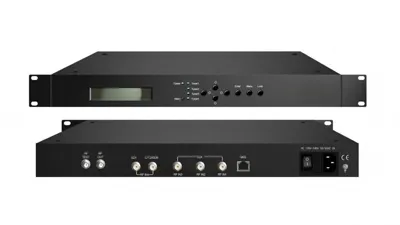
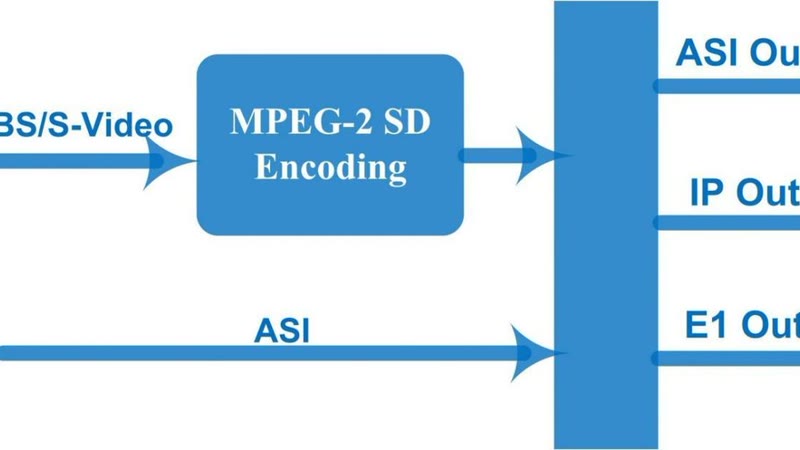
The SDI to ASI stage is an encoder. It compresses the SDI video with MPEG-2, H.264 or HEVC, wraps the result into an MPEG transport stream and delivers it on a BNC ASI port, where the multiplexer, the scrambler or the modulator behind it can pick it up. Without that box there is no stream to route.
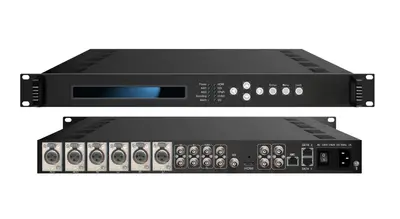
Our FUQ4322C HD encoder is the model built for that job. Its page publishes video inputs across HDMI, SDI, YPbPr and CVBS on one chassis, encoding "MPEG-2 HD/SD, MPEG-4 AVC/H.264 HD/SD" at a "Bitrate Range" of "2.5 – 19.00 Mbps", audio in "MPEG-1 Layer II, HE-AAC (v1&v2), LC-AAC, DD AC3 (2.0)" with AC3 pass-through on the SDI and HDMI inputs, and a "Low Delay" row of "150ms - 650ms". The output side is what makes it an interface box rather than a plain encoder: it publishes "2 ASI Input for remux" and "2×ASI output ports, BNC interface", so it can take an existing transport stream in, add its own encoded services to it and hand the combined stream on without a separate multiplexer in the rack.
Closed captioning is published on the same page as "EIA 608 and EIA 708", which matters where the SDI feed carries embedded captions that must survive the encode. The chassis is 482mm×405mm×44.5mm and draws 16W.
Smaller sites usually want the same function with fewer channels:
| Model | Published SDI input | Published codec and bit rate | Published output |
|---|---|---|---|
| FUQ4322C | SDI plus HDMI, YPbPr and CVBS on one chassis | MPEG-2 HD/SD; MPEG-4 AVC/H.264 HD/SD; 2.5 – 19.00 Mbps | 2×ASI output ports on BNC, plus IP; 2 ASI inputs for remux |
| FUQ4322AB | 1×HD-SDI and 1×HDMI | HEVC/H.265 0.5 – 20.00 Mbps; MPEG-4 AVC/H.264 4 – 20.00 Mbps | 2×ASI output ports on BNC, plus IP; 2 ASI inputs for remux |
| FUQ4353 | pluggable 3G-SDI, HDMI, YPbPr and CVBS inputs | MPEG-2 and H.264, MP2 / AAC / AC3 audio | 2 ASI out on BNC (MPTS or SPTS), IP (1 MPTS and 2 SPTS) over UDP, RTP/RTSP |
| FUQ4335X | 4-8-12 HD-SDI or HDMI inputs | HEVC/H.265 or H.264; 0.5Mbps~20 Mbps each channel | IP streams over UDP, RTP and RTSP |
| FUQ3224K | 4-8-12 channel HD-SDI and HDMI 1.4 | HEVC/H.265 0.5Mbps~20 Mbps; H.264 4 Mbps~20Mbps | Gigabit IP output |
| FUQ4312D | 4 inputs across CVBS, S-Video and SD-SDI | MPEG-2 SD; 720×480 59.94i and 720×576 50i | ASI or UDP/IP transport streams |
The split between those models is the usual one: how many channels you have to encode, and whether the next box in the rack wants ASI or IP. Where the run is IP-only, the HD-SDI encoders in the lower half of the table are enough, because they publish Gigabit IP output and no ASI port. Where an existing ASI multiplexer or modulator has to be fed, the models with BNC ASI outputs are the ones that fit, and the two ASI remux inputs on the FUQ4322C and the FUQ4322AB mean the encoded services can join a stream that is already running instead of being carried alongside it.
SDI to QAM: When the Receivers Are Ordinary Televisions
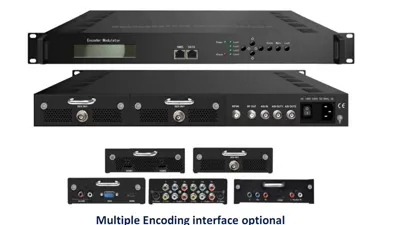
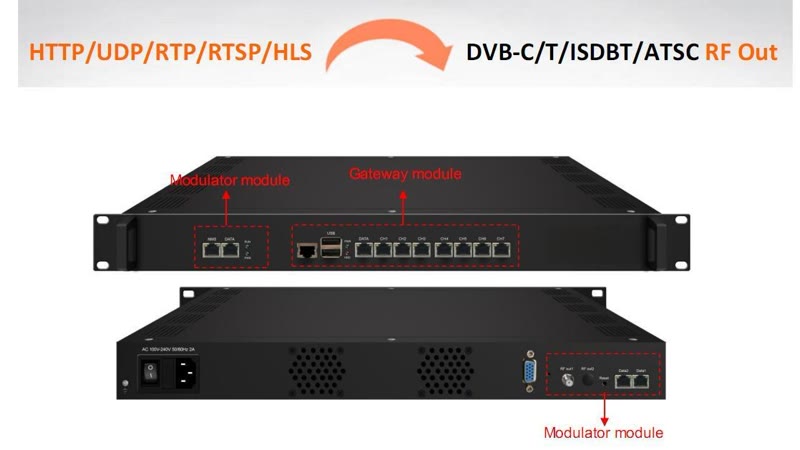
Where the screens are televisions with their own tuners on a coax plant, an SDI feed has to end on an RF carrier rather than on an ASI port. The encoder modulator does both steps in one chassis: it compresses the SDI or HDMI source and puts the result on a DVB-C, DVB-T, ATSC or ISDB-T channel the television scans.
The FUQ4653 is the model that takes SDI directly. Its modular input drawer accepts HDMI and SDI modules, the chassis publishes ASI and IP outputs, and the modulation rows are printed as options on the page: "DVB-T (Optional)" at "6M, 7M, 8M" bandwidth and "DVB-C (Optional)" at "J.83A (DVB-C), J.83B, J.83C". Video is encoded in MPEG2 or MPEG-4 AVC/H.264, with audio in "MPEG1 Layer II;MPEG 2-AAC; MPEG 4-AAC and Dolby Digital AC3 2.0".
Two other routes reach the same RF output, and both are common on real projects:
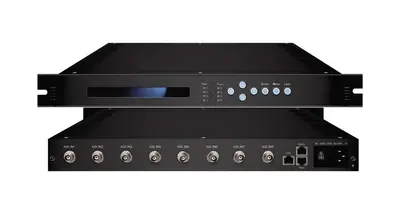
- Encode first, modulate second. An SDI to ASI encoder such as the FUQ4322C produces the transport stream, and a single-channel QAM modulator with an ASI input places it on a carrier — the FUQ4412B publishes one ASI channel in and an RF out in a 482mm×300mm×44mm chassis drawing 22W.
- A 4K or multi-input modulator that also accepts ASI. The FUQ4653U takes dual HDMI 2.0, 2×ASI and 32×IP inputs and outputs DVB-C and DVB-T, encoding H.265/HEVC and H.264/AVC from "1Mbps~23 Mbps" up to "3840×2160 60P". Its ASI inputs are the way a service that was already encoded from SDI elsewhere in the plant gets onto RF here.
For ATSC networks the modulator publishes the standard rather than a band, which is the row to check first: the FUQ3514B accepts "dual-channel DVB-ASI and SMPTE-310 inputs", modulates to "ATSC A/53" with "8VSB" constellation over a "50~860MHz, 1Hz stepping" RF range, and publishes an MER of "≥ 40dB" with a shoulder level of "60dB". Its 8VSB output is what an ATSC television or set-top box tunes, and its DPD row — "over 10dB ACPR improvement (normally)" — is the one that keeps adjacent channels clean in a full rack.
| Route | What the SDI feed becomes | Model to specify |
|---|---|---|
| SDI to ASI, then a separate modulator | a transport stream on BNC, then an RF carrier | FUQ4322C plus FUQ4412B |
| SDI straight to RF | an RF carrier in one chassis | FUQ4653 |
| SDI to ASI to QAM for an ATSC plant | 8VSB carrier from an ASI or SMPTE-310 input | FUQ3514B |
| 4K or multi-source to RF | DVB-C / DVB-T carriers from HDMI, ASI and IP inputs | FUQ4653U |
ASI in the Rack: Distribution, Switching and Redundancy
ASI survives in modern headends because it is the cheapest way to carry a transport stream across a rack or a building without involving a network: point-to-point on 75-ohm coax, no switch, no multicast, no configuration. That is why the interface stage usually includes a distribution amplifier and a switcher as well as the encoder.
The FUQ4713 is the distributor in our range. It is published as routing "1-216Mbps ASI signals" through 2 inputs and 24 outputs in "6×4 groups", with output replication synchronised across all ports so that every copy of the stream is identical, and with an LCD display, front-panel keyboard and SNMP/NMS control for the rack.
The FUQ3515 is the redundancy piece. It is published as carrying "1 main plus 2 backup ASI inputs and 2 independent ASI outputs", switching automatically on "TS packet integrity monitoring of bitrate, sync and continuity" — the three checks that decide whether the stream is still worth distributing. It carries the 188-byte TS packet format and draws 15W from AC mains, with web-based control and firmware upgrades, so it fits alongside a modulator bank without a separate power budget.
| Device | Published function | Published capacity | Published power |
|---|---|---|---|
| FUQ4713 DVB-ASI distributor | replicate one ASI stream to many destinations | 2 inputs, 24 outputs in 6×4 groups, 1-216Mbps | not published on the page |
| FUQ3515 ASI TS switcher | automatic failover between a main and two backup feeds | 3 ASI inputs (1 main + 2 backup), 2 ASI outputs | 15W |
Where a page above reads "not published", the value is genuinely absent from that model's specification table. Ask for the datasheet of the exact model and we confirm the row rather than quoting a neighbouring unit's figure into the design.
ASI to IP and IP to ASI: Where the Rack Meets the Network
Most headends today are mixed: the sources arrive as carriers or as ASI, the distribution is IP, and the conversion between the two legs sits in a gateway. The gateway does not re-encode — it takes the transport stream it finds and republishes it, which is why it costs a fraction of the equivalent encoder.
The FUQ4619B-2 ASI to IP gateway is published with 8 ASI inputs and "20/32/256 SPTS" outputs, a "Transmission Bit-rate" row of "Maximum total bit-rate is 400Mbps—256 SPTS output", and one Gigabit IP output. In the other direction the FUQ4618RY publishes 12 channels of IP to ASI conversion with dual Gigabit Ethernet inputs on RJ45 or SFP, carrying "MPTS/SPTS" with PCR timing restoration and jitter correction. The FUQ4618SY publishes the same 12 output channels at "840Mbps throughput", with dual BNC interfaces on each channel.
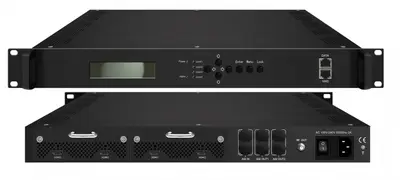
Where the rack is dense, the modular version takes the same job into a 1U frame: the FUQ4618PX is published as a modular gateway with three hot-swappable cards, each card handling "512 SPTS/MPTS" streams over UDP/RTP with CA filtering and PCR correction, and with dual Gigabit Ethernet ports for one input and one output.
| Model | Direction | Published capacity | Published power |
|---|---|---|---|
| FUQ4619B-2 | ASI to IP | 8 ASI inputs to 20/32/256 SPTS; 400Mbps total | 20W |
| FUQ4618RY | IP to ASI | 12 IP channels, MPTS/SPTS, dual Gigabit RJ45/SFP | 22W |
| FUQ4618SY | IP to ASI | 12 output channels, 840Mbps throughput, dual BNC per channel | 22W |
| FUQ4618PX | IP to ASI, modular | 3 hot-swappable cards, 512 SPTS/MPTS per card | 20W |
The capacity row is the one that sizes the project. A gateway published at 400Mbps with 256 SPTS outputs is a statement about the *sum* of the streams it can carry, not about 256 services at full bit rate: 256 services at 1.5 Mbps fit comfortably inside 400 Mbps, while the same 256 services at 8 Mbps do not. Read both numbers — total bit rate and stream count — against the channel plan you intend to run, and treat the lower of the two as the real ceiling.
SDI Into a Server: Capture, Playback and Test
Not every SDI signal goes to air. Studios capture SDI into a server for editing, engineering rooms play transport streams back into a modulator to test it, and both jobs need interfaces that a headend chassis does not provide. Those are separate models, and they are the ones buyers miss when they plan a rack.
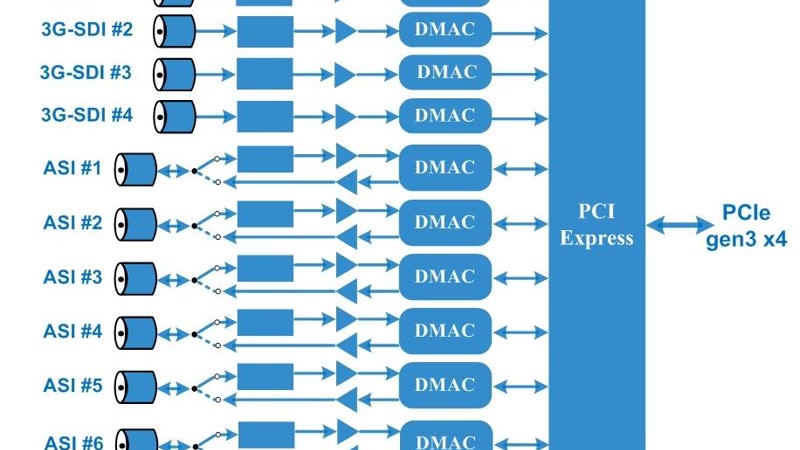
The FUQ204B capture card carries 4×3G-SDI Level A-B inputs and 6 bi-directional ASI ports on a PCIe3 x4 host interface. Its published standard rows are the SDI levels themselves — "SMPTE 424M Standard", "SMPTE 292M Standard", "SMPTE 259M Standard" — alongside "DVB-ASI: EN50083-9" on the ASI side, and it is published for "Linux ≥ 4.x, 5.x" hosts with DMA transfer for low latency. In a headend context that card is how an SDI source is recorded, analysed or re-streamed without an encoder.
The FUQ-XQR closes the loop from the other end. It takes USB 2.0 in and delivers "108Mbps" through a DVB-ASI/BNC output, generating DVB-compliant HD and SD signals for testing. A modulator, a switcher or an IRD that behaves correctly in the rack but not on air can be exercised with it before the rack is installed. The FUQXB transport stream analyzer is the measurement counterpart: 1× ASI and 1× RF (DVB-C) input, real-time analysis at 160Mbps, automatic handling of 188- and 204-byte packets, and offline capture up to 120Mbps.
The rack these paths belong to is laid out stage by stage in the IPTV headend equipment guide, its network end is covered in the DVB to IP gateway guide, and the broadcast version, an SDI source feeding ordinary televisions, in the SDI to QAM modulator guide.
Which Path Fits Your Project?
A single table settles most SDI projects, because the answer follows from the receiver at the far end rather than from the source. Work backwards: identify what has to tune or decode the service, and the path becomes a choice between two or three models.
| Source on site | Receiver at the far end | Path | Model to specify |
|---|---|---|---|
| SDI camera or playout server | an existing ASI multiplexer or modulator | SDI to ASI, then distribute | FUQ4322C, FUQ4713 |
| SDI camera or playout server | a television on coax | SDI to QAM in one chassis | FUQ4653 |
| SDI or HDMI sources | set-top boxes and smart TVs on the LAN | HD-SDI or HDMI to IP | FUQ4335X, FUQ3224K |
| SDI in a remote or contribution link | a headend that receives IP | SDI to IP, then ASI where the rack wants it | FUQ4322AB, then a FUQ4618RY gateway |
| ASI feeds already running | an IP distribution network | ASI to IP gateway, no re-encoding | FUQ4619B-2 |
| Broadcast feeds on a redundant path | a modulator bank that must not stop | TS switching between a main and two backups | FUQ3515 |
Two details decide the last column in practice, and both are published rather than implied. The first is the input level: a 3G-SDI source needs a chassis whose page names 3G-SDI, not one that only lists HD-SDI. The second is the output the next box expects — an ASI BNC, an IP stream, or an RF carrier — because that is the interface the encoder has to publish, and a model that only offers one of the three cannot be adapted later.
Capacity: Bit Rate, Port Speed and Stream Counts
Interface capacity is arithmetic on published rows, and it is worth doing before the order rather than at commissioning. The numbers to collect are the per-service bit rate from the encoder page, the total bit rate or throughput from the gateway page, and the ASI port speed from the distributor page.
| Stage | Published figure | Model page |
|---|---|---|
| Encode | "2.5 – 19.00 Mbps" per service | FUQ4322C |
| Encode | HEVC/H.265 "0.5 – 20.00 Mbps", H.264 "4 – 20.00 Mbps" | FUQ4322AB |
| Encode | "0.5Mbps~20 Mbps" each channel | FUQ4335X |
| ASI distribution | "1-216Mbps" per ASI path | FUQ4713 |
| ASI to IP | "Maximum total bit-rate is 400Mbps—256 SPTS output" | FUQ4619B-2 |
| IP to ASI | "840Mbps throughput" on 12 output channels | FUQ4618SY |
Read those rows together and the design choices appear. A gateway published at 400 Mbps total carries about 50 services at 8 Mbps, or 21 services at the top of the FUQ4322C published range of 19 Mbps, so the same box covers a small line-up comfortably and a large one only at low bit rates. A single ASI path published at 1-216Mbps carries roughly 27 services at 8 Mbps, which is why a signal fed to several modulators from one distribution amplifier usually has room to spare but not unlimited room.
Two limits are easy to miss. The first is the stream-count ceiling that comes with the bit-rate ceiling — a gateway cannot exceed either the total or the count. The second is that the ASI side and the IP side of a headend are sized separately: an 840Mbps IP-to-ASI gateway does not make the ASI distribution behind it faster, and a 400Mbps ASI-to-IP gateway does not raise the throughput of the network it feeds. Size each leg on its own published row.
Rack Space, Power and Control
Once the path is fixed, the physical rows decide whether the units fit the rack and the power budget. Where a page publishes a dimension, a consumption figure or a temperature, it is quoted below; where it does not, the table says so rather than borrowing a value from a neighbouring model in the same line.
| Model | Published dimensions | Published consumption | Published temperature |
|---|---|---|---|
| FUQ4322C | 482mm×405mm ×44.5mm | 16W | Not published on the page |
| FUQ4322AB | 482mm×405 mm×44.5mm | not published on the page | not published on the page |
| FUQ4312D | 482mm×455mm×44.5mm | not published on the page | 0~45℃ (operation), -20~80℃ (storage) |
| FUQ4412B | 482mm×300mm×44mm | 22W | 0~45℃ (operation), -20~80℃ (storage) |
| FUQ3515 | not published on the page | 15W | 0~45℃ (work), -20~80℃ |
| FUQ4618RY | not published on the page | 22W | 0~45℃ (operation), -20~80℃ (storage) |
| FUQ4618PX | not published on the page | 20W | not published on the page |
Control and monitoring are published the same way. The FUQ4322C runs from "LCD/keyboard and web management", the FUQ4312D publishes "LCD/keyboard, network management(NMS)", the FUQ4412B puts local control on "an LCD and keyboard" with NMS for the remote side, and the FUQ4713 publishes an LCD display, front-panel keyboard and SNMP-based NMS. The FUQ3515 publishes "web-based control and firmware upgrades" from its 1RU chassis, and the FUQ4618RY, the FUQ4618SY and the FUQ4618PX publish web, LCD or SNMP management on the gateway side. In practice that means the interface stage can be commissioned from the front panel with a laptop on the management port, and left to report over the building network afterwards.
Every unit is built in our own factory in Guangzhou and runs a 72-hour burn-in before dispatch, so an interface shelf that will never be switched off does not start its life on an untested sample. Where a row reads "not published on the page" above, the model's specification table genuinely does not carry it — ask for the datasheet and we confirm the value for the exact configuration instead of estimating it.
What to Send Us for a Quotation
An SDI interface quotation is quick when the six facts below are on the table, because each one maps to a published row and removes a round of questions. Send them and we return the models that fit, their datasheets and a factory-direct price.
- The source standard. 3G-SDI, HD-SDI or SD-SDI, and the frame rate and resolution, because the encoder has to be published for that level.
- The channel count. How many SDI sources have to be encoded at once, and whether they are all on site now or arrive in phases.
- The audio. Embedded SDI audio, AES/EBU or analog, and the audio codec the receivers expect.
- The next box in the chain. An ASI BNC, an IP network, or an RF carrier — this decides whether the encoder, the encoder modulator or the gateway is the unit to specify.
- The receiver at the far end. A television with a DVB-C, DVB-T, ATSC or ISDB-T tuner, a set-top box, or a server on the LAN.
- The rack and the mains. Units of height available, the RF channel plan if the output is coax, and the AC supply in the room.
Frequently Asked Questions
What is the difference between SDI and ASI?
SDI carries uncompressed baseband video and audio on 75-ohm coax, and a 1080i stream runs at about 1.485 Gbps. ASI carries a compressed MPEG transport stream on the same kind of BNC cable at a published rate such as 1-216Mbps on the FUQ4713. A headend needs the ASI form; the SDI form has to be encoded first.
Can I connect an SDI camera straight to a QAM modulator?
Only through an encoder modulator, which compresses the SDI source and modulates it in one chassis. The FUQ4653 is published with HDMI and SDI input modules and DVB-T and DVB-C modulation options, so it takes the camera on one side and feeds coax televisions on the other. A plain modulator without an encoding stage cannot accept SDI at all.
Which model converts SDI to ASI?
The FUQ4322C encodes SDI, HDMI, YPbPr and CVBS video to MPEG-2 or H.264 at "2.5 – 19.00 Mbps" and publishes "2×ASI output ports, BNC interface". The FUQ4322AB does the same job for one HD-SDI and one HDMI input with HEVC/H.265 as well. Both also publish two ASI remux inputs.
How many SDI channels can one chassis encode?
It follows the published input count rather than a rule of thumb. The FUQ4322C takes 4 inputs across HDMI, SDI, YPbPr and CVBS, the FUQ4335X and the FUQ3224K publish 4-8-12 HD-SDI or HDMI inputs, and the FUQ4322AB is a 2-input chassis. Tell us the channel count and we match it to the input cards that cover it.
Do I still need ASI if the whole installation is IP?
Not for distribution, but usually for the interface. The FUQ4618RY gateway converts IP back to ASI in 12 channels, and the FUQ3515 switches between ASI feeds with automatic failback. Where a modulator or a multiplexer in the rack only accepts ASI, those two boxes are what connect it to the IP side.
What bit rate does one HD service take?
The encoders publish their own ranges: "2.5 – 19.00 Mbps" on the FUQ4322C, HEVC/H.265 "0.5 – 20.00 Mbps" and H.264 "4 – 20.00 Mbps" on the FUQ4322AB, and "0.5Mbps~20 Mbps" each channel on the FUQ4335X. Use the figure for the model you are specifying; a gateway published at 400 Mbps total carries about 50 services at 8 Mbps.
How do I get the datasheet and a factory-direct price?
Send the source standard, the channel count, the audio format, the interface the next box expects, the receiver at the far end, and the rack space available. We reply with the model list, the datasheet for each exact model, and the price, lead time and shipping options. Every unit is built in our Guangzhou factory, runs a 72-hour burn-in, and we ship to 200+ countries.
If the SDI stage is one part of a bigger project, the IPTV encoder guide covers the encoding choices in more depth, the DVB to IP gateway guide and the transport stream multiplexer guide pick up the chain behind it, the HDMI to coax modulator guide and the IP to QAM modulator guide cover the coax leg, and the CATV headend equipment guide maps the whole rack stage by stage. The encoder, encoder modulator, modulator, IP gateway and other devices pages list the lines these models come from, and the solutions pages show the chains end to end. Tell us the sources, the receiver and the rack, and we will match the model and quote it — the fastest route is the contact form, and the FAQ answers the commercial questions first.
Previous
Satellite Modulator: DVB-S, DVB-S2 and DVB-S2X
Next
Digital Headend System: CATV Headend Equipment
Talk to the headend engineers before you specify
Send the model number you are looking at — or the channel count and the input and output formats you work with — and we answer with the datasheet, the configuration and a written price. The reply comes from the headend team in Guangzhou, not a sales line.