IP to QAM Modulator: Send IPTV Channels to Coax TVs
An IP to QAM modulator turns IPTV streams into DVB-C RF channels that legacy coax TVs can tune. Datasheet specs, channel-plan steps and model selection. Each model named in this article is one of 190 in the Hanxing catalogue, published with its own specifications and datasheet.
Hanxing Team
Broadcast & IPTV Experts
The path this guide walks
- IP streams inIPTV source, headend or playout
- IP to QAM modulatorone to 64 carriers
- RF outcombined onto the coax
- Coax distributionthe building’s existing cabling
- Existing TVsno new set-top box needed
The point of the conversion: the TVs at the far end stay exactly as they are.
An IP to QAM modulator takes the MPEG transport streams your IPTV headend already produces and puts them on DVB-C carriers, so a coaxial television finds them with an ordinary channel scan. The published range covers 192 to 1,536 IP inputs, 4 to 112 QAM carriers, RF output across 50–960 MHz in 1 kHz steps, and MER of 40 dB or better on every model that publishes the row.
That sentence hides the three decisions that decide an order: the output standard, the carriers your channel list occupies, and the input capacity behind them. The standard is settled in the DVB-C, DVB-T and ATSC modulator guide; this page stays on the IP-to-coax leg.
What Is an IP to QAM Modulator?
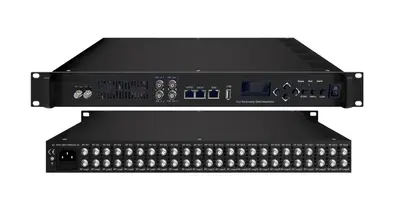
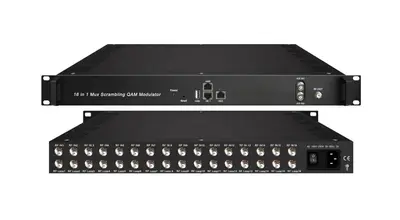
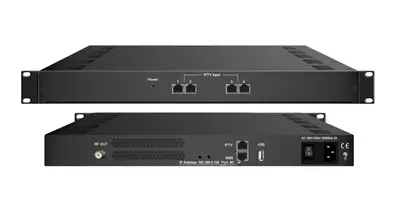
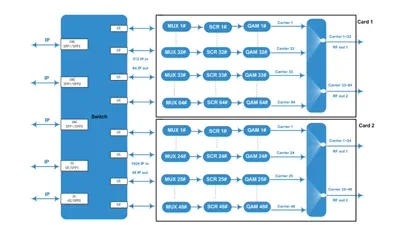
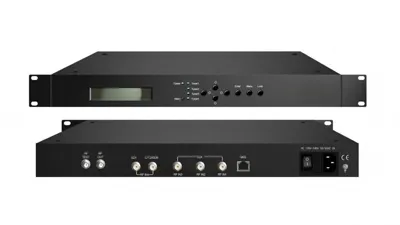
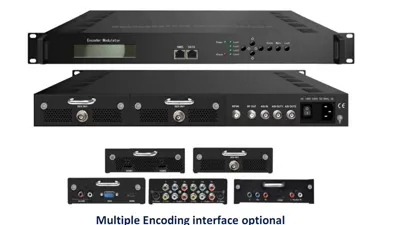
An IP to QAM modulator is a headend chassis that receives MPEG transport streams as UDP or RTP over Ethernet, remultiplexes and optionally scrambles them, then modulates the result onto DVB-C QAM carriers on coaxial cable. Most units in this range do all three stages inside one rack unit.
The three stages are published separately on each model page:
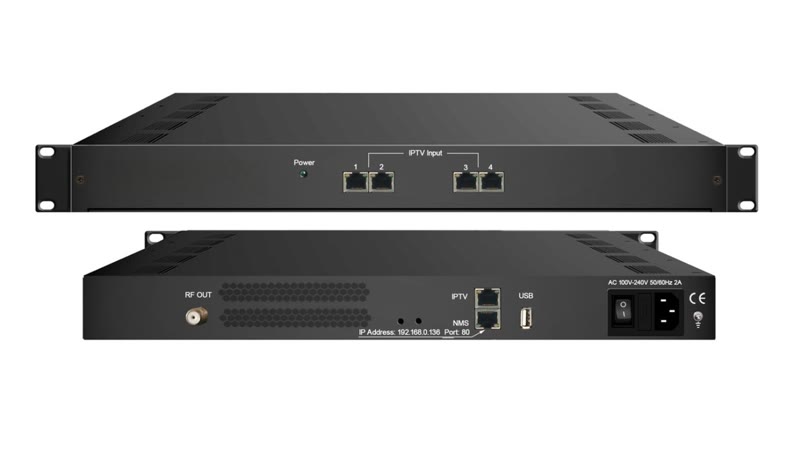
- Input. Transport streams over UDP or RTP, unicast or multicast with IGMP V2/V3, as printed on the FUQ4427, the FUQ4443 V2, the FUQ4459E and the FUQ200A and FUQ200B. The FUQ4443 V2 adds 6 ASI inputs as a second path, and the FUQ44105B v3 accepts 128 IP inputs beside 24 or 16 tuner inputs.
- Processing. PID remapping, automatically or manually, with a published limit per channel: 180 on the FUQ4427, 256 on the FUQ4443 V2 and the FUQ200A and FUQ200B, 512 on the FUQ4459E, 748 per input channel on the FUQ4455B. Scrambling is published on most models as ETR289, ETSI 101 197 and ETSI 103 197, connected locally or remotely.
- Output. QAM carriers on an F-type 75 Ω port, tunable across 50–960 MHz in 1 kHz steps, at a level from −20 to +10 dBm (87–117 dBµV) in 0.1 dB steps on the FUQ4443 V2, the FUQ4459E and both FUQ200 platforms.
Direction matters, because half the wrong orders are reverse orders. A QAM modulator takes IP in and puts RF out. Where satellite, cable or terrestrial feeds have to become IP streams, the device is a tuner-to-IP gateway, and the FUQ4619C is the reference for that direction in this catalogue.
Is an IP to QAM Converter the Same Thing as a Modulator?
Yes. Buyers search for an IP to QAM converter, an IPTV to QAM modulator, an edge QAM or an IP-to-coax headend, and the catalogue answers all four with the same class of chassis. What changes between the names is direction and output standard, never the hardware class.
| Term you may search | What the hardware actually is |
|---|---|
| IP to QAM modulator, IP to QAM converter | The same chassis: IP in, DVB-C carriers out |
| IPTV to cable modulator, IPTV to QAM | The same device, described by the hotel and MDU projects that buy it |
| Edge QAM | Operator wording for the same IP-in, RF-out stage in a cable plant |
| Coax to IP converter, QAM to IP | The reverse direction — a tuner-to-IP gateway, not this device |
| IP to DVB-T modulator | Same class, EN300 744 output: the FUQ4415B or the FUQ4419U |
| IP to ATSC modulator | Same class, ATSC A/53 8VSB output: the FUQ4419BX |
| IP to ISDB-T modulator | Same class, ARIB STD-B31 output: the FUQ4417 |
One distinction matters at enquiry stage: a converter that takes RF in and publishes streams is the opposite product, and pairing the wrong one leaves the coax wing without carriers at all. Where the source is SDI rather than IP, the stages come apart differently — see the SDI to QAM modulator guide.
How Many Channels Fit on One QAM Carrier?
A carrier carries one multiplex, and its ceiling is the symbol rate multiplied by the bits per symbol, then reduced by the 188/204 coding overhead. At 256 QAM and 7.0 Msps that is 51.6 Mbit/s — about six HD programs at 8 Mbit/s each, before any stuffing.
Buyers tend to ask it as a per-stream question — IP stream to QAM capacity — but the ceiling belongs to the standard, not to the chassis. A different model changes the carrier count and the PID budget, not the bits one 8 MHz carrier can carry.
| Published rows used | Symbol rate (Msps) | Bits per symbol | Payload (Mbit/s, calculated) | HD at 8 Mbit/s | SD at 4 Mbit/s |
|---|---|---|---|---|---|
| FUQ200B, J.83B 64 QAM | 5.057 | 6 | 27.96 | 3 | 6 |
| FUQ200B, J.83B 256 QAM | 5.361 | 8 | 39.52 | 4 | 9 |
| FUQ4443 V2, 64 QAM | 7.0 | 6 | 38.71 | 4 | 9 |
| FUQ4443 V2, 256 QAM | 7.0 | 8 | 51.61 | 6 | 12 |
Two caveats: the payload column is arithmetic — symbol rate × bits per symbol × 188/204 — not a datasheet value, and it ignores stuffing and null packets; the program counts assume a bit rate you choose, so 4 Mbit/s SD services fit twice as many while UHD cuts it by three or four. The datasheets publish symbol rate and constellation, not a program count, so ask for a carrier count rather than a fixed channels-per-carrier claim from any supplier.
Which Model Fits Your Stream and Carrier Count?
Two published counts narrow the range: IP inputs in, and QAM carriers out. The table below lists only rows each model page prints, so a missing value stays missing rather than being borrowed from a faster sibling in the same family.
| Model | IP inputs (published) | QAM carriers out | Constellation | MER |
|---|---|---|---|---|
| FUQ4455B | 192 (4 FE plus 1 GE) | 4 on one F port | 64/256 QAM | not listed |
| FUQ4427 | 512 across 3 GE ports | 16 non-adjacent on one F port | 16–256 QAM | ≥40 dB |
| FUQ4443 V2 | 1,024 IP plus 6 ASI | 16 or 32 on one F port | 16–256 QAM | ≥40 dB |
| FUQ4459E | 1,536 across 3 GE ports | 48 non-adjacent on 2 F ports | 16–256 QAM | not listed |
| FUQ44105B v3 | 128 IP plus 24/16 tuner plus 2 ASI | 16 DVB-C carriers plus 16 IP MPTS | QAM, J.83A/B | ≥40 dB |
| FUQ200A | 10G SFP+, 9,600 Mbit/s per port | up to 128 DVB-C, 64 per daughter card | not listed | ≥40 dB |
| FUQ200B | up to 512 IP per card, 10G SFP+ | 32 to 112 non-adjacent, 192 or 384 Mbit/s per RF port | 16–256 QAM | ≥40 dB |
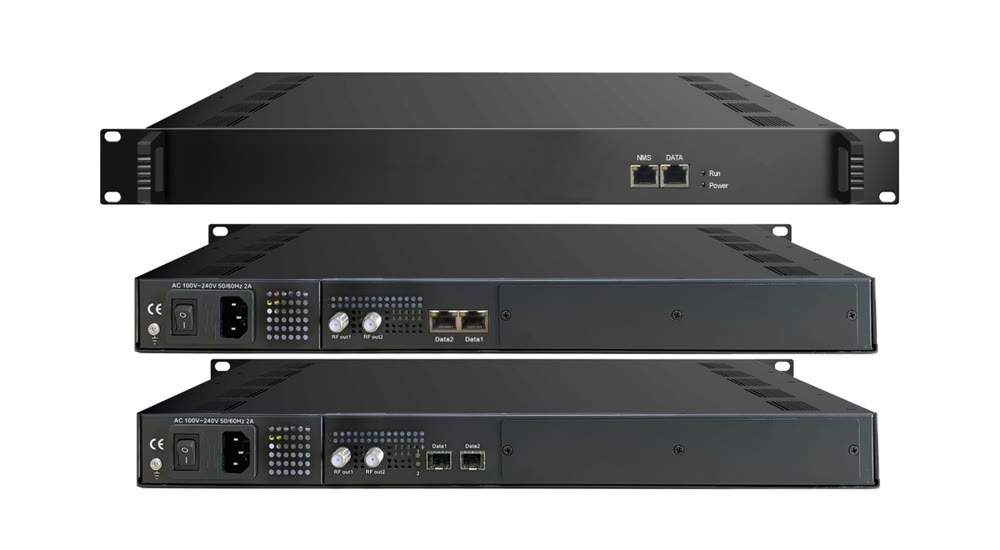
Sizing in practice: a small building or a single rack position takes 4 to 16 carriers, a hotel or campus distribution takes 16 to 48, and a cable operator platform takes 64 to 128. The FUQ4455B covers the first case in a 430×180×44 mm chassis; the FUQ4459E fits the middle one with 15.4 W of consumption and 3 kg of weight; the FUQ200 platforms take the top end, with optional redundant power supply published on the FUQ200A. All of them sit on the modulator range page.
What Should You Compare on a Datasheet?
Four rows decide whether a unit fits: IP inputs, carrier count, constellation and MER. Two more decide whether it installs cleanly: the output level range and the number of F ports, because carriers split across two ports hold a flatter per-carrier level across the band.
| Row | Published examples (with units) | Why it decides the purchase |
|---|---|---|
| IP inputs | 192 on FUQ4455B; 1,536 on FUQ4459E; 9,600 Mbit/s per 10G port on FUQ200A | Future streams need spare input capacity |
| Carrier count | 4 / 16 / 32 / 48 / 112 across this range | Sets how many multiplexes the coax plan holds |
| Constellation | 16–256 QAM across the range; 64/256 only on the FUQ4455B, not listed on the FUQ44105B v3 | Bits per symbol, so payload per carrier |
| Symbol rate | 5.0–9.0 Msps on FUQ4455B; 3,600–7,000 ksps on FUQ200B | With constellation, fixes the capacity ceiling |
| MER | ≥40 dB on FUQ4427, FUQ4443 V2, FUQ200A and FUQ200B; not listed on FUQ4455B and FUQ4459E | Headroom before splitters and long cable runs |
| Output level | −20 to +10 dBm (87–117 dBµV), 0.1 dB step | The granularity a flat spectrum needs |
| RF range | 50–960 MHz, 1 kHz step | Places carriers where the local channel raster allows |
| Power draw | 15.4 W on FUQ4459E; 50 W or 75 W on FUQ200A/B | Heat and PSU sizing in the rack |
Where a page does not publish a row it is marked not listed, never borrowed from a sibling chassis; request that model's datasheet and the missing rows come with it.
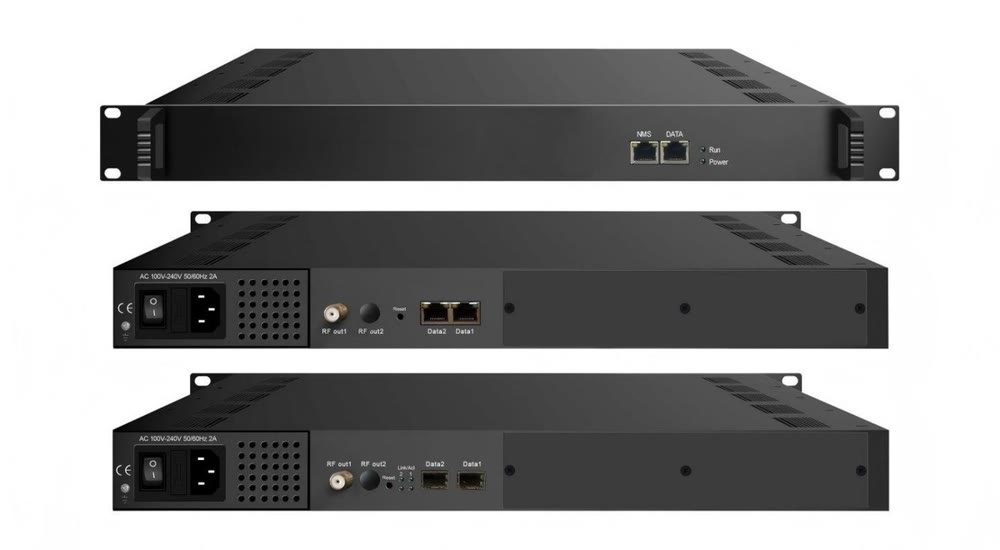
Can One Chassis Output DVB-C, DVB-T or ATSC?
No. The output standard is fixed by the model you order, and it has to match the tuners inside the televisions you are keeping, not the format your headend publishes. Four output families are published in this catalogue, and the model rows below are the four decisions.
| Output standard | Published model | Published output rows |
|---|---|---|
| DVB-C (ITU-T J.83 A/B/C) | FUQ4455B, FUQ4427, FUQ4443 V2, FUQ4459E, FUQ44105B v3, FUQ200A, FUQ200B | 16–256 QAM, RS (204, 188); MER ≥40 dB on FUQ4427, FUQ4443 V2 and the FUQ200 platforms |
| ATSC (A/53, 8VSB, 6 MHz) | FUQ4419BX | 256 IP inputs, 8 non-adjacent carriers on one F port, MER ≥40 dB, ACL −55 dBc, 0.5 dB level step |
| DVB-T (EN300 744) | FUQ4419U, FUQ4415B | QPSK/16/64 QAM, 8, 16 or 24 non-adjacent carriers and MER ≥40 dB on the FUQ4419U; 128 IP inputs to 4 carriers and 4 MPTS at 6M/7M/8M on the FUQ4415B |
| ISDB-T (ARIB STD-B31) | FUQ4417, FUQ3516R | DQPSK to 64 QAM, 2K/4K/8K, MER ≥42 dB |
Two practical notes. The ATSC model publishes a 0.5 dB level step rather than 0.1 dB, which matters on a tightly levelled plan; and the ISDB-T models use a different RF window (30–1000 MHz on the FUQ4417, at −30 to −10 dBm). Where the source is a satellite transponder rather than IP, the same decision sits in the satellite transmodulator guide, and the ISDB-T case in the ISDB-T modulator guide.
How Is It Configured and Commissioned?
IP QAM configuration is six steps, in order, all from the browser interface: load the stream list, build one multiplex per carrier, fix constellation and symbol rate to the channel plan, set each carrier's level, place carriers on non-adjacent frequencies, then measure MER at the furthest outlet.
- Confirm multicast first. Headend streams are normally multicast, so the switches on the path need IGMP V2/V3 support — the protocol every input row in this range publishes.
- Build multiplexes from the channel list. Group services that share a bit-rate budget, then check the PID ceiling before adding another service: 180 per channel on the FUQ4427, 256 on the FUQ4443 V2, 512 on the FUQ4459E.
- Set constellation and symbol rate together. Capacity follows both rows: 256 QAM at 5.361 Msps carries 39.5 Mbit/s, at 7.0 Msps it carries 51.6 Mbit/s.
- Set the level per carrier. The published window is −20 to +10 dBm (87–117 dBµV) in 0.1 dB steps; a combiner cannot repair a mismatch that arrived with the carrier.
- Keep carriers non-adjacent: the FUQ4459E publishes 48, the FUQ200B 32 to 112, and adjacent placement puts interference into the receiver rather than into the plan.
- Measure, then document. Verify MER of 40 dB or better at the furthest outlet and hand over the carrier plan; the site-side sequence is in the IPTV headend installation checklist.
When Do You Not Need One?
If every screen is a Smart TV, a set-top box or a decoder on the LAN, the headend already reaches it over the network and no RF stage is required. Modulation earns its place when the televisions can only tune coax, or when one lineup must reach RF and IP screens at once.
| Situation | What to install | Why |
|---|---|---|
| Screens are Smart TVs or STBs on the LAN | Nothing on the RF side | The IPTV headend already multicasts to them |
| Televisions are legacy and coax-only | IP to QAM modulator | IP channels become DVB-C carriers the tuner finds in a scan |
| One lineup must reach coax and IP screens | QAM modulator beside the headend | A single IPTV source feeds both distributions |
| RF feeds must reach IP devices | Tuner-to-IP gateway | The opposite conversion: tuner input, IP output |
| Televisions are analog-only | Analog RF modulator | PAL, NTSC or SECAM carriers instead of QAM |
Where the coax line-up starts from satellite rather than from IP, the same modulator sits behind a tuner bank and the design is an SMATV headend — the SMATV system guide walks the dish-to-socket chain.
The room-level version is in the hotel IPTV headend guide, and the wider rack around the modulator in the IPTV headend equipment guide.
Do You Need a Tuner-to-IP Gateway Instead?
If the streams already exist as IP and the destination is IP, no modulator is involved at all. The gateway turns RF into streams, and the two devices sit at opposite ends of the same chain rather than competing for one slot.
The FUQ4619C is the reference for that direction in this catalogue: a 1RU chassis of 482×300×44 mm and 3.5 kg, drawing ≤40 W, with 512 PIDs per channel and scrambling to ETR289, ETSI 101 197 and ETSI 103 197. A hybrid site commonly runs both: the gateway publishes multicast for the new wing, and one modulator puts the same services back on coax for the refurbished floors. Tender documents often call that coax leg IPTV to cable QAM, which is this chassis described from the service side rather than from the port side. The device-level comparison is in the DVB to IP gateway guide.
What Does an IP QAM Modulator Cost?
An IP QAM modulator price is a configuration total rather than a catalogue number, so there is no list price. Carrier count, 1G or 10G input, ASI or tuner inputs, scrambling, redundancy and any branding or packaging request all move the number, and two buildings with the same room count can land on different chassis.
The cost drivers, in the order they usually change a quote:
- Carrier count and input path — 4 carriers and 48 carriers are different platforms, and 1G Ethernet on the compact models against 10G SFP+ at up to 9,600 Mbit/s per port on the FUQ200A and FUQ200B is a different input stage.
- Add-on inputs and redundancy — 6 ASI on the FUQ4443 V2, 24 or 16 tuner inputs on the FUQ44105B v3, and the optional dual power supply published on the FUQ200A.
- Scrambling and management — ETR289 and ETSI 101 197 and ETSI 103 197 configuration, plus the management interface the site's operators will actually use.
Standard chassis are quoted per unit; where a site wants its own branding, packaging or software build, the minimum quantity and the schedule are confirmed with the quotation because they depend on the model. Every unit is built in our Guangzhou factory, runs a 72-hour burn-in before dispatch, and ships to 200+ countries. Send the carrier count, the input format and the output standard through the contact form and the reply carries the datasheet for that exact model plus a written quotation; the commercial questions are answered on the FAQ page first.
Analog-Only Buildings: Is a QAM Modulator Enough?
No. A DVB-C carrier is invisible to an analog-only television, so a building full of old sets needs a different output stage: the FUQ2500B converts IP, HDMI and AV inputs into analog RF output for up to 64 channels, with A2 and NICAM728 audio and PAL, NTSC or SECAM modulation including OSD insertion.
The distinction is worth settling before the rack is ordered, because the two chassis serve different receivers. Ask for the datasheet and the published rows come with it rather than being inferred from the family name.
FAQ
What does an IP to QAM modulator do?
It converts MPEG transport streams arriving over UDP or RTP from an IPTV headend into DVB-C QAM carriers on coaxial cable. One unit takes the IP inputs, multiplexes and optionally scrambles them, then outputs carriers that any DVB-C television finds with a normal channel scan.
Is an IP to QAM converter the same as a modulator?
Yes. Converter, modulator, edge QAM and IPTV to cable modulator all name the same IP-in, RF-out chassis. The device that does the opposite — RF in, IP out — is a tuner-to-IP gateway, and the two are not interchangeable in a rack.
How many channels fit on one QAM carrier?
Capacity is symbol rate multiplied by bits per symbol and by 188/204. At 256 QAM and 7.0 Msps that is 51.6 Mbit/s, about six HD programs at 8 Mbit/s each. The datasheets publish symbol rate and constellation, not a program count, so send us the bit rate per service and we return the carrier count.
Do I need DVB-C, DVB-T or ATSC output?
Match the output standard to the tuners inside the televisions, not to the streaming platform. DVB-C covers cable-style distribution, DVB-T is published on the FUQ4415B and FUQ4419U, ATSC A/53 8VSB on the FUQ4419BX, and ISDB-T on the FUQ4417 and FUQ3516R. One chassis produces one output standard.
How many IP inputs should I specify?
Count the streams you will actually deliver and add headroom for new channels. Published capacity runs from 192 IP inputs on the FUQ4455B to 1,536 on the FUQ4459E, while the FUQ200A and FUQ200B accept up to 9,600 Mbit/s per 10G SFP+ port and 512 IP per card.
Can the modulator encrypt channels for a CAS?
Most QAM models in this range publish scrambling to ETR289, ETSI 101 197 and ETSI 103 197, configured locally or remotely. Confirm the conditional access system you plan to run with our engineers before ordering, because the scrambler has to match the heads and smart cards you will issue.
Can I keep the existing coaxial cable?
Yes, and that is the reason to add modulation instead of replacing every screen. The modulator reuses the coax, splitters and amplifiers already installed as long as the plant still passes signal within specification, which is why a level and MER check at the furthest outlet comes before the order.
What does an IP QAM modulator cost?
There is no list price, because carrier count, input type, ASI or tuner options, scrambling, redundancy and branding all change the configuration. Standard chassis are quoted per unit, and custom builds confirm minimum quantity and schedule with the quotation.
Previous
Hospital IPTV System: Headend Design and Ward Wiring
Next
Hotel IPTV System: The Complete Headend Guide
Talk to the headend engineers before you specify
Send the model number you are looking at — or the channel count and the input and output formats you work with — and we answer with the datasheet, the configuration and a written price. The reply comes from the headend team in Guangzhou, not a sales line.