Satellite Transmodulator: DVB-S2 to DVB-C/DVB-T
How a satellite transmodulator turns DVB-S/S2 feeds into DVB-C or DVB-T carriers on a building's existing coax: tuners, descrambling and models. Each model named in this article is one of 190 in the Hanxing catalogue, published with its own specifications and datasheet.
Hanxing Team
Broadcast & IPTV Experts
The path this guide walks
- Satellite dishthe LNB delivers the IF band to the headend
- Tuner banklock the transponders the site is buying
- DescrambleCAM/CI or BISS, where services are encrypted
- Re-multiplexselect services, remap PIDs, rebuild PSI/SI
- Modulate to coaxDVB-C QAM or DVB-T COFDM carrier on RF
- Screenstelevisions on the building coax, no set-top box
A transmodulator converts one carrier type into another: the dish side stays satellite, the building side becomes DVB-C or DVB-T.
A satellite dish on the roof and a coax outlet in every room is the cheapest television infrastructure a hotel, hospital or apartment block can own — and a satellite transmodulator is the box that makes the two halves work together. It receives the transponders the dish already sees, keeps the services the building actually wants, and re-modulates them onto the DVB-C or DVB-T carriers that every television on that coax already knows how to tune.
This guide covers what a satellite transmodulator does, when it beats the alternative of taking the same satellite feed to IPTV instead, the rows that decide which model to order, and which units in our range publish those rows. Every figure quoted below is printed on the product page of the model it belongs to. Where a page does not publish a value, this guide says so and sends you to the datasheet rather than estimating it, because a transmodulator is bought on tuner count, descrambling and output standard, and a guessed number only shows up at commissioning.
What Is a Satellite Transmodulator?
A satellite transmodulator takes the intermediate-frequency output of an LNB, demodulates the DVB-S, DVB-S2 or DVB-S2X carriers on it, selects and re-multiplexes the services the site wants, and re-modulates that transport stream onto a new carrier — normally DVB-C (QAM) or DVB-T (COFDM) — for the building's coaxial network. One chassis replaces a satellite receiver at every television.
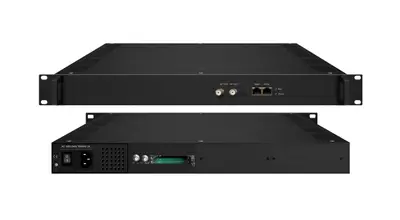
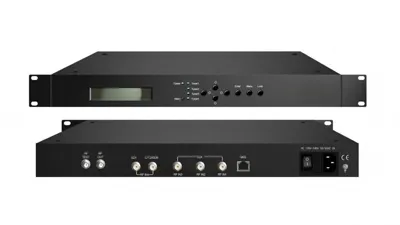
The word used in the industry for that move is turn-around: the signal comes in on one standard and leaves on another. The FUQ41013K is published as a transmodulator built to convert satellite signals into terrestrial formats, with "2 groups multiplexing and 2 groups DVB-T modulating" on the output side, and the FUQ4415EF page states that its "demodulation, re-multiplexing, and modulation run in one pass". That single pass is what removes a receiver, a modulator and a rack of cabling per channel from the headend room.
A transmodulator is not a receiver and not an IRD. It never outputs baseband video, so it cannot drive a video wall or feed an encoder. If the destination is a screen that expects an HDMI or SDI signal, the box needed is an IRD, and the IRD and decoder guide covers that job. A transmodulator's output is always a radio-frequency carrier, and its input is always a transport stream — either from its own tuners or from an IP or ASI feed that the same chassis can merge in.
Satellite to Coax or Satellite to IPTV: Which Route Fits the Building?
Both routes start at the same dish, so the choice is made by the building: a transmodulator feeds the coaxial cable already in the walls and lets each television's own tuner do the work, while a satellite-to-IPTV route builds a data network and puts a set-top box or app in front of every screen.
| What the building already has | Route that fits | Why |
|---|---|---|
| Coax to every room, televisions with DVB-C or DVB-T tuners | Satellite transmodulator | No new cabling, no set-top box, no per-room receiver |
| CAT6 to every room, smart TVs or an existing IPTV platform | Satellite to IPTV gateway | The tuners become multicast streams the IP network already carries |
| Coax in some wings, data in others | Both, split at the headend | The same chassis can publish IP streams and RF carriers |
| A handful of premium encrypted channels for a VIP area | IRD or CI receiver per service | Descrambled baseband is needed, not a carrier |
The coax route is the one that survives a building project. Satellite distribution on its own needs a star of cables from the dish to each outlet, and in an existing block that cabling was never installed; the coax in the walls was put there for terrestrial television. Once the satellite services arrive as DVB-C or DVB-T carriers, they join the terrestrial channels on the same combiner and reach the rooms as ordinary channels, which is why the FUQ4415EF page lists "hospitality TV" and "local TV distribution" among its published uses.
The IPTV route is the one to choose when the screens are modern and the project is new. There a gateway does the tuning, and the rest of the headend is the IP chain — the DVB to IP gateway guide and the headend equipment guide cover that side in detail, and the gateway models that do it for satellite are listed further down this page.
How the Signal Path Works, From LNB to Room Television
The chain has seven stages between the dish and the screen, and only the last two happen outside the headend. Knowing where each stage sits is what makes a quotation checkable, because every purchase question — tuner count, descrambling, output standard — belongs to one specific stage rather than to the project as a whole.
- The dish and LNB deliver the satellite band as an intermediate frequency on coax, which the FUQ41013K page publishes as 950~2150MHz on its DVB-S/S2/S2X tuner.
- A multiswitch or DiSEqC controller selects the polarity and satellite the headend is allowed to see; the FUQ3902B page publishes DiSEqC control among its features.
- The transmodulator's tuner bank locks the transponders the site is buying. Tuner counts published in this range run from 2 on the FUQ41013K to 24 on the FUQ44105B-3.
- Each locked transponder is demodulated to a transport stream, and if the services are encrypted the chassis clears them through a CAM or BISS before they can be re-multiplexed.
- The services the building wants are selected, the unwanted ones dropped, and the surviving PIDs are remapped into a new multiplex; the FUQ44105R-2 publishes PID remapping at "256 output per channel".
- PSI/SI tables are regenerated so the receivers can find the services. The FUQ41013K publishes "Generate PSI/SI table automatically" and "Accurate PCR adjusting" for exactly this step.
- The finished multiplex is modulated onto the output carrier, combined with the other headend feeds, and sent down the coax to the televisions.
Two of those stages are where projects fail. If the transmodulator cannot descramble, every encrypted service has to be handled by a separate CI receiver, which puts the receiver count back into the rack; and if the PSI/SI is passed through untouched, the televisions will find the channels but sort them badly, which is what leaves a hotel with channel 1 on the wrong number. Both are published rows on our pages rather than service promises.
The Inputs You Have to Plan For: Tuners, CAM and BISS
Tuner count is the first number, because one tuner locks one transponder: pick a chassis with fewer tuners than the line-up needs and the missing channels have no source, no matter how many carriers the output can produce. Descrambling is the second, and the two are published side by side on every model page.
Our published tuner counts are 2 on the FUQ41013K, 4 on the FUQ4415EF and the FUQ4653E, 8 on the FUQ4459R and the FUQ4459B, and up to 24 on the FUQ44105B-3. Free-to-air feeds need nothing, but a hotel line-up built from a pay satellite service needs CAM modules or BISS in the chassis, and the two are not the same mechanism:
| Model | Published input side | Published descrambling |
|---|---|---|
| FUQ41013K | 2 DVB-S/S2/S2X tuners; "CAM/CI 2 sets" | 2 CAM/CI slots |
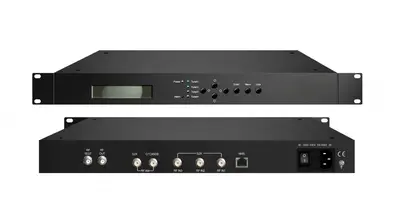
| FUQ4415EF | 4 tuner inputs in DVB-S/S2/S2X, or one DVB-C/T/T2/ISDB-T tuner | "embedded BISS descrambling" |
| FUQ4459R | 8 tuner inputs | "CAM/CI descrambling and web-based NMS" |
| FUQ4459B | 8 tuner inputs plus 128 IP inputs via UDP/RTP | "BISS descrambling supported" |
| FUQ4459AB | "12x DVB-S2/T tuner inputs and 128 IP (UDP/RTP) streams" | "BISS Mode 1/E descrambling" |
| FUQ44105B-3 | up to 24 DVB-S2 tuners, 128 IP sources over GE1 and ASI | Scramble standard ETR289, ETSI 101 197, ETSI 103 197 |
The distinction matters at procurement. CAM descrambling needs a card per encrypted service and is the route a broadcaster or a pay-TV distributor takes; BISS is the lower-cost route used for contribution and for turning around feeds that are protected by a fixed key. If the source is a consumer satellite package, neither is a licence to redistribute it — the rights question sits with the content owner, and the equipment decision only starts after that is settled.
The input side is not limited to satellite. The FUQ4415EF accepts "4 tuner inputs in DVB-S/S2/S2X or DVB-C/T/T2/ISDB-T", and the FUQ4653E publishes "4 tuner inputs for satellite, cable or terrestrial sources and 2 ASI inputs", so one chassis can mix a satellite transponder, a terrestrial multiplex and a local ASI feed into the same output line-up.
The Output Rows That Decide the Order: Standard, Constellation, MER and Level
The output standard is decided by what the televisions in the building can tune: DVB-C in a cable-fed block, DVB-T in a terrestrial-fed one. Everything after that choice — constellation, bandwidth, MER and output level — is a published row, and those four rows decide whether the receivers lock at all.
| Row | DVB-C output (published) | DVB-T output (published) |
|---|---|---|
| Standard | EN300 429 / ITU-T J.83A/B/C, published on the FUQ4459E | EN300 744, published on the FUQ41013K and the FUQ44105R-2 |
| Constellation | 16, 32, 64, 128, 256QAM on the FUQ4459E | QPSK, 16QAM, 64QAM on the FUQ44105R-2 |
| Bandwidth | 6/7/8 M on the FUQ4459B; 8M on the FUQ4459E | "DVB-T 6M, 7M, 8M" published on the FUQ4415B |
| FEC and interleaving | RS (204, 188) on the FUQ4459E | FEC 1/2, 2/3, 3/4, 5/6, 7/8 and guard interval 1/4, 1/8, 1/16, 1/32 on the FUQ44105R-2 |
| FFT / transmission mode | Not applicable to QAM | 2K 4K 8K on the FUQ44105R-2 |
| MER | ≥40db on the FUQ44105B-3 | ≥42 dB on the FUQ44105R-2 |
| RF range | 50~960MHz, 1kHz step on the FUQ44105B-3 | 30~1000 MHz published on the FUQ4653E |
| Output level | -20~+10dBm (87~107 dBµV) on the FUQ44105B-3 | Not published on every DVB-T model — confirm on the datasheet |
The MER row is the one a system integrator checks first, because it is the headroom the carrier has before the building's own splitters and long cable runs spend it. A published figure of 40 dB or better on the modulator output is normal for a headend; what is not normal is assuming it, which is why the table above cites the model that prints each value.
Two rows deserve a warning. The output level is specified in dBm on some pages and in dBµV on others, and on the FUQ44105B-3 both are printed against the same figure, "-20~+10dBm (87~107 dBµV)". Take the unit that matches the rest of the site design rather than converting, and treat a page that publishes neither as "send us the level the combiner expects and we confirm it on the datasheet". The bandwidth row is the other: a 6 MHz plan and an 8 MHz plan are not interchangeable at the receiver, so the bandwidth is confirmed against the local channel raster before the order is placed.
The Transmodulators and Modulators We Publish
Our satellite input range runs from a two-tuner chassis that puts two DVB-T carriers on a small site up to a 24-tuner unit that produces 16 QAM carriers plus the same line-up as IP streams. The table below is built from the rows each model page publishes; where a model prints nothing, the cell says so.
| Model | Published headline | Tuner inputs | Output | MER |
|---|---|---|---|---|
| FUQ41013K | TransModulator 2-In 2-Out DVB-S/S2/S2X | 2 DVB-S/S2/S2X tuners, 950~2150MHz | 2 groups DVB-T modulating, DVB-T EN300744 | Not published on the page |
| FUQ4415EF | Transmodulator 4 Tuner Inputs | 4 tuner inputs, DVB-S/S2/S2X or DVB-C/T/T2/ISDB-T | 4 DVB-C RF or 2 DVB-T RF | Not published on the page |
| FUQ4459R | DVB-T Modulator 8 Tuner Inputs 4 RF | 8 tuner inputs, multi-mode 60~890 MHz | One RF port, 4 non-adjacent DVB-T carriers | Not published on the page |
| FUQ4459B | DVB-C Modulator 8 Tuner Inputs 128 IP | 8 tuner inputs plus 128 IP via UDP/RTP | 4 non-adjacent DVB-C carriers | Not published on the page |
| FUQ4459AB | Quad-Channel DVB-T/DVB-C | 12x DVB-S2/T tuner inputs plus 128 IP | DVB-T/C modulation to EN300744/J.83A/B on one board | Not published on the page |
| FUQ4653E | Modulator 4 Tuner + 2 ASI Inputs | 4 tuner inputs, satellite, cable or terrestrial | RF, ASI and UDP IP ports from one 1-U chassis | Not published on the page |
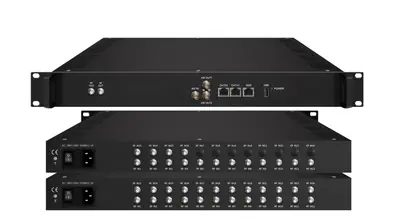
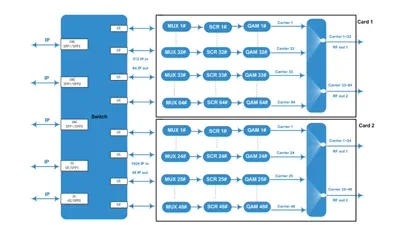
| FUQ44105B-3 | QAM Modulator 16-24 DVB-S2 Tuner 128 IP | up to 24 DVB-S2 tuners, 128 IP, ASI | 16 RF carriers and 16 IP (MPTS) streams | ≥40db |
| FUQ44105R-2 | DVB-T Modulator 24-16 Tuner 256 IP 1 ASI | 24/16 FTA DVB-S/S2/S2X tuner inputs, 256 IP, 1 ASI | 8 RF carriers and 8 IP MPTS streams | ≥42 dB |
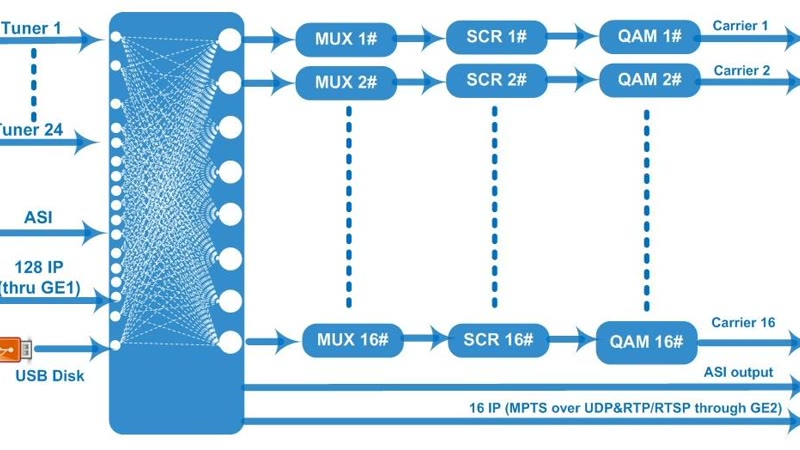
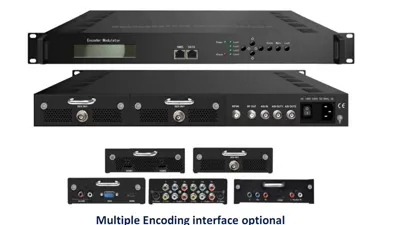
Three of those models are worth separating out. The FUQ41013K is the smallest complete turn-around: two satellite tuners, two CAM slots and two DVB-T carriers, which is the shape a single hotel or a community repeater takes when only a handful of services have to be redistributed. The FUQ4459AB is the one that does both output standards on the same board, published as quad-channel DVB-T and DVB-C with BISS Mode 1/E descrambling, which suits a site that has cable-fed and terrestrial-fed wings. The FUQ44105B-3 is the density end: up to 24 DVB-S2 tuners in, 16 RF carriers plus 16 IP MPTS streams out, with scrambling to ETR289 and ETSI 101 197 and ETSI 103 197.
A note on what this range does not publish. Every modulator output standard printed on our pages is DVB-T, DVB-C or QAM, ATSC or ISDB-T — there is no DVB-T2 modulator output row anywhere in the catalogue, and the DVB-T2 references that do appear are tuner inputs on the transmodulator, modulator and gateway models rather than transmitted carriers. If a project is specified on DVB-T2 output, say so with the enquiry and the configuration is confirmed model by model rather than assumed from the family name.
Planning the Line-Up: Transponders, Services and Carriers
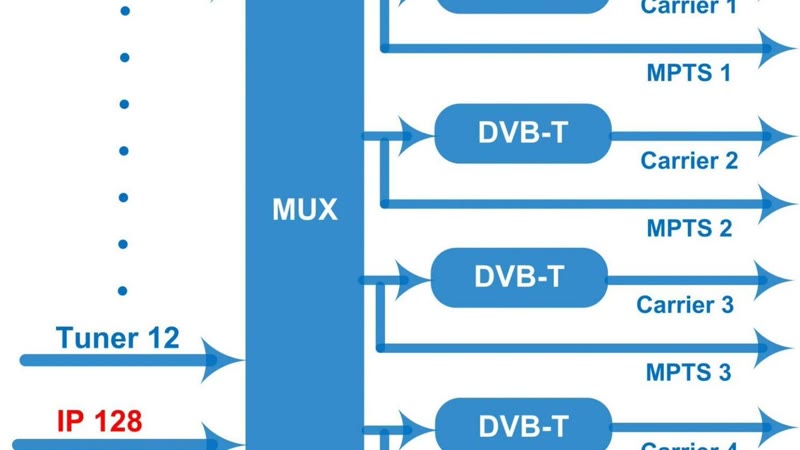
The line-up is built from two counts, and confusing them is the most common planning error: transponders in, decided by the tuner count, and carriers out, decided by the modulator section. A site can lock 24 transponders and still publish only 16 carriers, because several transponders' worth of services are re-multiplexed into one output multiplex each.
PID handling is what makes that re-multiplexing possible, and it is a published row on most pages:
| Model | Published multiplexing row |
|---|---|
| FUQ41013K | 256 per input channel, with A/V PID filtering |
| FUQ4415EF | 128 per input channel |
| FUQ44105R-2 | 256 output per channel |
| FUQ4459E | 512 per output channel |
| FUQ44105B-3 | PID remapping, automatically or manually |
The practical planning sequence is to write the room-facing channel list first, then work backwards. Services that share a transponder and are all wanted end up on the same carrier with no extra work; services pulled from different transponders have to be re-multiplexed, which spends both a tuner and a share of the output multiplex's bit rate. How many services fit on one multiplex depends on the bit rate of each service and the constellation chosen, and our pages publish the constellation and symbol rate rows rather than a headline channel count — the FUQ44105B-3 prints a symbol rate of "5.0Msps~7.0 Msps, 1ksps stepping" and the FUQ4455B prints "5.0Msps~9.0Msps, 1ksps stepping", so a capacity figure for a specific line-up is a datasheet question rather than an estimate to run on.
Leave the returning space for the carriers you did not plan. A headend that adds two channels in year two needs an empty input card slot and a free carrier in the output plan, and the license-gradable channel counts published elsewhere in the range exist for exactly that reason.
Satellite to IPTV Instead: the Gateway and IRD Route
Where the building has a data network rather than a coax plant, the satellite feed is turned into multicast streams and the rest of the chain is IP. Three published roles cover it, and the choice between them is made by whether the services are encrypted and whether the destination is a set-top box or a video server.
| Stage | Model | Published role |
|---|---|---|
| Turn transponders into IP | FUQ3902B | DVB-S/S2/S2X demodulator, descrambler and IP multiplexer with 2 tuner inputs, remuxing up to 32 channels into a single MPTS and feeding 32 IP stream outputs over UDP/RTP |
| Many tuners into many streams | FUQ4619C-3 | 1RU gateway for 24 FTA tuners, 2 DVB-ASI inputs and 1 USB input, delivering up to 1024 SPTS streams over UDP/RTP/RTSP with BISS Mode 1 and Mode E |
| Clear encrypted services | FUQ4696 | CI receiver across 8 tuner inputs, wired for 2/4 RF tuners on DVB-S/S2/S2X, outputting 1 MPTS and 16 SPTS |
The FUQ3902B is the smallest of the three and the one to start from when a single satellite feed has to reach an IPTV platform: it publishes 256 PIDs per input channel, PID remapping and PCR adjusting, and a 482mm×328mm×44mm 1RU chassis, with DiSEqC control for the dish side. The FUQ4619C-3 is the high-count option, and its 24 tuner inputs are the reason a site can retire a wall of receivers without retiring the services. Where the feed is encrypted and the middleware needs clean streams, the FUQ4696 clears the services through CAM/CI or BISS before they leave the chassis.
The trade against a transmodulator is straightforward. An IP route needs a set-top box or a smart TV app at every screen, which is a per-room cost, a per-room failure point and a per-room software lifecycle; the coax route needs neither, but it inherits whatever the existing coax will carry. Where both are needed, the two run side by side at the headend rather than competing — the hotel headend guide and the hospital IPTV system guide cover the site side of that split.
Adding Terrestrial and IP Feeds to the Same Coax
Very few buildings are satellite-only, and the headend that wins the tender puts the satellite channels, the terrestrial multiplex and any IP-originated channels on one cable with one channel plan. A transmodulator makes that possible because its output is just another RF carrier, combined and distributed by the same passive hardware as the terrestrial signal.
- Satellite services arrive as new DVB-C or DVB-T carriers from the transmodulator.
- Terrestrial channels arrive from a UHF antenna and stay on their own multiplexes; on the FUQ4459AB the input list publishes "12x DVB-S2/T tuner inputs", so the same chassis can lock satellite and terrestrial transponders together.
- IP-originated channels — a local information channel, a hotel welcome channel, a camera feed — need an IP QAM modulator rather than a tuner, and the IP to QAM modulator guide covers that leg.
- Everything meets at a combiner and then at the distribution amplifier, and from there the plan is set by the output levels published on each modulator rather than by the satellite side.
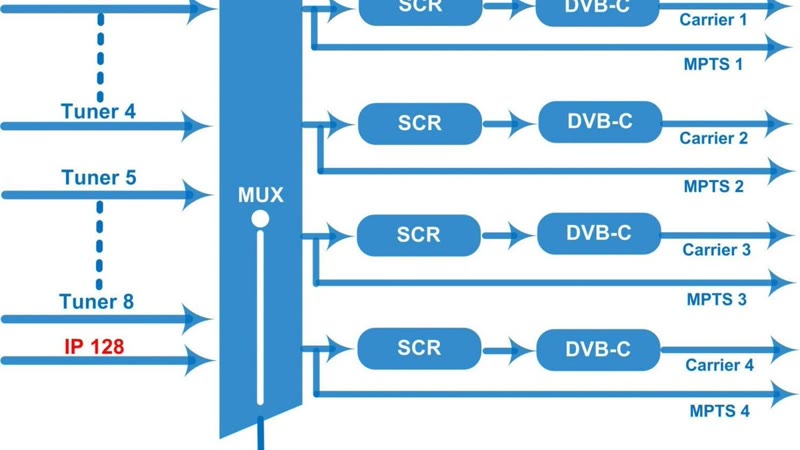
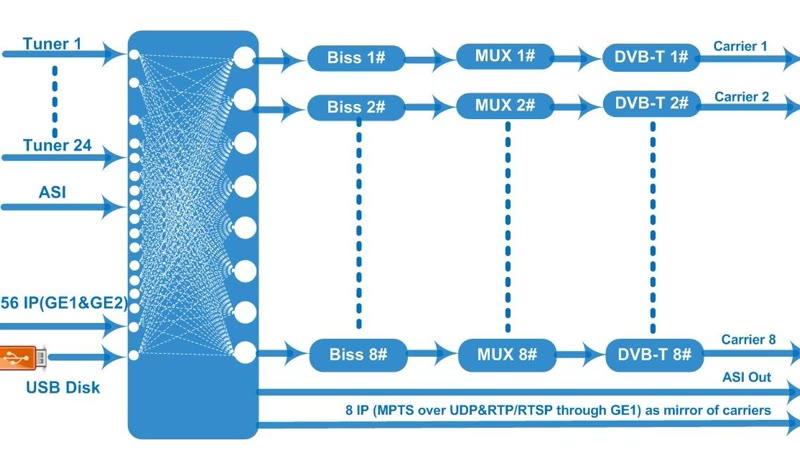
Two rules keep that combination clean. Keep the carriers non-adjacent where the plan allows it, because adjacent carriers in the same band interfere at the receiver: the FUQ4459R page publishes "one RF output port delivers 4 non-adjacent carriers to DVB-T standards" and the FUQ4459B publishes "4 non-adjacent carrier outputs". And set every carrier's level on the modulator itself, because a combiner cannot fix a level mismatch that arrived with it — the FUQ44105B-3 publishes a 0.1dB step on its output level, which is the granularity a flat spectrum needs.
Installation Notes: Rack, Levels, Power and Environment
Almost everything in this range is a one-rack-unit chassis, which is what keeps a satellite turn-around inside a single headend cabinet: the FUQ4653E is published as a 1-U chassis, and the FUQ4459AB, the FUQ4619C-3 and the FUQ3902B are all published as 1RU rack-mount units, with the FUQ3902B giving dimensions of 482mm×328mm×44mm.
| Item | Published value |
|---|---|
| Operating temperature | 0~45℃ (operation), -20~80℃ (storage) on the FUQ41013K; 0~45℃ (work), -20~80℃ (storage) on the FUQ3902B |
| RF output level | -20~+10dBm (87~107 dBµV), 0.1dB step on the FUQ44105B-3 |
| RF range | 50~960MHz, 1kHz step on the FUQ44105B-3 |
| Management | Web-based NMS on the FUQ41013K, the FUQ3902B and the FUQ4619C-3; LCD and keyboard control alongside NMS on the FUQ4415EF |
| Redundancy | Optional dual power supply published on the FUQ44105B-3 and the FUQ44105R-2 |
Two rows here need to be read at the page rather than the family. Power supply figures differ between models and several pages print them with extraction artefacts, so the mains configuration for a specific unit should be confirmed on its own datasheet instead of copied from a sibling — a headend that ships with the wrong supply voltage loses more time than the price difference between two models. The same caution applies to weight and to any figure where a page publishes nothing at all: our rule is that an absent row is a datasheet question, never a value carried over from another chassis.
Every unit in this range is built and tested in our own factory in Guangzhou and runs a 72-hour burn-in before it ships, because a headend that is never switched off should not start its life on an untested sample. We ship to 200+ countries, and the satellite-side accessories a turn-around needs — the dish, the LNB, the multiswitch and the combiners — are quoted with the headend rather than left to the installer's local supplier.
What to Send Us for a Satellite Transmodulator Quotation
A turn-around can be quoted in one exchange if the enquiry carries five facts, and the list below is the shortest one that has ever produced a usable reply. Without them the first answer is a question rather than a price, and every round trip through a project schedule costs a working day.
- The destination country, because the output standard, the channel raster and the mains configuration all follow it.
- How many transponders and which satellite, and whether any of the services are encrypted — this fixes the tuner count and whether CAM or BISS is needed.
- The room-facing channel list, with the services that must appear and the ones that can be dropped.
- The output standard and carrier count the building can tune: DVB-C QAM if the rooms are cable-fed, DVB-T if they are terrestrial-fed, and both if the site is mixed.
- Whether the same line-up also has to leave the chassis as IP streams, because several models in the table publish RF and IP outputs in parallel.
Frequently Asked Questions
What is a satellite transmodulator?
A satellite transmodulator receives the intermediate-frequency output of a satellite LNB, demodulates the DVB-S, DVB-S2 or DVB-S2X carriers it carries, selects and re-multiplexes the services the site wants, and re-modulates that transport stream onto a new carrier — normally DVB-C (QAM) or DVB-T (COFDM) — for the building's coaxial network. The FUQ4415EF page states that its demodulation, re-multiplexing and modulation run in one pass.
Do I need a satellite transmodulator or an IRD?
It depends on what the far end expects. A transmodulator outputs an RF carrier, so it is the right box when the rooms have ordinary televisions on coax that tune DVB-C or DVB-T channels. An IRD outputs baseband video, ASI or IP, so it is the right box when the destination is a video wall, an encoder or a server. A transmodulator never produces baseband output — if a screen needs HDMI or SDI, the box is an IRD.
Can one chassis output both DVB-C and DVB-T?
On some models, yes. The FUQ4415EF is published with 4 tuner inputs in DVB-S/S2/S2X or DVB-C/T/T2/ISDB-T and outputs 4 DVB-C RF or 2 DVB-T RF signals, and the FUQ4459AB is published as a quad-channel DVB-T and DVB-C unit with DVB-T/C modulation to EN300744 and J.83A/B on the same board. Where a page publishes only one output standard, that is the standard the model produces.
How many satellite transponders can one transmodulator handle?
It follows the published tuner count, because one tuner locks one transponder. Our range publishes 2 tuners on the FUQ41013K, 4 on the FUQ4415EF and the FUQ4653E, 8 on the FUQ4459R and the FUQ4459B, 12x DVB-S2/T tuner inputs on the FUQ4459AB, and up to 24 DVB-S2 tuners on the FUQ44105B. The number of output carriers is a separate count, so several transponders can be re-multiplexed into fewer carriers.
Do I need CAM or BISS descrambling?
Only where the source services are encrypted. CAM/CI descrambling needs a card per encrypted service: the FUQ41013K publishes 2 CAM/CI sets and the FUQ4459R publishes CAM/CI descrambling. BISS is the lower-cost route for contribution and fixed-key feeds, published as Mode 1 and Mode E on the FUQ4619C-3 and the FUQ4619C-6, and as Mode 1/E on the FUQ4459AB. Free-to-air line-ups need neither.
What is the difference between satellite to coax and satellite to IPTV?
The far end. Satellite to coax re-modulates the services onto DVB-C or DVB-T carriers so the televisions' own tuners receive them with no set-top box and no new cabling. Satellite to IPTV — the FUQ3902B demodulator, the FUQ4619C tuner-to-IP gateway or the FUQ4696 CI receiver — turns the same services into UDP/RTP multicast streams for a data network, which needs a set-top box or a smart TV app at every screen.
Do you supply the datasheet and a factory-direct quotation?
Yes. Send the destination country, the number of transponders and whether the services are encrypted, the room-facing channel list, and the output standard and carrier count the building can tune, and we return the model confirmation with the datasheet for that exact model and a quotation. Every unit is built in our Guangzhou factory, runs a 72-hour burn-in before dispatch, and we ship to 200+ countries.
A satellite turn-around sits between the dish and the distribution amplifier, and the HDMI to coax modulator guide covers the other source that ends up on the same building cable, while the DVB-C, DVB-T and ATSC modulator guide settles the output standard and the DVB to IP gateway guide covers the IP route this guide compares it against. The satellite-side models are listed together on the modulator and modem page, the gateways on the IP gateway page and the receivers on the IRD, decoder and transcoder page, and the solutions pages show the chains end to end. Tell us the country, the transponder count and the output standard the televisions can tune and we will match the model and quote it — the fastest route is the contact form, and the FAQ answers the commercial questions first.
Previous
Digital Headend System: CATV Headend Equipment
Next
ISDB-T Modulator Guide: Brazil, Japan and LatAm
Talk to the headend engineers before you specify
Send the model number you are looking at — or the channel count and the input and output formats you work with — and we answer with the datasheet, the configuration and a written price. The reply comes from the headend team in Guangzhou, not a sales line.