Hotel IPTV System: The Complete Headend Guide
A hotel IPTV system from the rack out: which route fits the property, what the headend must publish, how it is sized, and what to send for a quotation. Each model named in this article is one of 190 in the Hanxing catalogue, published with its own specifications and datasheet.
Hanxing Team
Broadcast & IPTV Experts
The path this guide walks
- Satellite / cable feedor local playout
- IRDreceive and descramble
- Encoderto IP
- IPTV gatewaymulticast, VOD, EPG
- Hotel networkaccess switches
- Guest room screensSTB or smart TV app
A hotel IPTV system is the headend rack and the property network that between them turn satellite, terrestrial and in-house feeds into IP streams for every guest screen. The rack is smaller than most properties expect: one gateway locks 24 tuners, one encoder covers the local HDMI sources, and one modulator publishes 48 carriers while drawing 15.4W. What changes from project to project is not the chain but the route the line-up takes to the room.
This page is the decision map for that route — which distribution route a property should keep, what the rack has to publish, how the headend is sized against rooms and channels, and what a supplier needs before quoting. The technical walk-through of channel sources, coax planning and rack environment is in the hotel TV system guide, and the room-side comparison of set-top boxes and Smart TV apps has its own page.
What Is a Hotel IPTV System?
A hotel IPTV system receives television outside the property, converts each feed into a transport stream, assembles one channel line-up with its EPG and rights, and distributes that line-up as IP multicast to guest screens — set-top boxes or Smart TV apps — over the property's own data network, with an RF leg where the building still only has coax.
That last sentence is where most hotel projects are won or lost. The headend chain is the same in a 40-room boutique and a 400-room resort; the difference is whether the line-up leaves the rack as multicast, as DVB-C carriers, or as both. The hospitality solutions pages map those chains end to end, and the sections below take the decision one step at a time.
Which Route Fits the Property: Coax, IP or Hybrid?
The route is decided by what is already in the walls: a property with a working coaxial riser and televisions that still tune RF keeps them, a new build pulls data cable and puts a switch on every floor, and a refurbishment lands in between, adding IP floor by floor.
| Route | What the property keeps | What the headend must publish | Published example in our range |
|---|---|---|---|
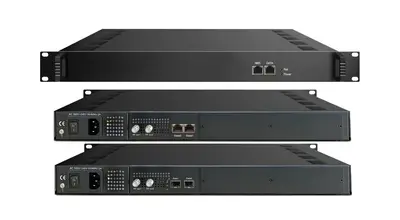
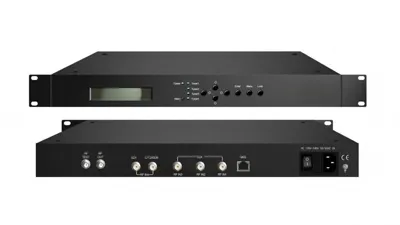
| Coax-only plant | The coaxial riser and the televisions' own tuners | DVB-C or DVB-T carriers | FUQ4459E, 48 non-adjacent carriers from 1536 IP inputs, 15.4W |
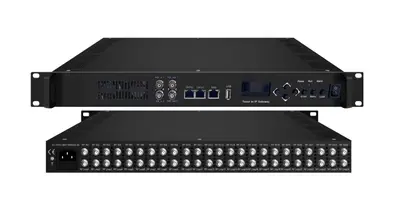
| IP-only network | Structured cabling and a managed switch per floor | UDP and RTP multicast | FUQ4619C-3 24-tuner gateway, BISS Mode 1 and Mode E |
| Hybrid plant | The coax wing as built, plus an IP wing added floor by floor | Carriers and multicast from the same line-up | Modulator chassis for the coax wing, gateway for the IP wing |
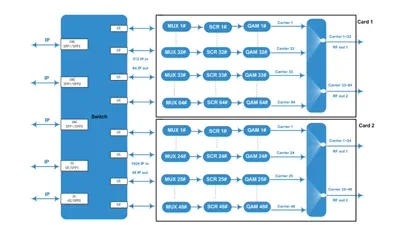
Two published rows matter when that table is read against a real building. The RF side is a carrier count and an output level: the FUQ4459E publishes "Max 1536 IP in thru 3 GE ports", a modulation standard of "EN300 429/ITU-T J.83A/B/C" and an output level of "-20dBm~+10dBm(87~117dBµV), 0.1dB stepping". The IP side is a tuner count and the encryption it can clear: the FUQ4619C-3 publishes "24 tuners inputs +2 ASI inputs +1 USB inputs" with DVB-C tuning to "J.83A(DVB-C), J.83B, J.83C" and "BISS Descrambling" of "Mode 1, Mode E".
Where the property still runs a single small coax plant and only needs a handful of extra channels, that whole route collapses to one box: the FUQ4412B is a single-carrier QAM modulator in a "482mm×300mm×44mm" chassis drawing "22W", which is the entry point of the modulator and modem line.
What Goes Into the Headend Rack?
The rack is specified stage by stage, and every stage is bought on one published row: how many feeders it locks, how many channels it encodes, how many carriers it publishes, or how many PIDs it remaps. Reading the rows in that order is what keeps a quotation checkable.
| Stage | Job | Published example | Published row |
|---|---|---|---|
| Ingest | Lock satellite and cable carriers and republish them as IP | FUQ4619C-3 | "24 tuners inputs +2 ASI inputs +1 USB inputs" |
| Clear encryption | Remove BISS scrambling on entitled feeds | FUQ4619C-3 | "BISS Descrambling" of "Mode 1, Mode E" |
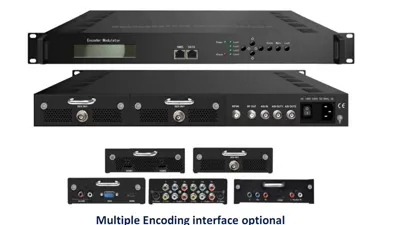
| Encode | Compress HDMI and SDI sources into transport streams | FUQ4647B | "1Mbps~13 Mbps each channel" |
| Encode and modulate | Add 2 to 4 local channels to a coax plant in one chassis | FUQ4635S | "2/4*RF DVB-C out (2/4 carriers combined output), F type interface" |
| Remap and rebuild | Select programs, remap PIDs, rebuild PSI and SI | FUQ4653XY | "128 PID input per channel" |
| Modulate | Place the line-up on cable carriers | FUQ4459E | "48 non-adjacent carrier", "512 per output channel" |
| Guide data | Publish the EPG the guest menu is built from | FUQ2044TL | EPG system, 2044 TS streams, ASI and IP output |
| Rights and guest accounts | Hold the keys and the subscriber records | FUQ-1.0 and FUQ-SMS | CAS and SMS platform |
| Guest device | Decode for the guest | Set-top box or Smart TV app | Compared room by room on the STB versus Smart TV app page |
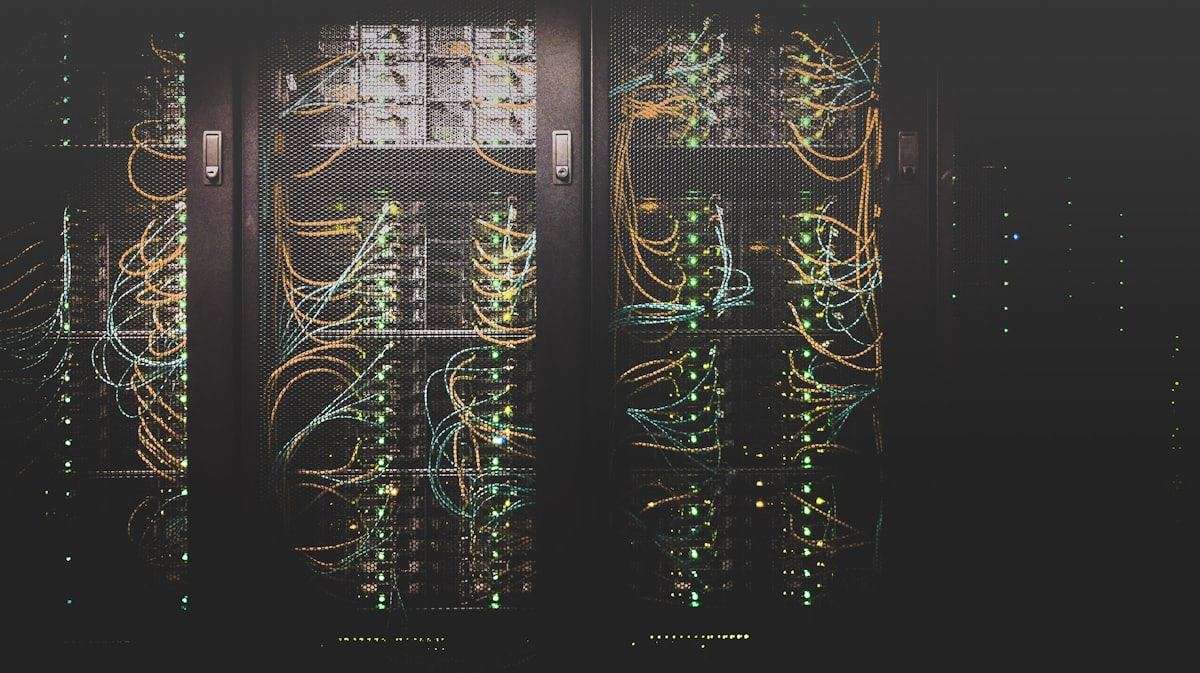
One route around the rack is worth knowing before the list is fixed. The FUQ1000A is published as an integrated IPTV hotel system platform that carries live TV, VOD, CAS and PMS on one headend, so a property that wants the whole stack from a single supplier starts there and adds encoding and modulation only where its own sources or its own coax demand them.
How Many Rooms Can One Headend Serve?
Rooms do not size a hotel headend; services and bit rate do. A property with 200 rooms watching the same 60 channels needs the same headend as a property with 50 rooms watching them, because every screen joins the same multicast group. What changes with room count is the network and the room devices.
The rows that actually set the size are published per model. The FUQ4619C-3 locks 24 tuners, so it takes 24 RF feeds rather than 24 channels. The FUQ4459E publishes up to 1536 IP inputs, 48 carriers and "512 per output channel" of PID remapping. The FUQ4443-2 publishes "Max 1024 IP input through 3" and "256 per channel". The FUQ4635S and FUQ4647B encode at "1Mbps~13 Mbps each channel", which is the range the network plan is built on.
What Does a 100-Room Line-Up Consume?
Take a property with 100 rooms and a 60-channel line-up. At an example 6 Mbps per service — inside the published "1Mbps~13 Mbps each channel" range — the property network carries 360 Mbps of multicast when every screen watches a different channel. The floor switches are sized on that figure, not on the room count.
Two published notes belong in that calculation. Multicast only works if the switches do their part: the FUQ1000A page states that where UDP is used for live services, "switches of access layer should support IGMP protocol". And the RF wing has its own ceiling: the FUQ4459E publishes 48 carriers in a 44.5mm-high chassis at "15.4W", so a line-up that outgrows one chassis is extended by a second rather than by a bigger card.
Set-Top Box, Smart TV App or Both?
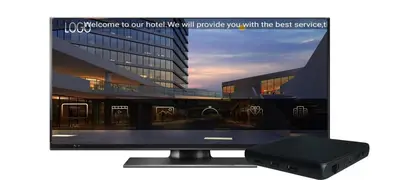
A property renewing its televisions can put the client on the panel and drop the in-room hardware; a property with older panels, or one that wants an identical interface everywhere, keeps a set-top box per room. Both routes run on the same headend, so the decision is reversible and the cost sits in the room, not the rack.
The trade-off is set out room by room on the set-top box versus Smart TV app page. What matters in headend terms is that the line-up is published once as multicast either way, so adding the second route does not mean a second headend.
Where Do VOD, EPG, CAS and PMS Fit?
The software layer sits on the same rack: the EPG behind the guest menu, the CAS that holds keys, the SMS that holds guest accounts, and the PMS link behind the welcome screen. The FUQ1000A combines live TV, VOD, CAS and PMS on one headend, while the FUQ2044TL and the FUQ-SMS cover the same jobs as separate systems.
Where services are free-to-air, none of the rights layer is needed, and the rack is ingest, encode, remap and modulate. Where they are sold or restricted, the scrambling standard has to match the receivers in the building before the order is placed — the CAS and SMS headend guide takes that decision further.
How Is a Hotel IPTV Project Delivered?
A hotel IPTV project runs in six steps, and the first two decide the rack: an audit of rooms, cabling and content sources, then a design covering the rack, the bandwidth plan and the room-device route. The last four are install, configure, test and launch, and each ends in something the property signs off.
- Audit — count rooms and outlets per floor, record which televisions tune RF and which only take HDMI, and list the satellites, terrestrial multiplexes and local sources available at the site.
- Design — fix the route, the carrier plan or multicast groups, the channel count and the room-device decision.
- Install — the headend rack, the switches for the IP wing, and the room devices.
- Configure — the line-up, EPG, languages and guest services, and the PMS link where one exists.
- Test — sample rooms on each floor, multicast joins under load, and the RF levels on the coax wing.
- Launch — staff training and go-live.
The rack-level detail behind the install and configure steps — power, cabling, layout and commissioning — is in the headend installation checklist. Every unit we ship is built in our Guangzhou factory and runs a 72-hour burn-in before dispatch, and we ship to 200+ countries.
What Should the RFQ Include?
A hotel IPTV quotation is checkable only if the enquiry carries the property, the sources and the room devices, because those three decide the model count. We do not publish list prices; each quotation is built against the configuration you confirm.
Send these seven items and the model match follows:
- The destination country and the site type, with the room and outlet count.
- The route the property expects to keep: coax, IP, or a hybrid.
- The sources available: which satellites, which terrestrial multiplexes, and how many local HDMI or SDI feeds.
- The channel count and the languages the guest menu must carry.
- The room device: set-top box, Smart TV app, or both.
- Whether any services are sold or restricted, so the CAS and SMS route is settled early.
- The rack space, power available, and whether the property also needs VOD.
Frequently Asked Questions
What is a hotel IPTV system?
A hotel IPTV system is the headend rack plus the property network that turn satellite, terrestrial and in-house feeds into one channel line-up and distribute it as IP multicast to guest screens, with an RF leg where the building still only has coax. It covers the ingest, encoding, remapping, rights and guide-data stages, and the room devices that decode the result.
How many rooms can one IPTV headend serve?
Rooms do not size the headend, services and bit rate do: 200 rooms watching the same 60 channels need the same headend as 50 rooms watching them, because every screen joins the same multicast group. What scales with rooms is the network and the number of room devices. Our FUQ4459E publishes 48 carriers and 1536 IP inputs in 1U.
Do hotels still need coaxial cable?
Only where the building already has it and the televisions still tune RF. A property can keep the coaxial riser and feed it from a QAM chassis such as the FUQ4459E, run IP to the rooms instead, or run both from the same line-up. A new build normally pulls data cable and puts a switch on each floor.
What equipment goes into a hotel IPTV headend?
Six stages in order: ingest through a tuner-to-IP gateway such as the FUQ4619C-3; encoding of local sources, on the FUQ4647B at "1Mbps~13 Mbps each channel"; PID remapping and PSI rebuild; the rights layer, CAS and SMS; guide data through an EPG system; and modulation on a carrier chassis where the property has a coax wing.
Should a hotel use set-top boxes or Smart TV apps?
Both run on the same headend, so the choice is about the room rather than the rack. A property renewing its televisions can remove the in-room hardware with a Smart TV app; a property with older panels, or one that wants one identical interface everywhere, keeps a set-top box per room. The comparison page costs both routes on a 100-room property.
How much bandwidth does a hotel IPTV system need?
It follows the channel count and the encoding bit rate, not the room count. At an example 6 Mbps per service — inside the published "1Mbps~13 Mbps each channel" of our encoders — a 60-channel line-up is 360 Mbps of multicast when every screen watches a different channel. The access switches must support IGMP, as the FUQ1000A page states for UDP live services.
Does a hotel need a conditional access system and an SMS?
Only where services are sold or restricted. Scrambling is applied by the chassis, the conditional access system holds the keys, and the SMS holds the guest accounts and entitlement — the FUQ-1.0 and FUQ-SMS are those two parts. A free-to-air line-up needs neither.
What information do you need to quote a hotel IPTV system?
The country and site type with the room count, the route the property expects to keep, the sources available, the channel count and languages, the room device, whether any services are restricted, and the rack space and power. Send those and we return the model confirmation with the datasheet for each exact model and a quotation.
The Bottom Line
A hotel IPTV system is bought as a route, not as a box: confirm what the walls can carry, size the rack on feeders, carriers and bit rate rather than on rooms, and settle the rights layer before the receivers are chosen.
The same chain is walked in more depth for other property types — the hospital IPTV system guide covers continuous-uptime sites, the campus IPTV system guide the multi-building case — and the equipment side is on the IP gateway, modulator and encoder pages. Send the property, the sources and the room count through the contact form and we will match the chassis and quote it.
Video guides on this topic
All guidesWhat does a hotel IPTV headend like this cost, and which models go in it?
Price follows your channel count and the inputs you have - there is no list price, so send both and we quote each model with its datasheet.
Ask for the model list and a quote
What does a rollout like this cost per room?
Price follows your channel count and the inputs you have - there is no list price, so send both and we quote each model with its datasheet.
Ask for the model list and a quotePrevious
IP to QAM Modulator: Send IPTV Channels to Coax TVs
Next
FM Transmitters Explained: 50W vs 5KW, What to Buy
Talk to the headend engineers before you specify
Send the model number you are looking at — or the channel count and the input and output formats you work with — and we answer with the datasheet, the configuration and a written price. The reply comes from the headend team in Guangzhou, not a sales line.