Hotel TV System: Sources, Headend and Distribution
Where a hotel's TV channels come from, how the headend distributes them over coax or IP, and what the guest rooms and services layer need at the end. Each model named in this article is one of 190 in the Hanxing catalogue, published with its own specifications and datasheet.
Hanxing Team
Broadcast & IPTV Experts
The path this guide walks
- Sourcessatellite, terrestrial, cable, IP and property-owned feeds arrive at the site
- Receivetuners and gateways lock the feeds and republish them as transport streams
- Processde-scramble, select services, remap PIDs, rebuild PSI/SI and insert the guide
- ControlCAS, SMS, EPG, logo insertion and advertising on the line-up
- DistributeQAM, DVB-T or ATSC carriers on coax, or multicast on the hotel LAN
- Guest rooma hospitality television with a tuner, or a set-top box on the network
A hotel TV system is the same headend chain as a CATV plant; what changes is the size of the line-up, the services layer in the room and whether the building keeps its coax.
A hotel television system is bought for two things at once. Guests expect the channels they get at home, in the language they speak, on the screen that is already in the room. The property expects the same rack to run for years without a truck roll every month. Everything between the dish on the roof and the screen in room 512 is one chain of five stages, and each stage decides what the next one can accept.
This guide walks that chain in order: where the channels come from, how they enter the headend, what happens to them before distribution, whether the building is fed on coax or on IP, and what the guest room and the services layer need at the end. Every figure quoted below is printed on the product page of the model it belongs to. Where a page does not publish a value, this guide says so and sends you to the datasheet instead of estimating, because a hotel TV system is bought on port counts, carrier counts and standards, and a guessed number only shows up after the rooms are already wired.
What Is a Hotel TV System?
A hotel TV system is the equipment and software that bring television into a property and deliver it to every guest screen from one central configuration. Five stages do the work: the sources, the reception stage that locks them into the headend, the processing stage that builds the line-up, distribution to the rooms, and the services layer.
complete headend guide for hotels builds, and the STB vs Smart TV app comparison decides what sits on the last screen. The equipment for it is grouped on the IPTV and hospitality solutions page.
In a digital system the unit of work is the MPEG transport stream, not the individual channel. That is why selection, re-labelling, scrambling and guide data all happen before the RF stage, and why one chassis can serve dozens of rooms without a per-room device. It is also why the questions that decide a quotation are asked early: which standards the property can receive, how many languages the guide must carry, and whether the rooms keep their coax or move to the LAN.
The table below is the order the chain is built in. Each row names the job and the published chassis that does it in our range.
| Stage | Job in the chain | Published examples |
|---|---|---|
| Sources | Satellite, terrestrial, cable, IP and property-owned feeds | dish and LNB, DVB-T/T2 antenna, cable feed, SRT/HTTP contribution |
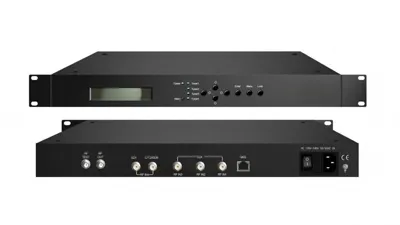
| Receive | Lock the feeds and republish them as transport streams | FUQ4619C-3 tuner-to-IP gateway, FUQ4415EF transmodulator |
| Process | De-scramble, select services, remap PIDs, rebuild PSI/SI | FUQ4455A mux-modulator, FUQ4216B dual multiplexer |
| Control | Entitlement, billing, guide data, branding and advertising | FUQ-SMS platform, FUQ2044TL EPG system |
| Distribute | Carry the line-up to the rooms as RF on coax or as IP on the LAN | FUQ4443-3 IP QAM modulator, FUQ4619X IPTV gateway |
Where Do a Hotel's TV Channels Come From?
A hotel usually takes channels from four kinds of source, and most properties mix at least two of them. Satellite carries the widest international line-up, terrestrial antenna covers national channels, a cable operator feed fills the local gap, and IP or streaming sources cover niche and premium channels that arrive over the internet.
The mix decides the headend, because each source type lands on a different input. A satellite transponder needs a tuner that locks a 950 to 2150 MHz band and, where the service is encrypted, a conditional access path. A terrestrial or cable feed needs a DVB-T, DVB-T2, DVB-C or ATSC demodulator. An internet feed needs a gateway that terminates SRT, HTTP or HLS. A property's own channel needs an encoder.
There is also a commercial reason to care about the mix. Free-to-air satellite channels are received at the property, while premium and sports content is usually licensed and encrypted, which is what a conditional access system and an SMS are for. The table keeps the four families and what each one presents at the headend input.
| Source | What arrives at the headend | Published entry point |
|---|---|---|
| Satellite | LNB output in the 950~2150 MHz IF band, encrypted or free to air | tuner inputs on the FUQ4619C-3 gateway, BISS Mode 1 and Mode E descrambling |
| Terrestrial | DVB-T or DVB-T2 multiplex from a roof antenna, 6/7/8 MHz | 24 RF tuner inputs across DVB-T, T2, C, S and S2 on the FUQ4619C V3 |
| Cable operator | DVB-C carrier, J.83A, J.83B or J.83C | J.83A(DVB-C), J.83B and J.83C tuner inputs on the FUQ4619C-6 |
| IP and streaming | SRT, HTTP, UDP, RTP, RTSP, HLS or RTMP streams on Ethernet | FUQ4619X IPTV gateway, FUQ-NEP10 |
How Do Satellite and Cable Feeds Get Into the Headend?
They land on tuner inputs and leave as transport streams over IP. A tuner-to-IP gateway is the usual first box: it locks the transponders the property is buying, descrambles what it is allowed to, and republishes each service as a stream the rest of the rack can switch and modulate.
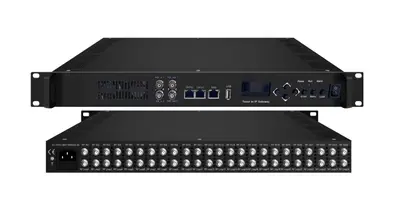
Our gateway range publishes the rows a designer needs for that job. The FUQ4619C-3 tuner-to-IP gateway publishes 24 tuner inputs plus 2 ASI inputs and 1 USB input, an input band of 950~2150MHz for DVB-S and DVB-S2, BISS descrambling in Mode 1 and Mode E, and up to 1024 SPTS streams over UDP, RTP or RTSP with switchable MPTS bypass or SPTS modes. The same family is published in other input mixes: the FUQ4619C V3 takes 24 RF tuner inputs across DVB-T, T2, C, S and S2, and the FUQ46610F publishes 16 tuner inputs and 2 ASI inputs with 512 SPTS or 16 MPTS outputs.
Buildings that keep a pure coax distribution — no set-top boxes, no room network — do not need the IP leg at all. A transmodulator converts one carrier type straight into another. The FUQ4415EF publishes 4 tuner inputs in DVB-S, S2 or S2X, or DVB-C, T, T2 and ISDB-T, and outputs 4 DVB-C RF signals or 2 DVB-T RF signals, with multiplexing of 128 services per input channel and embedded BISS descrambling. The FUQ41013K publishes 2 DVB-S/S2/S2X tuners and 2 CAM/CI slots into 2 groups of DVB-T modulation, with 256 PID remapping per input channel and modulation to EN300744.
| Published row | FUQ4619C (24-tuner) | FUQ4619C V3 | FUQ46610F |
|---|---|---|---|
| Tuner inputs | 24 tuners + 2 ASI + 1 USB | 24 RF tuner inputs | 16 tuner inputs + 2 ASI |
| Standards | DVB-S, DVB-S2, DVB-S2X | DVB-T, T2, C, S, S2 | DVB-S/S2/S2X plus DVB-C/T, ATSC, ISDB-T |
| Input band | 950~2150MHz | tuner band not published on this page | 60~890MHz multi-mode, 6/7/8 M bandwidth |
| Descrambling | BISS Mode 1, Mode E | not published on the page | BISS Mode 1, Mode E, up to 850Mbps |
| IP output | up to 1024 SPTS over UDP/RTP/RTSP | streams over UDP/RTP | 512 SPTS or 16 MPTS |
| Chassis | 1RU; weight and power on the datasheet | 1RU, 3.5 kg, ≤40W | 1RU |
Where a page in this list does not publish a row you need — a tuner count on a specific variant, or the band of a legacy model — ask for the datasheet. We confirm the figure for the exact chassis rather than assuming it carries over from a sibling.
How Do IP and Streaming Sources Enter the Headend?
Through a protocol gateway rather than a tuner. The stream is already compressed when it arrives, so the job is not to decode it but to move it between protocols and rate-shape it, then hand it to the multiplexer as a service that behaves exactly like a satellite feed.
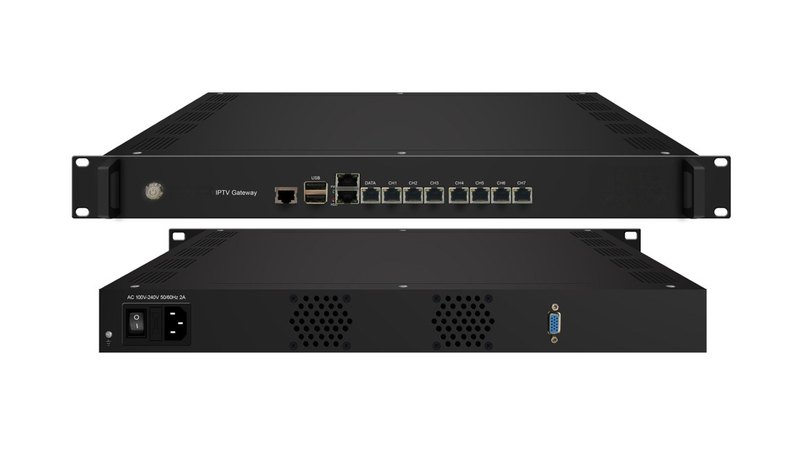
The FUQ4619X IPTV gateway publishes 8 data ports that accept SRT, HTTP, UDP, RTP, RTSP, HLS and TS input and output SRT, HTTP, UDP, HLS and RTMP, including TS files loaded over the web interface. Its published capacity is about 80 HD/SD programs over UDP multicast at a CPU load of ≤80%, with 16G of memory, a 120G SSD, a 4T SATA disk, an SFP+ port and a published user number of 600. The FUQ-NEP10 is the smaller gateway in the same family: 8-12 concurrent HD/SD programs at 8Mbps, IP anti-jitter on the input side, and dual Ethernet ports.
Where the property already runs a playout or middleware server, the headend only has to pick the services up. The FUQ4619T and FUQ4619A IPTV gateway servers publish 7 IP input channels with the same protocol set, and their pages name hotel TV and CATV systems as the deployments they are built for. For an IP-only contribution path with fewer ports, the FUQ4619B-3 publishes 7 IP inputs and 1 data output running 80 concurrent HD/SD programs at 2Mbps over UDP multicast at ≤80% CPU load.
| Published row | FUQ4619X | FUQ-NEP10 | FUQ4619T / FUQ4619A |
|---|---|---|---|
| Ports | 8 data ports | dual Ethernet, 1 full I/O | 7 IP input channels |
| Protocols in | SRT, HTTP, UDP, RTP, RTSP, HLS, TS | SRT, HTTP, UDP, RTP, RTSP, HLS | SRT, HTTP, UDP, RTP, RTSP, HLS |
| Protocols out | SRT, HTTP, UDP, HLS, RTMP | RTMP output | SRT, HTTP, UDP, HLS, RTMP |
| Program capacity | about 80 HD/SD over UDP multicast at ≤80% CPU | 8-12 HD/SD programs at 8Mbps | 7 input channels, web NMS |
| Named deployments | IPTV headends | broadcast contribution | hotel TV and CATV systems |
What Happens Between the Tuner and the Modulator?
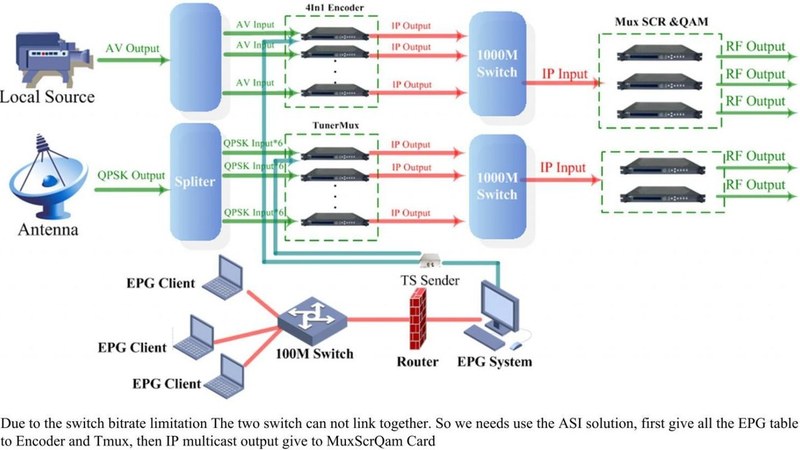
This is the stage that turns a pile of incoming streams into one ordered line-up, and it is where most hotel projects are won or lost. Services are de-scrambled, unwanted ones dropped, PIDs remapped, the PSI/SI tables rebuilt, the guide data inserted, and only then handed on for modulation.
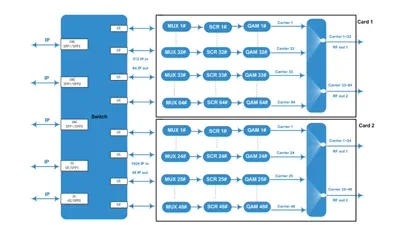
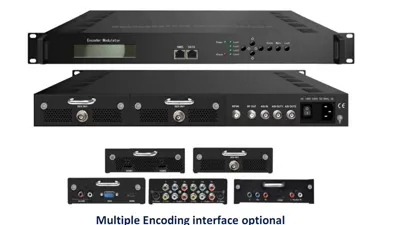
A multiplexer that also modulates saves a chassis. The FUQ4455A publishes 128 IP inputs through 3 GE/SFP and 2 GE ports, plus 32 IP inputs over 10 FE ports, 2 ASI inputs and a USB player, and it generates up to 48 DVB-C, 32 DVB-T and 28 ISDB-T non-adjacent carriers, with 256 PIDs per channel, automatic PSI/SI generation and PID remapping under unicast or multicast IGMP V2/V3. For ISDB-T properties the FUQ4216B is a dual multiplexer published with 12 ASI inputs, 2 IP UDP outputs and PSI/SI table editing, described on its page as a TS re-multiplexer that also handles IIP packet generation and remote upgrades.
Entitlement and billing sit in the same stage. The FUQ-SMS subscriber management platform is published for million-level user bases with CAS-compatible interfaces, batch entitlement distribution and SMS-based mobile charging on a modular C/S architecture, and it works alongside the FUQ-1.0 conditional access system.
Guide data and branding are what guests actually notice. The FUQ2044TL EPG system publishes support for up to 2,044 transport streams, 65,530 programs and 64-day EIT scheduling, with ASI and IP outputs and Windows or Linux client software. The FUQB EPG server publishes 2044 transport streams, 69,905 programs and 16-day EIT events with ATSC-compliant PSI/SI generation in Client/Service mode. For a channel that has to carry a property logo or a wake-up message, the FUQ-OSD100 inserts logos and on-screen graphics in real time on one channel of DVB-ASI or IP input, and the FUQ-ADS system serves text, graphic and video advertising from a 1RU chassis with ASI and IP interfaces.
Coax or IP: How Does the Line-Up Reach the Rooms?
Two distribution legs exist and a hotel can run both from the same line-up. On the coax leg the processed services are modulated onto RF carriers and every television tunes them with its own tuner, which is why a property can replace an analogue headend without touching the room walls.
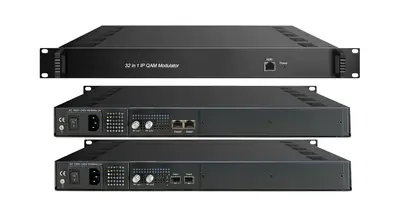
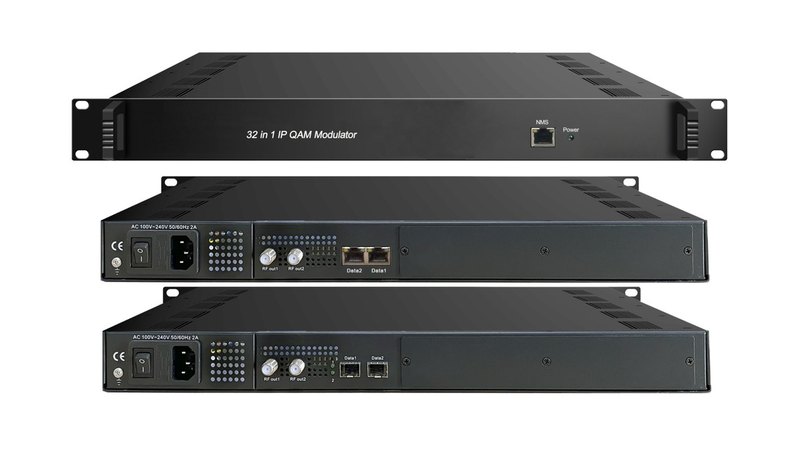
QAM modulation is the standard choice for the coax leg. The FUQ4443-3 IP QAM modulator publishes up to 1024 IP inputs at a maximum of 840Mbps per GE port, 32 non-adjacent carriers out of 2 F-type ports at 75 ohm, output levels from -20dBm to +10dBm (87 to 117 dBµV) in 0.1dB steps, 16 to 256QAM with a symbol rate of 5.0 to 7.0Msps in 1ksps steps, and a published MER of ≥40dB. The FUQ44105B publishes 24/16 tuner inputs, 128 IP inputs and 2 ASI inputs into 16 DVB-C carriers plus 16 IP (MPTS) streams, so it can feed a coax leg and an IP leg at once.
Where the property prefers DVB-T on the coax, the FUQ4415B turns 128 IP inputs into 4 DVB-T carriers, the FUQ44105R V3 publishes 24/16 tuner inputs and 128 IP inputs into 8 non-adjacent DVB-T carriers to EN300744 with 2K, 4K or 8K FFT, and the FUQ4459R publishes 8 tuner inputs into 4 non-adjacent carriers. For ATSC properties the FUQ4419BX is published as an ATSC A/53 modulator with up to 256 IP inputs and 8 RF outputs on 8VSB at 6MHz bandwidth.
| Distribution route | What the room needs | Published chassis |
|---|---|---|
| DVB-C coax | television with a DVB-C tuner, no box | FUQ4443-3, FUQ44105B, FUQ4454E |
| DVB-T coax | television with a DVB-T tuner | FUQ4415B, FUQ44105R V3, FUQ4459R |
| ATSC coax | television with an ATSC tuner | FUQ4419BX |
| Satellite to coax | television with a DVB-C or DVB-T tuner | FUQ4415EF, FUQ41013K |
| IP to the room | set-top box or hospitality smart TV on the LAN | FUQ4619X, FUQ1000A platform |
| Hybrid | coax in legacy rooms, IP for screens and services | FUQ44105B publishes RF and IP outputs together |
The IP leg has its own requirement that projects miss: if live services are carried over UDP, the access-layer switches have to support IGMP, a condition published in the server notes of our FUQ1000A hotel platform page. That single line decides whether the property needs a switch upgrade before the headend is even ordered.
How Many Channels Fit on the Coax?
It follows the standard on the carrier and the bit rate each service is encoded at, so there are two figures to keep apart: the payload a carrier can hold, and the payload the property actually uses. The first is fixed by the standard; the second is a decision made at the encoder.
The carriers in a hotel plant are usually 8 MHz in DVB territories and 6 MHz in ATSC territories. As standard-defined figures, an 8 MHz DVB-C carrier at 256QAM holds about 38Mbps of payload, an 8 MHz DVB-T carrier at 64QAM with a 2/3 code rate and 1/32 guard interval holds about 19.9Mbps, and a 6 MHz ATSC carrier at 8VSB holds about 19.4Mbps. Those are the ceilings, not a promise about the services a property will fit into them.
| Standard | Carrier and modulation | Standard payload | Published chassis rows |
|---|---|---|---|
| DVB-C | 8 MHz, 256QAM | about 38Mbps | symbol rate 5.0 to 7.0Msps in 1ksps steps, MER ≥40dB |
| DVB-T | 8 MHz, 64QAM, code rate 2/3, guard 1/32 | about 19.9Mbps | EN300744, FFT 2K 4K 8K, carriers published as non-adjacent |
| ATSC | 6 MHz, 8VSB | about 19.4Mbps | ATSC A/53, RS(208,188)+Trellis, MER ≥40dB |
What the property puts into each carrier depends on how hard the encoders are working. Our encoders publish their own ranges — the FUQ4339KN network encoder publishes 1~13Mbps per channel in HEVC/H.265 and MPEG-4 AVC/H.264, and the FUQ4635S HDMI encoder modulator publishes 1Mbps~13Mbps per channel with MPEG-4 AVC/H.264. A property that chooses 4Mbps per service fits roughly twice as many services per carrier as one that stays at 8Mbps, and that decision is made with the channel list in front of the engineers, not in the datasheet.
What Does the Guest Room Need?
The room device depends on the distribution leg the property runs. On coax, a hospitality television with a built-in DVB-C, DVB-T or ATSC tuner needs nothing else; the television tunes the carriers the headend produced. On IP, the room needs a set-top box or a hospitality smart TV that joins the multicast stream.
Beyond the tuner, the room device decides three things the headend has to respect. The first is channel ordering: guests expect the line-up in a logical sequence, which is why LCN and PSI/SI consistency matters after every re-mux. The second is language: a guide and welcome screen that switch per guest language are built from the EPG and platform layers, not from the modulator. The third is where paid content is authorised — the entitlement lives in the CAS and SMS, and the room device only presents what it is allowed to decode.
Our published range covers the headend, the platform and the distribution stages; the room device itself is specified per property, because the choice between a hospitality television, a set-top box and a smart-TV application depends on what the property already owns. Tell us what is in the rooms today and we confirm the compatible route with the quotation.
Where Do VOD, Welcome Screens and PMS Fit?
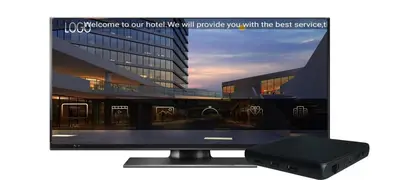
They sit on top of the distribution, in the software layer that talks to the property management system. The headend makes channels arrive; this layer decides what the guest sees when the screen comes on, what can be bought, and how a check-out clears a room back to a neutral state.
The FUQ1000A is published as an integrated IPTV hotel system platform covering live TV, VOD, CAS and PMS on one headend, with IP output, hardware decoding and ad insertion inside the same unit. Its page also publishes the sizing notes that matter in a quotation: an IPTV server is specified at the published reference of a Dell 730 for the live services, a storage server is strongly recommended when online VOD runs beyond 300 terminals, and the access-layer switches must support IGMP when UDP is used for live services. Those three lines are the difference between a demonstration and a system that survives a full house.
For properties that already run their own middleware, the FUQ100B IPTV server and the FUQ100B-2 modular encoder-receiver-gateway are published as modular platforms with 3 to 6 card slots for HDMI, tuner and IP MPEG-TS inputs, converting between SRT, HTTP, UDP, RTP, RTSP, HLS and RTMP on cards, and the pages name IPTV server work for hotel deployments as their use. PMS integration scope — guest name on the welcome screen, checkout clearing, folio display — is confirmed against the property's own system, because the interfaces differ between vendors and the feature list follows the interface, not the marketing page.
Which Distribution Route Suits Which Property?
Most hotel projects are decided by two facts on the ground: what the rooms already contain, and whether the property wants paid content and a guest-facing interface. Those two facts usually point at one of three shapes, and the headend is specified around them rather than the other way round.
A property that keeps analogue-era coax in the walls and just wants channels takes the coax route: a tuner or gateway stage, a multiplexing stage where a guide is needed, and a QAM, DVB-T or ATSC modulator sized to the carrier count. A property that wants welcome screens and VOD takes the IP route: the same reception stage, then the platform layer and multicast distribution to boxes or hospitality televisions. Properties in the middle — some rooms on coax, public areas on IP, premium content protected — run both legs from one line-up, which is the reason our modulators publish RF and IP outputs side by side.
| Property shape | Distribution | The stage that decides the quotation |
|---|---|---|
| Existing coax rooms, channels only | DVB-C or DVB-T on coax | modulator carrier count and MER |
| Mixed rooms and public screens | coax plus IP multicast | gateway port count and switch IGMP support |
| VOD, welcome screen and paid content | IP with platform layer | storage sizing and CAS/SMS scope |
Rack, Power and Environment
The stages above are rack equipment, so the room they go into is part of the design. The published chassis in the range are mostly 1RU, and the power and environment rows are printed on each model page rather than assumed from the family.
The power rows read either a wide-range input — the FUQ4619C gateway publishes 100~240VAC at 50/60Hz — or a dual AC 100V or AC 220V input, as the FUQ4443 modulator publishes. The environment rows on the gateways and modulators read 0~45℃ in operation with storage from -20~80℃, so an air-conditioned headend room is the assumption.
The published consumption figures are modest enough that a hotel headend is a small electrical load: our gateways publish 20W, the FUQ4443-3 modulator publishes 15.4W, and the FUQ4619C V3 gateway publishes ≤40W. What matters more is the shape of the rack. A fixed-function stage is one chassis per job, while a modular processor holds several functions in one frame — the FUQ300 publishes 6 slots, the FUQ400B and FUQ400 publish 6 configurable slots with IP on GE1 and GE2 plus ASI output on the FUQ400, and the FUQ200 publishes 3 slots with one GE bidirectional data port. Modular frames are what keep a small plant tidy when the line-up changes later.
Two more published rows belong in the rack plan: a dual Gigabit Ethernet pair on the gateways and modulators, and F-type 75 ohm outputs on the RF side, as published on the FUQ4443-3 with its 2 F-type ports for 32 carriers. Every unit is built at our Guangzhou factory, which has been running since 1994 across 15,893 square metres of production space with more than 100 self-developed products, and every chassis runs a 72-hour burn-in before it is dispatched. We ship to 200+ countries.
What Should Be in a Quotation Request?
Send the site facts first, because they decide the chain before any model number. The room count and the building plan settle the distribution legs; the sources settle the reception stage; the lineup settles the carrier count; and the services layer settles the platform.
A request that can be quoted without a second round of questions usually contains:
- The room count, plus any public areas, meeting rooms or back-of-house screens on the same system.
- The sources available at the property: satellite dish, terrestrial antenna, cable operator feed, internet feeds, and any property-owned channel.
- What the rooms contain today: hospitality televisions with tuners, set-top boxes, or screens with no tuner.
- The channel lineup by language, and whether a programme guide and welcome screen are required.
- Whether any content is paid or protected, and which PMS the property runs.
- Rack space, power, UPS provision and whether redundancy is required.
Frequently Asked Questions
What is a hotel TV system?
A hotel TV system is the equipment and software that bring television into a property and deliver it to every guest screen under one central configuration. It has five parts: the sources, the reception stage that locks those signals into the headend, the processing stage that builds the channel line-up, the coax or IP distribution, and the services layer that carries the guide, welcome screen and paid content.
Can a hotel keep its existing coax and still add IPTV?
Yes, and many projects run both legs from one line-up. The FUQ44105B publishes 16 DVB-C carriers plus 16 IP (MPTS) streams from the same chassis, and the FUQ4443 IP QAM modulator publishes up to 1024 IP inputs into 32 carriers. Rooms that still have a DVB-C tuner take the coax, while screens on the LAN take the IP leg.
How do satellite channels reach the guest rooms?
The dish and LNB deliver a 950~2150MHz IF band to a tuner stage. The FUQ4619C tuner-to-IP gateway publishes 24 tuner inputs with BISS Mode 1 and Mode E descrambling, and a property that keeps coax-only rooms can use the FUQ4415EF transmodulator, published as 4 tuner inputs into 4 DVB-C RF or 2 DVB-T RF signals. Where services are licensed, a CAM/CI or BISS path is planned with the tuner.
How many channels can one headend deliver?
It follows the published carrier count of the chassis rather than its rack size. Our pages print 32 carriers on the FUQ4443, 16 DVB-C carriers on the FUQ44105B, 8 non-adjacent DVB-T carriers on the FUQ44105R V3, 8 ATSC carriers on the FUQ4419BX, and up to 48 DVB-C, 32 DVB-T and 28 ISDB-T carriers on the FUQ4455A, with 256 PIDs per channel.
What equipment does a hotel TV headend contain?
Four groups. Reception is tuner-to-IP gateways or transmodulators; processing is multiplexing, descrambling, PID remapping and PSI/SI rebuilding; control is the conditional access system, SMS, EPG, logo insertion and advertising; and distribution is QAM, DVB-T or ATSC modulation for coax, or multicast over the property LAN. A modular chassis such as the FUQ400B carries several of those functions in one frame.
Do we need VOD, a welcome screen and PMS integration?
That depends on the property, and the platform layer is where it is decided. The FUQ1000A is published as an integrated IPTV hotel system platform covering live TV, VOD, CAS and PMS. Its page recommends a storage server when online VOD runs beyond 300 terminals, and IGMP-capable access switches when live services use UDP. PMS integration scope is confirmed against the property's own system.
What does the guest room need?
On coax, a hospitality television with a DVB-C, DVB-T or ATSC tuner is enough, because it tunes the carriers the headend produced. On IP, the room needs a set-top box or a hospitality smart TV that joins the multicast stream. Which route is right depends on what the property already owns, so we confirm the room-side option with the quotation.
What information do you need to quote a hotel TV system?
The room count and building plan, the sources available at the property, what the rooms contain today, the channel line-up by language, whether any content is paid or protected, the PMS in use, and the rack space, power and redundancy available. We reply with the model list for each stage, the datasheet for the exact chassis, and a quotation. Standard units are quoted per unit, and custom branding, packaging or software minimums are confirmed for that configuration.
We reply with the model list for each stage, the datasheet for the exact chassis, and a quotation. Standard units are quoted per unit with no published list price; where a project calls for custom branding, packaging or software, the minimum order and lead time are confirmed with the quotation for that configuration. The FAQ page answers the commercial questions, the solutions pages show the chains end to end, and comparison material for the adjacent decisions lives in the CATV headend equipment guide, the satellite transmodulator guide and the IP to QAM modulator guide.
Previous
Campus IPTV System: Headend and Dorm Distribution
Next
Satellite Modulator: DVB-S, DVB-S2 and DVB-S2X
Talk to the headend engineers before you specify
Send the model number you are looking at — or the channel count and the input and output formats you work with — and we answer with the datasheet, the configuration and a written price. The reply comes from the headend team in Guangzhou, not a sales line.