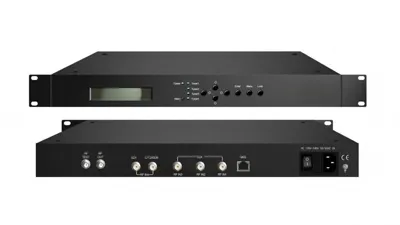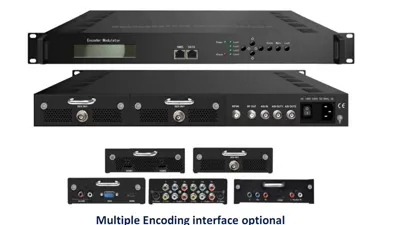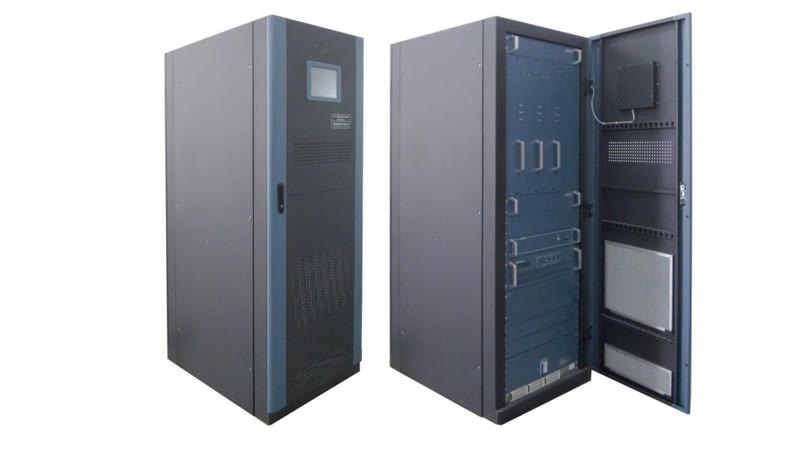
DVB-T Transmitter Guide: Power, Channel and Coverage
How to size a DVB-T transmitter: standard, output power, UHF channel, MER and SFN accuracy, with the published specs of every model we build. Each model named in this article is one of 190 in the Hanxing catalogue, published with its own specifications and datasheet.
Hanxing Team
Broadcast & IPTV Experts
The path this guide walks
- Sourcessatellite, studio or playout
- Encode and multiplexservices grouped into one transport stream
- Stream to the siteASI or IP to the transmitter
- DVB-T transmitterone UHF channel, COFDM, amplified
- Filter and combineone channel per chassis, combined before the antenna
- Antennathe coverage the plan asks for
The transmitter is the last active stage: everything in front of it decides what is broadcast, the transmitter decides how far it reaches.
A DVB-T transmitter is the last active box in a terrestrial television chain, and it is usually the hardest one to compare. The standard, the channel and the coverage are decided by the site rather than by the catalogue, and the pages that sell transmitters publish different rows in different units. This guide walks the decision in the order a project actually makes it: standard first, then power, then the RF figures, then the site around the cabinet.
Every specification quoted below is printed on the product page of the model it belongs to, in the words that page uses. Where a row is not published for a model, this article says so instead of estimating it, and the missing value is a question for the datasheet. Models named in the tables link to the page that carries their full specification.
What Does a DVB-T Transmitter Do in a Terrestrial TV Chain?
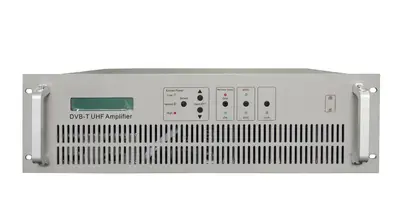
A DVB-T transmitter is the last active box in a terrestrial chain. It takes the MPEG transport stream that leaves the headend, places it on one UHF channel as a COFDM signal, and amplifies that signal to the level the coverage plan requires. Everything upstream decides what is broadcast; the transmitter decides how far it reaches.
On the pages in this catalogue the output side is one UHF channel on a coaxial connector rated for that model's power: the FUQ8313 family publishes a 1-5/8 inch output interface, and the FUQ8351-2 publishes an optical input interface on FC/APC beside its connector row, which reads connector N-K. How the transport stream reaches the exciter — optical, ASI or IP — is confirmed against the datasheet of the model you pick rather than assumed from a neighbouring model.
Three consequences follow, and each one shows up in a quotation.
- One channel per chassis. The DVB-T models published here are single-channel units, where several of them feed one antenna the page states that a power combiner is required. An extra channel is therefore a second transmitter, not an extra card.
- The site decides the accessories. On the higher-power pages the filter, the antenna, the feeder and the combiner are listed as per order, while the hard feeder, elbow, hoop and central pin are listed as standard configuration. That split is why the antenna and the run length belong in the first enquiry.
- The transmitter is not the headend. It carries what the headend already produced. A complete terrestrial site adds encoding, multiplexing and modulation in front of it, and those stages are set out further down this guide.
Which Standard Do You Order: DVB-T, DVB-T2, ATSC or ISDB-T?
The transmitter has to match the tuners in the homes you serve, so the standard is decided before the power. The transmitter pages in this catalogue publish DVB-T, one model also publishes ATSC and ISDB-T, and the headend processors publish all three. Where a network is built or rebuilt on DVB-T2, tell us before we quote.
| Model | Published standard | Where the row appears |
|---|---|---|
| FUQ8351 | DVB-T / ATSC / ISDB-T | TV standard row on the low-power transmitter |
| FUQ8322 | DVB-(T), 4/16/32/64 QAM mode | Standard and modulation rows |
| FUQ8313 and FUQ8323 | DVB-T (model title; RF rows published) | Names DVB-T and its channel; no separate standard row |
| FUQ230 headend processor | DVB-T EN300744, ATSC A/53, ISDB-T ARIB STD-B31 | Standard rows on the modular processor |
| FUQ4619C IP gateway | DVB-T/T2/C/S/S2 tuner inputs | Receive side, for feeding IP from off-air |
Two practical readings of that table matter at order time.
DVB-T2 appears in this catalogue on receiving hardware, such as the FUQ4619C gateway that tunes DVB-T, DVB-T2, DVB-C, DVB-S and DVB-S2 inputs into IP. If your receivers are DVB-T2, the transmission standard has to match them, and we confirm the transmitter datasheet against your requirement rather than leaving it to inference from a neighbouring model.
The standard also decides the modulation rows you will read later. The FUQ8322 page publishes support for 4, 16, 32 and 64 QAM, and the headend processor publishes the ATSC and ISDB-T equivalents beside DVB-T. When a network mixes standards, the comparison is the same one the modulator guide walks for cable and in-building carriers: DVB-C, DVB-T and ATSC modulator selection.
How Much Output Power Do You Need?
Output power follows the coverage plan, not the other way round. What a receiver sees is the effective radiated power at the antenna, which is the transmitter output minus feeder loss plus antenna gain, so a 100 W transmitter on a high-gain array can out-reach a 600 W unit behind a long lossy feeder.
| Model | Published output | Page wording |
|---|---|---|
| FUQ8351 | 10 W, 20 W, 30 W, 50 W, 100 W optional | Output power row |
| FUQ8322 (both variants) | 200 W / 300 W / 400 W / 500 W / 600 W optional | Output rating row, adjustable |
| FUQ8313 and its V2 | 800 W to 1200 W RF output | Model title; final power amplifier for 800 W |
| FUQ8323 and its V2 | Single channel; final power amplifier for 2000 W | Final power amplifier row; supply for the final amplifier 2500 W / 3000 W |
Work one number the other way to see why the plan comes first. An effective radiated power of 1 kW is reachable with a 100 W transmitter behind an antenna with 10 dB of gain, or with a 400 W transmitter behind 4 dB of gain. The transmitter is only one term in that sum, which is why the enquiry form asks for the antenna and the feeder length rather than the power alone.
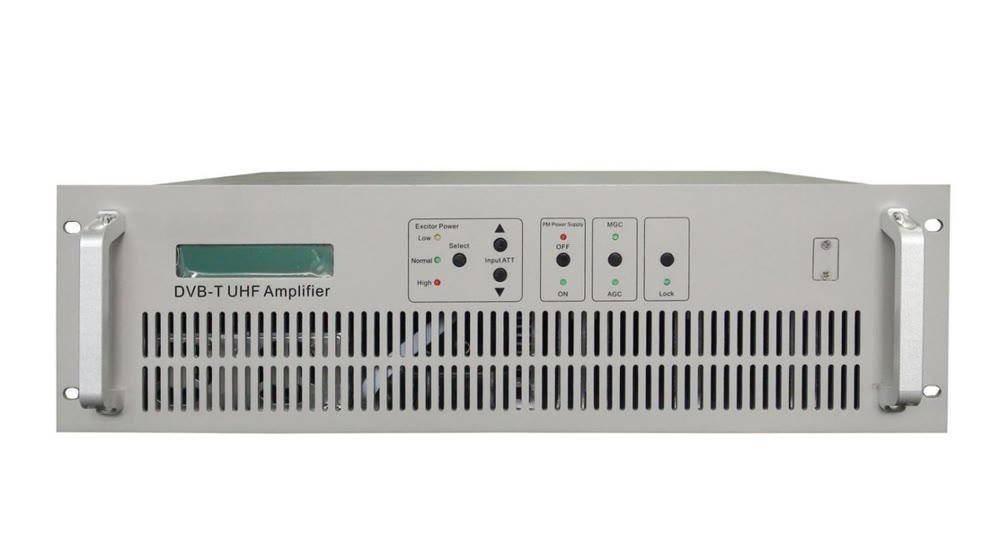
Each of those rows is published on the model page it belongs to: the FUQ8322 page carries the adjustable 200 W to 600 W rating, the FUQ8313 V2 page the 800 W to 1200 W cabinet with its 1-5/8 inch output, and the FUQ8323 V2 page the final amplifier and supply rows. The transmitter line collects every DVB-T and FM transmitter in the catalogue on one page with its datasheet.
Two rows on the higher-power pages carry the redundancy question. The FUQ8322 page lists the exciter and the power supply as standard configuration, and states that a redundancy component is available and negotiable. Ask for it at quotation time: retrofitting redundancy into a rack that was ordered without it costs more than specifying it once.
Which UHF Channel, and What Bandwidth Does the Model Cover?
Every DVB-T transmitter page here publishes the same working frequency range, 470 MHz to 806 MHz, which covers the UHF television band used by terrestrial networks in most of the world. One low-power model publishes a narrower window, any 100 MHz inside that range, so it is ordered against a known channel plan.
The output interface belongs to the same decision. The FUQ8313 and FUQ8323 families publish a 1-5/8 inch output, which is the connector a broadcast site's rigid feeder is built around; the low-power FUQ8351 publishes an input connector row reading N-K. Moving from a 7/8 inch or N-type installation to a 1-5/8 inch feeder is a site change, so the connector is worth confirming while the cabinet is still being specified.
Where a site carries more than one channel, the pages say what has to be added: the filter is listed as per order, and the note on the model explains that when multiple single-channel transmitters are involved a power combiner is required. A combiner is quoted with the transmitter set, because it is sized by the number of channels and the total power that reaches the antenna.
The RF Rows That Decide Reception: MER, Shoulder Level and Stray
Commissioning engineers compare transmitters on the same handful of rows, and all of them are on the product pages here: modulation error ratio, shoulder level at the channel edges, in-band and out-of-band stray, and return loss. The published figures differ between the low-power and high-power ranges, and the difference is worth reading before ordering.
| Published row | FUQ8351 | FUQ8322 | FUQ8313 / V2 | FUQ8323 / V2 |
|---|---|---|---|---|
| MER | 35 dB or better, after correction | 36 dB or better | 33 dB or better | 33 dB or better |
| Shoulder level | 40 dB or better at FC plus or minus 4.2 MHz | Not published | 36 dB or better at IF plus or minus 4.2 MHz | 36 dB or better at IF plus or minus 4.2 MHz |
| In-band stray | -60 dBc or better | Not published | -60 dBc or better | -60 dBc or better |
| Out-of-band suppression | -65 dBc or better | Not published | 65 dBc or better | 65 dBc or better |
| Output return loss | 26 dB or better | 20 dB or better | 20 dB or better | 20 dB or better |
| Output power variation | plus or minus 0.25 dB | plus or minus 0.2 dB | plus or minus 0.25 dB | plus or minus 0.25 dB |
A high MER keeps the constellation clean at the receiver, and the shoulder level is what decides whether the signal stays inside its own channel. Site acceptance measurements cover both, so a transmitter that is specified on power alone can fail a commissioning test that a neighbouring model passes.
One wording detail is easy to miss. The FUQ8351 publishes its MER and shoulder figures after correction, single channel, and the qualifier is part of the row: the figure is quoted with correction applied, so a figure quoted with it and a figure quoted without it are not the same measurement. Read the qualifier before comparing one model with another.
The monitoring tool that closes the loop is the transport stream analyzer: the FUQXB analyzer publishes an ASI input and an RF DVB-C input on USB, so the same laptop that reads the stream can read the carrier beside it.
MFN or SFN: The Frequency Accuracy Row That Changes the Order
Two transmitters on different channels can tolerate a looser frequency reference than two transmitters on the same channel. The published rows make that explicit: the MFN figure is a hundred hertz, the SFN figure is one hertz, and only a GPS-locked reference holds that in the field.
| Model | Frequency accuracy row | Published wording |
|---|---|---|
| FUQ8322 (both variants) | MFN and SFN | MFN: 100 Hz or better; SFN: 1 Hz or better |
| FUQ8351 | MFN and SFN | MFN: 100 Hz; SFN: 1 Hz |
| FUQ8313 / V2 and FUQ8323 / V2 | No accuracy figure published | The model description states MFN and SFN topologies are supported; no accuracy value appears in the RF rows |
A multi-frequency network is the simpler project: each site takes its own channel and the accuracy row protects only against interference with neighbouring channels. A single frequency network is the harder one, because every transmitter in the group has to be frequency identical and bit identical, and the headend has to supply the synchronisation reference that keeps them so. The mega-frame interface defined in ETSI TS 101 191 carries that reference through the distribution network, which is why an SFN project asks about the GPS receiver at the site and about the timing source behind it.
The difference between the two columns is also a difference in the quotation. A one-hertz reference is a different exciter option from a hundred-hertz one, so an enquiry that says SFN or MFN from the start gets a model list that fits the network rather than one that has to be upgraded afterwards. Where the model you want does not publish the row, ask us for the datasheet: an unpublished row is a question, not a yes.
What Sits in Front of the Transmitter
A transmitter is one stage of a chain that starts with sources and ends at the antenna. Between the two sit encoding, multiplexing and, for a network that keeps RF and IP in step, a monitoring point. The stages below are the ones the catalogue publishes, with the model that covers each.
| Stage | What it does | Model published in the catalogue |
|---|---|---|
| Encoding | HDMI and SDI sources into a transport stream | FUQ4339KN: 48 HDMI inputs, H.264 and H.265, 1 to 13 Mbps per channel |
| Multiplexing | Group programmes per service, remap PIDs | FUQ4218B: 8 ASI and 512 IP inputs, 4 ASI and IP outputs |
| Modulation | Transport stream onto RF carriers for cable or in-building distribution | FUQ4455A: 128 IP and 2 ASI inputs, MER 40 dB or better |
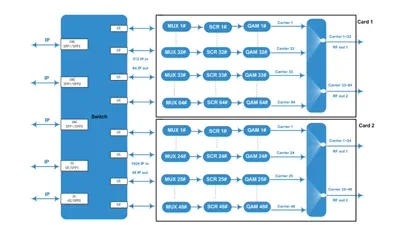
| Headend processing | Channel build and standard conversion in one chassis | FUQ230: 128 IP inputs, DVB-T EN300744, ATSC A/53, ISDB-T ARIB STD-B31 |
| IP side | Off-air and satellite feeds into multicast for a parallel IP network | FUQ4619C: 24 RF tuner inputs, DVB-T/T2/C/S/S2 |
| Transmission | One UHF channel to the antenna | The DVB-T models in the tables above |
The order of those stages is the same order the signal takes, and it is the order the site should be designed in. Skipping a stage shows up later as a mismatch: an encoder that delivers a stream the multiplexer cannot address, or an RF carrier that is correct while the IP side of the same building is still waiting for a multicast group.
Two existing guides cover the neighbouring decisions in more detail. Where the plan starts from HDMI sources, the HDMI to coax route walks encoding, multiplexing and modulation into one chassis; where it starts from a hotel or hospital network, the headend equipment guide sets out the same stages with IP distribution as the final hop.
Where the station is built around an FM carrier instead of a UHF channel, the power classes are compared in the FM transmitter power guide, the antenna and feeder that follow the transmitter are chosen in the broadcast antenna guide, and the whole station is costed in the small FM station budget guide.
Site, Power and Cooling: What the Transmitter Needs Around It
The environmental rows decide whether a transmitter can be installed where you want it. The FUQ8351, FUQ8313 and FUQ8323 pages publish a working temperature of -20 to +50 degrees Celsius and a relative humidity of 95 percent without condensation, and their mains row reads AC 220 V, plus or minus 10 percent, at 50 Hz. The FUQ8322 page publishes a second mains option at AC 380 V, plus or minus 20 percent, alongside AC 220 V at the same tolerance, and publishes no working temperature row, so confirm the room conditions for that model with us.
- Mains. The FUQ8351, FUQ8313 and FUQ8323 pages publish AC 220 V, plus or minus 10 percent, at 50 Hz. The FUQ8322 page publishes AC 220 V or AC 380 V, plus or minus 20 percent, so the higher-power model can be ordered against either supply.
- Cooling. The FUQ8322 page states inside cooling fan, and the FUQ8313 page publishes a monitor unit with an LCD display on the front door. A site plan should leave the airflow a cabinet needs and the dust control the pages ask for.
- Room conditions. The higher-power pages call for a machine room with less dust and no vibration, storage from -30 to +75 degrees Celsius, and atmospheric pressure between 86 and 106 kPa. Altitude and dust are site facts, not catalogue facts, so they belong in the enquiry.
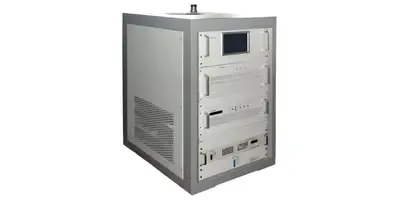
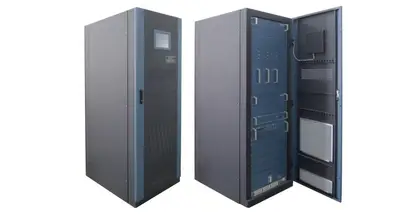
- Footprint. The FUQ8313 cabinet publishes 850 mm by 600 mm by 1695 mm, so confirm the door width, the floor space and the cable entry at the site before the delivery is booked.
- Grounding and lightning. A transmitting site is an outdoor system even when the cabinet is indoors; the antenna, the mast and the feeder are all part of the electrical path. Standard practice here is a bonded ground at the cabinet, lightning protection at the tower, and the feeder earthed at the entry point.
How the Transmitter Is Tested Before It Leaves the Factory
Every transmitter is measured on the same rows its page publishes, output power, MER, shoulder level and return loss, and each unit runs a 72-hour burn-in on the factory floor in Guangzhou. We have built headend and broadcast equipment there since 1994.
That is why the published figures are worth holding the supplier to. A unit that is tested on the rows a commissioning engineer will measure later arrives with a record that can be compared against the site report, and a model that publishes no figure for a row is telling you it has not been characterised on that row rather than that the row does not matter.
The factory facts behind the burn-in are not marketing copy. A 15,893 square metre production site is what makes a 72-hour run possible on every unit rather than on samples, and it is the reason a question about a specific channel, filter or combiner can be answered from the bench rather than from a brochure. Buyers who visit, or who ask for a test record, get the same information the quotation was built on.
What to Send Us for a DVB-T Transmitter Quotation
A quotation for a transmitter is a configuration, so the answers change with the site. Send the standard, the channel or channels, the coverage you have to reach, the antenna and feeder you plan to use, the mains available at the site, whether the network is MFN or SFN, and the quantity and destination port.
The list below is the one we work through before quoting, and every line of it changes at least one row on this page.
- Standard and receivers. DVB-T, DVB-T2, ATSC or ISDB-T, and the tuner class of the receivers the network serves.
- Channel plan. The UHF channel or channels, and whether neighbouring channels are in use at the same site.
- Coverage. The area or radius to be served, the antenna height above ground, and the terrain between the site and the edge of coverage.
- RF path. Antenna gain, feeder type and length, and whether a combiner or a filter has to be added.
- Site. Mains available, the space the cabinet needs at the site, and the room conditions.
- Network type. MFN or SFN, and where the synchronisation reference comes from on an SFN.
- Redundancy. Whether the exciter and the power supply have to be duplicated, which the FUQ8322 page lists as standard configuration with a negotiable redundancy option.
- Logistics. Quantity, spare parts, and the destination port for the shipping documents.
We do not publish a list price, because a transmitter with a different channel, filter, combiner or antenna is a different product rather than a different discount. Send the details above through the quotation form and the reply carries the model list, the datasheets, the accessory list and a written factory-direct price. Where a project needs branding on the cabinet or a modified configuration, the solutions page sets out how those orders are handled, and the minimum quantity is confirmed with the quotation rather than published as a blanket figure. Order, payment and warranty questions are answered the same way on the FAQ page, and the full catalogue with every datasheet starts at the product index.
Frequently Asked Questions
How is a DVB-T transmitter different from a DVB-T modulator?
A modulator builds DVB-T carriers for a cable or in-building network and runs at a low output level, which is why the modulator pages here publish output in dBm rather than watts. A transmitter is built to drive an antenna: it publishes tens to hundreds of watts, with the filtering, cooling and combiner provisions a broadcast site needs.
How much transmitter power do I need to cover a town?
Power alone cannot answer that. The figure that matters is the effective radiated power at the antenna, which is the transmitter output minus feeder loss plus antenna gain, and the coverage also depends on terrain, antenna height and the receiver class. Send the target area and the site details and we work the configuration with you.
Can one transmitter carry several TV channels?
The DVB-T models published here are single-channel units: FUQ8351, FUQ8322, FUQ8313 and FUQ8323 each carry one channel. The product pages state that when several single-channel transmitters feed one antenna, a power combiner is required, so an extra channel normally means an extra transmitter plus the combiner that joins them.
Does the transmitter support SFN operation?
Two models publish the frequency accuracy row directly: FUQ8322 and FUQ8351 state MFN plus or minus 100 Hz and SFN plus or minus 1 Hz. The FUQ8313 and FUQ8323 pages state that the platform supports MFN and SFN topologies but publish no accuracy figure, so for a single frequency network ask us for the datasheet of the exact model before you specify it.
What accessories come with a DVB-T transmitter?
On the FUQ8323 pages the hard feeder, elbow, hoop and central pin are listed as standard configuration, while the filter, antenna, feeder and combiner are all listed as per order. Tell us the antenna, the feeder type and the run length when you order, so the accessories are quoted with the transmitter rather than added later.
Do you publish prices for these transmitters?
No list price is published, because the cost depends on the channel, the output power, the filter and combiner arrangement and the accessories. Send the standard, the channel plan, the coverage you have to reach and the site details, and we reply with the model list, the datasheets and a written factory-direct price.
Previous
IPTV Headend Installation Checklist and Rack Layout
Next
Conditional Access and SMS in a Digital Headend
Talk to the headend engineers before you specify
Send the model number you are looking at — or the channel count and the input and output formats you work with — and we answer with the datasheet, the configuration and a written price. The reply comes from the headend team in Guangzhou, not a sales line.